How Much Bitcoin Puts You in the Top 1% in 2026? Address Data Points to About 2.9 BTC
Key Takeaways
- •Roughly 2.87 BTC is enough for an address to enter the top 1% of nearly 60 million funded Bitcoin addresses, while a single BTC ranks near the top 1.6%.
- •The popular 0.28 BTC claim is a population-based scarcity calculation rather than holder data, and the 2026 version has shifted to about 0.25 BTC as world population reached 8.3 billion.
- •Bitcoin's supply is capped at 21 million coins, with about 20.09 million mined as of October 2026, meaning fewer than about 1% of people alive could each hold more than 0.25 BTC at the same time.
- •Addresses do not equal people, since custodial wallets such as a Binance cold wallet holding roughly 248,000 BTC serve millions of customers, and spot ETF investors may not appear in any on-chain list.
- •Institutional involvement is reshaping distribution, with more than 64 public companies holding 688,000 BTC as of May 2025, and nothing fixes the top 1% threshold near 3 BTC as adoption patterns change.
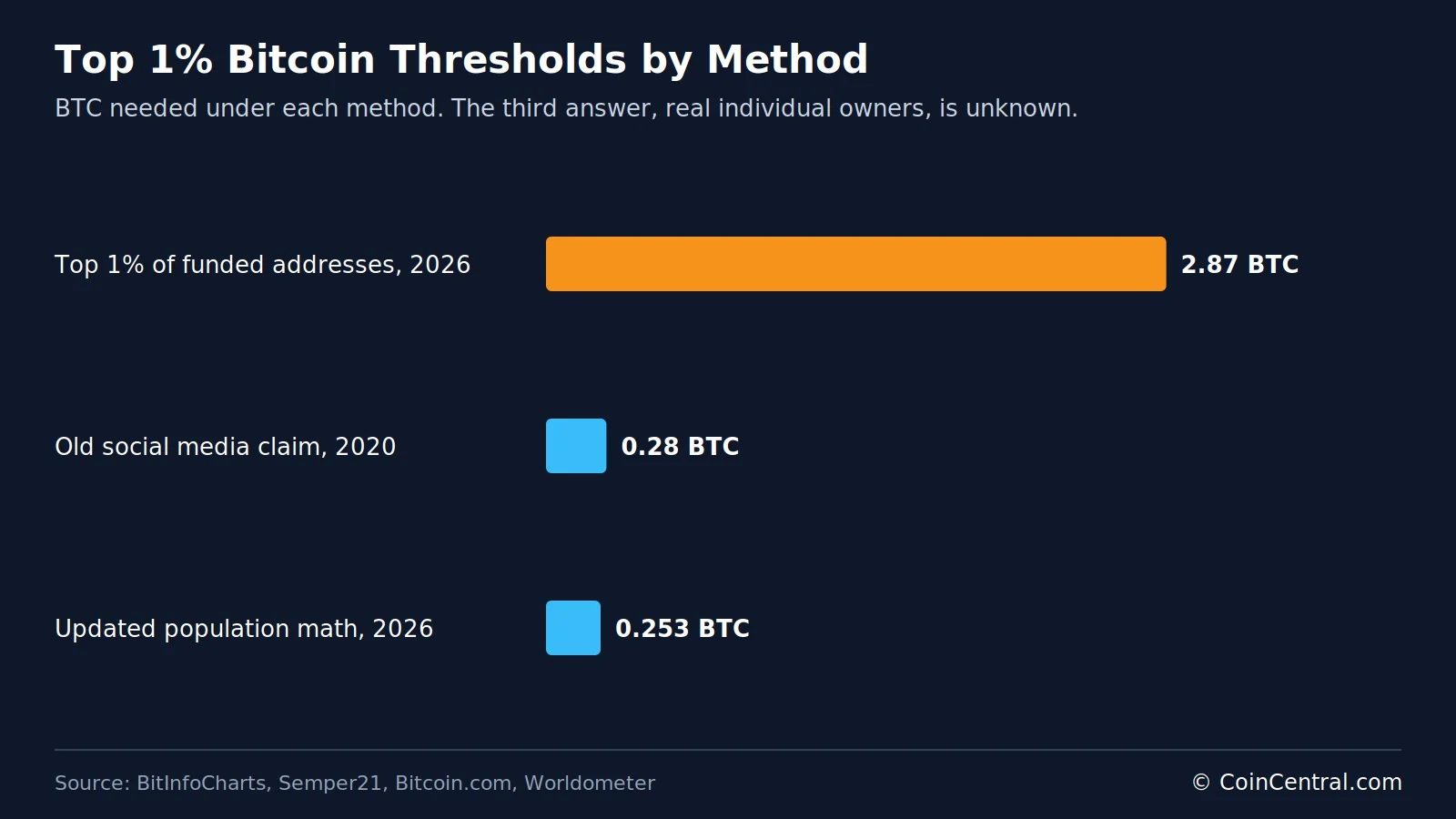
The amount of Bitcoin required to rank among the wealthiest 1% of holders depends on how the question is measured. Three different figures circulate online, and each answers a distinct question. Based on current address data, entry into the top 1% of funded Bitcoin addresses begins at roughly 2.9 BTC. A widely repeated claim holds that 0.28 BTC is enough, but that number comes from a population calculation, not from holder data. Updated for 2026, the population-based figure now sits closer to 0.25 BTC.
A funded address is a Bitcoin address with a balance above zero. BitInfoCharts counts almost 60 million of them, and empty addresses are excluded from the ranking.
This article walks through each number, shows the data behind it, and explains why nobody can give an exact answer for individual people.
The Three Answers at a Glance
Much of the coverage on this topic conflates three separate questions. Keeping them apart makes the numbers easier to interpret, and each answer suits a different reader. Someone checking a wallet wants the address figure. Someone curious about scarcity wants the population figure.
The first answer draws on real blockchain balances. It counts addresses with positive balances and locates where the top 1% threshold falls, making it the closest available measure.
The second answer is a mathematical exercise. It divides the 21 million coin cap by 1% of the world population and says nothing about who actually holds Bitcoin today.
The third answer cannot be found. One person can control many addresses, while a single exchange address can hold coins on behalf of millions of people.
How Much Bitcoin Puts You in the Top 1% in 2026?
Current address distribution data indicates that about 2.87 BTC is enough to place an address among the richest 1% of funded addresses. One Bitcoin lands at roughly the top 1.6%. A single whole coin is rare, but it falls just short of the top 1% line.
Owning one whole coin remains a meaningful milestone for many holders. The data confirms its rarity, even though it sits just outside the top percentile.
Ranks shift quickly. Moving from 1 BTC to about 3 BTC lifts an address from the top 1.6% into the top 1%. Moving from 3 BTC to 10 BTC raises it to the top 0.25%.
The 0.1 to 1 BTC band contains roughly 3.5 million addresses, about 3.6 times the number of addresses holding 1 BTC or more. Most on-chain Bitcoin holders are still small.
These figures describe addresses, not people. That distinction matters, and later sections explain why.
Bitcoin Address Distribution in 2026
BitInfoCharts tracks almost 60 million Bitcoin addresses with a positive balance, most of which hold very small amounts. About 34.7 million addresses hold less than 0.001 BTC, meaning addresses below that level account for more than half of all funded addresses. Addresses holding 0.01 BTC or more number about 12.8 million, or roughly one in five.
Only about 1.63% of funded addresses hold at least 1 BTC. More than 800,000 addresses sit between 1 and 10 BTC. The top 1% cutoff falls inside that band, and distribution modeling places it at about 2.87 BTC. With almost 60 million funded addresses in total, the top 1% corresponds to roughly 600,000 addresses.
Why Bitcoin Scarcity Matters
The Bitcoin protocol caps issuance at 21 million coins. As of October 2026, about 20.09 million have been mined, roughly 95.7% of the cap, leaving fewer than one million coins still to be issued.
The world population stands at about 8.3 billion. If Bitcoin were split equally, each person would receive about 0.00253 BTC, or 253,000 satoshis. One Bitcoin contains 100 million satoshis.
Even under a perfect split, only 21 million people could hold one whole coin, or about one person in every 395. The real number is far lower.
A holder of 0.1 BTC owns 10 million satoshis, about 40 times the equal share. A holder of 0.25 BTC holds roughly 99 times the equal share.
Some coins are likely gone for good. Lost private keys, forgotten passwords, destroyed drives, and dormant wallets of owners who have died all contribute. Blockchain.com notes that some circulating supply may be permanently lost or unspendable.
Satoshi Nakamoto is also believed to control a large early stash that has never moved. Together, these factors mean the supply open to investors is smaller than 21 million.
Where the 0.28 BTC Figure Came From
For years, posts have claimed that 0.28 BTC puts a holder in the top 1%. The claim spread around 2020 and was never a count of real holders.
The math used a world population of 7.5 to 7.8 billion. One percent of that is about 75 million people, and dividing 21 million BTC by 75 million produces about 0.28 BTC.
Population growth has since shifted the result. One percent of 8.3 billion is about 83 million people, and 21 million divided by 83 million gives about 0.253 BTC.
Lost coins alter the calculation again. If only 17 million BTC were available, the figure would fall to about 0.205 BTC. That is why numbers between 0.20 and 0.28 appear in Bitcoin discussions.
Bitcoin.com documented how the claim gained popularity in 2020. Analysts had pointed out that the 21 million cap makes it impossible for more than a small share of people to own large amounts.
The formula also has limits as a ranking tool. It assumes every coin sits with individuals and that coins are spread evenly. Neither is true, since companies, funds and governments hold large amounts.
So what does 0.25 BTC mean? It does not mean a person ranks in the top 1% of holders. It means that, because only 21 million coins can exist, fewer than about 1% of people alive today could each hold more than 0.25 BTC at the same time.
Why Addresses Are Not People
One address does not equal one investor. A person may control one address or hundreds, and modern wallets often create new addresses automatically. A holder with five BTC could appear as several smaller holders.
The reverse also happens. BitInfoCharts lists a Binance cold wallet with about 248,000 BTC. That is not one person's money, because the wallet holds coins for many customers.
Oobit reports that 460 million addresses have held a balance at some point. Of those, 288 million are empty today. Of the remaining 172 million, about 147 million belong to exchanges, services, merchants or other market actors. That leaves about 25 million addresses believed to be active wallets of private individuals, though even this is an estimate.
The same issue applies to Coinbase, Kraken, Bitfinex and other custodians. An address with 100,000 BTC could stand for hundreds of thousands, or even millions, of owners, which distorts simple rich lists.
Spot Bitcoin ETFs add another layer. Fund investors do not get their own addresses. The fund buys Bitcoin and holds it with an institutional custodian, so someone who owns 0.5 BTC through an ETF may not appear in any on-chain list.
What Entity Data Shows
Glassnode attempts to correct the address problem by grouping addresses that likely belong to the same owner, a process called entity adjustment. It also labels exchanges, miners and custodians.
Earlier Glassnode research found that smaller holders have gained a growing share of circulating supply, as Bitcoin has slowly spread into smaller wallets. The change is gradual, and large wallets still hold most coins.
Entities with less than 1 BTC hold about 6.8% of supply. Entities with 1 to 10 BTC hold about 10.1%. Together, holders under 10 BTC own about 17%.
The split remains very unequal. Large institutions, custodians and early holders control huge amounts, and even Glassnode cannot say how many people own each coin.
Analysts also label holders by size using sea creatures. Becoming a wholecoiner moves a holder out of the shrimp group and into the crab group.
How Rare Are 10, 100 and 1,000 Bitcoin?
BitInfoCharts shows about 150,000 addresses with at least 10 BTC, or roughly 0.25% of funded addresses. Around 99.75% hold less than 10 BTC.
About 20,000 addresses hold at least 100 BTC, or roughly 0.03%. Many belong to businesses, exchanges and institutions. About 2,000 addresses hold between 1,000 and 10,000 BTC.
Glassnode treats holdings above about 1,000 BTC as whale territory, with the largest holders classified as humpbacks. Many wallets at these sizes belong to businesses, exchanges and institutions.
Oobit reports that just 94 wallets hold more than 10,000 BTC each, and only 4 hold more than 100,000 BTC. It also reports that the top 1% of holders own 87% of all supply.
In theory, no more than 21 million wholecoiners can exist. In practice, the number is far lower: some people own many coins, companies own thousands, and some coins are lost.
Current address data shows about 970,000 addresses with at least 1 BTC. CoinLedger data cited by Oobit placed the figure near 988,627 wallets in 2025. The number of individual wholecoiners is lower, since exchanges and institutions hold many of these addresses.
How Many People Own Bitcoin?
Counting owners is harder than counting addresses. There is no registry of holders, and estimates run from 25 million to more than 500 million.
The gap comes from method. On-chain data and exchange counts give lower numbers, while surveys that include ETFs, fintech apps and custodial platforms give higher ones. Neither approach is wrong, because each measures something different. No one will ever know the exact number of owners.
Global crypto ownership grew 33%, from 420 million in 2023 to 562 million in 2024. South America grew 116.5% in one year, from 25.5 million to 55.2 million users.
Region and gender also shape ownership. Asia had 326.8 million crypto users in 2024, more than all other continents combined. The United States had 70.4 million, and 30% of American adults held digital assets.
Turkey leads with 25.6% of its internet population owning crypto, while China registers just 3.7%. UK ownership rose from 18% to 24% in 2025.
Men make up 61% of crypto owners worldwide. The 25 to 34 age group has the highest ownership rate, at 16.2% for men and 8.7% for women.
Will the Top 1% Line Move?
Yes. Nothing fixes the threshold near 3 BTC. If wealthy individuals, funds, companies and governments buy several coins each, the line could rise. If early holders sell to millions of small buyers, concentration could fall.
Institutions are changing the picture. ETF custodians, public companies and exchanges now hold large pools of Bitcoin, meaning Bitcoin may be owned by more people while looking more concentrated on-chain.
Oobit reports that more than 64 public companies held 688,000 BTC as of May 2025. Adoption models cited in the same report say retail ownership may drop from 85% in 2024 to 60% by 2030.
The same models estimate 100 million Bitcoin users by 2027 and 250 million by 2030. Future buyers could include pension funds, sovereign wealth funds, family offices and corporations.
Bitcoin's supply is fixed, but its wealth distribution is not. On-chain data now often shows custody setups rather than personal wealth.
If that happens, owning several whole coins could get harder. The exact meaning of the Bitcoin top 1% will keep changing.
The Bottom Line
According to 2026 blockchain data, an address holding about 2.9 BTC ranks in the top 1% of funded addresses. One BTC ranks near the top 1.6%, and 10 BTC near the top 0.25%.
Measured against an equal global split, any stake looks sizable. A holder of 0.1 BTC owns about 40 times the equal share, while a holder of 1 BTC owns about 395 times.
The 0.28 BTC claim needs context. It is a scarcity figure based on world population, and the 2026 version is about 0.25 BTC.
A fair rule of thumb holds that about 3 BTC is the best visible top 1% benchmark, though it should not be read as an exact count of human owners.
The clearest fact in the data is the fixed supply. There will never be more than 21 million BTC, and more than 8 billion people live on Earth.
Sources
- BitInfoCharts: Bitcoin Rich List and Address Distribution. Balance bands and largest identifiable wallets.
- Glassnode: BTC Entities Supply Distribution. Entity-adjusted supply by balance cohort.
- Glassnode Research: Bitcoin Supply Distribution Revisited. Clustering method and holder categories.
- Blockchain.com: Total Circulating Bitcoin. Supply data and the 21 million cap.
- Bitcoin.org: Bitcoin FAQ. Background on the fixed issuance schedule.
- Worldometer: World Population 2026, based on United Nations data.
- Semper21: Bitcoin Ownership Distribution. Estimates of the 1.6% and 2.87 BTC thresholds.
- Bitcoin.com News: How much BTC you need. Background on the 2020 0.28 BTC claim.
- Oobit: How Many People in the World Own Bitcoin? (May 18, 2026). Draws on Triple-A, CoinLedger, Chainalysis, Bitbo and DemandSage data.
- CoinCentral: Original article. https://coincentral.com/how-much-bitcoin-do-you-need-to-be-in-the-top-1-2026-statistics/

