Global Millionaire Numbers Rise Again in 2025, Driven by Strong Stock Markets
Key Takeaways
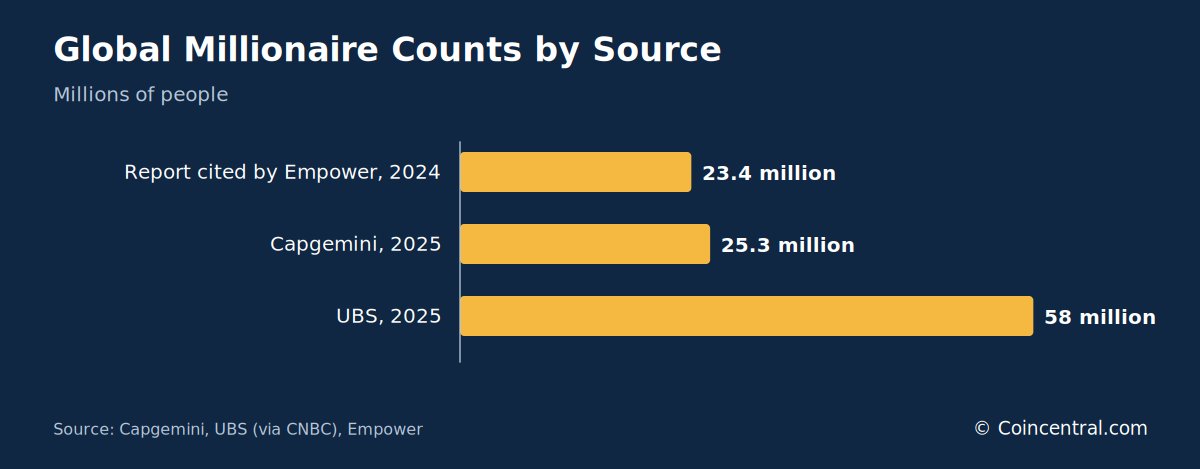
- •Capgemini counted 25.3 million high-net-worth individuals worldwide in 2025, an increase of nearly 2 million, while UBS estimated 58 million millionaires, with the gap reflecting differing measurement methods rather than disagreement over the growth trend.
- •Strong equity markets drove the expansion, lifting HNWI wealth 8.7% to a record $98.3 trillion, the biggest one-year rise since 2018, and global personal wealth 10.8%, the largest jump since 2017.
- •The United States added more millionaires than any other country, with Capgemini reporting a gain of 736,000 and UBS about 441,000, while Asia-Pacific posted the fastest regional growth at 9.4%, fueled by semiconductor demand.
- •The Middle East was the only region where millionaire numbers fell, declining 1.4%, which Capgemini attributed to lower oil prices, regional conflict and labor market strain.
- •Wealth gains were uneven: ultra-high-net-worth individuals were the fastest-growing group for a second consecutive year, the richest % of HNWIs hold 34.8% of all HNWI wealth, and median wealth fell in most of the 56 markets UBS tracks.
The world's millionaire population expanded again in 2025, and two of the most closely watched reports on private wealth attribute the increase to strong equity markets. The firms' headline totals differ substantially because each applies its own methodology for measuring wealth.
This article draws on three sources: the Capgemini World Wealth Report 2026, a UBS report covered by CNBC, and a millionaire statistics guide published by Empower. Together they outline how many millionaires exist, where they live and how they invest.
Because the reports use different definitions, their figures are most useful for identifying broad changes in wealth rather than producing a single definitive global count. Readers comparing results across years should use the same source and methodology each time.
All monetary figures are in US dollars, and percentages refer to 2025 unless stated otherwise.
Key Millionaire Statistics
- Capgemini counts 25.3 million high-net-worth individuals worldwide in 2025.
- UBS counts 58 million millionaires worldwide in 2025.
- The US added 736,000 millionaires in Capgemini data and about 441,000 in UBS data.
- Asia-Pacific posted the fastest growth in millionaires, at 9.4%.
- The Middle East was the only region where the count fell, down 1.4%.
- Only 19% of wealthy clients now use a single wealth firm, down from 39% in 2019.
How Many Millionaires Are There in the World?
Capgemini counted 25.3 million high-net-worth individuals (HNWIs) worldwide in 2025, an increase of nearly 2 million in a single year. The firm treats this group as its measure of the global millionaire population.
UBS produces a far higher number. Based on the 56 markets it tracks, the bank estimates that the world holds 58 million millionaires — a group that owns nearly half of all personal wealth, or about $250.6 trillion.
The gap between 25.3 million and 58 million reflects differences in method rather than any disagreement over the trend. Both reports record growth and both tie it to stock market gains. Readers comparing figures across years are better off sticking with a single source.
An earlier guide from Empower cited a record 23.4 million millionaires in 2024, a figure about 19 million below Capgemini's 2025 count and consistent with the rise Capgemini describes.
Counting millionaires is inherently difficult because wealth moves with markets and currencies. Falling share prices or shifts in exchange rates can push people across the $1 million line in either direction, which is why a single year can produce very different totals.
The 2026 report is the 30th edition of Capgemini's study, which has tracked global wealth for three decades. Capgemini executive Kartik Ramakrishnan called 2025 an exceptional moment for both the size of the HNWI population and the assets it controls.
How Much Wealth Do Millionaires Hold?
Capgemini says HNWI wealth rose 8.7% in 2025 to a record $98.3 trillion, the largest one-year increase since 2018, driven by strong stock markets and easing inflation.
UBS reports that global personal wealth climbed 10.8%, the biggest jump since 2017 and more than double the pace recorded in both 2024 and 2023. According to UBS economist James Mazeau, the US stock market rose about 18% in 2025.
Mazeau noted that wealth creation becomes more closely tied to business results and investment returns as people move up the wealth bands, which helps explain why richer groups gained more: wealthier households tend to hold more shares.
The two reports follow different populations, so their growth rates should not be compared line by line. Capgemini tracks HNWIs, while UBS measures personal wealth across all adults in its 56 markets. UBS also calculates wealth in US dollars, meaning the weaker dollar in 2025 changed how regional growth appeared. On that basis, UBS put wealth growth at 17.5% in Europe, the Middle East and Africa, 8.5% in the Americas and 5.9% in Asia-Pacific.
Where Are Millionaires Growing Fastest?
Capgemini found that stock markets — aided by AI-related rallies — drove wealth growth in five of six regions. Asia-Pacific grew fastest, with a 9.4% rise in millionaires and 10.5% growth in wealth, as demand for semiconductors lifted equity markets across Asia.
North America followed at 9.1%, led by the United States. Europe expanded 6.5% after declining in 2024, helped by steadier stock markets and easing inflation. Empower cited a 2.1% drop in Europe's millionaire count in 2024.
Africa grew 4.1%, supported by higher prices for precious metals, while Latin America managed growth of just 0.3% as trade uncertainty held back expansion. The Middle East was the only region to shrink, falling 1.4%. Capgemini attributed the decline to lower oil prices, regional conflict and labor market strain. UBS said it is too early to know how the Iran war will affect wealthy investors there, adding that the outcome may depend on how much of their wealth sits in US assets and currencies.
Regional size also matters: a rapid rise from a small base can add fewer people than a slower gain in a large market.
How Many Millionaires Are There by Country?
The United States added more millionaires than any other country. Capgemini says it gained 736,000 in 2025, a 9.2% rise that lifted the total to 8.7 million. In 2024, a report cited by Empower put the US increase at 562,000, or 7.6%.
UBS gives a lower US figure, estimating a gain of about 441,000 — more than 1,200 new millionaires a day — a rise of 1.9%. The bank also notes that the US still has the largest millionaire population in the world.
Japan added 436,000 millionaires and China added 154,000, according to Capgemini, followed by Canada with 30,000, Australia with 18,100 and India with 11,300. Among the countries named in the report, Japan recorded the second-largest gain after the US.
The diverging US numbers stem from several factors. UBS says the weaker dollar made gains in other markets look larger when measured in dollars, and the two firms also define and count millionaires in their own ways.
Smaller markets grew fastest in percentage terms. Morocco rose 16.8% and Luxembourg 13.5%, while Germany rose 11.1% and France and the United Kingdom rose 2.7% and 2.6%, respectively. UBS reported increases of 6.4% in Turkey and 3.5% in the United Arab Emirates. In Mexico, Capgemini found the HNWI population up 1.8% and HNWI wealth up 5.4%.
The Ultra-Wealthy and the Wealth Gap
Capgemini counts about 250,000 ultra-high-net-worth individuals (UHNWIs). Their number rose 9.4%, making them the fastest-growing wealth group for a second consecutive year, and their wealth rose 9.7%, outpacing the 8.7% gain for HNWIs overall.
Wealth remains concentrated at the top: the richest 1% of HNWIs hold 34.8% of all HNWI wealth. UBS reports that the combined net worth of the world's billionaires rose nearly 25% in the year to April, partly because there were more billionaires.
Gains were also uneven within the millionaire class. UBS found that everyday millionaires with $1 million to $5 million saw combined assets rise 170% since 2000 after inflation, while richer groups recorded a 343% increase.
Median wealth fell in most of the 56 markets UBS tracks even as total wealth rose. In the US, median wealth per adult fell nearly 20% from 2020 to 2025, while average wealth rose about 10% over the same period after inflation. These gaps matter for the broader picture: total wealth can rise sharply while the typical person sees little change. UBS points to stock market exposure as a main reason richer households gain more.
Empower adds US data for 2024. Wealth held by Americans worth $30 million or more rose close to 12%, and the number of US multi-millionaires worth $10 million or more increased 5.2%.
What Do Millionaires Invest In?
Equities took a larger share of wealthy portfolios. Capgemini says stocks made up 25% of HNWI allocations in January 2026, up three percentage points from a year earlier, driven by strong corporate earnings and technology gains. Fixed income rose to 20%, up two points, after bond markets delivered their best returns since 2020. Alternative investments fell to 12%.
Capgemini says the decline in alternatives reflects the stronger showing of public equities, though interest has not disappeared: 68% of HNWIs plan to raise their exposure to private equity.
In the US, Empower reports that 47% of millionaires own stocks, with an average portfolio worth $949,248.
US Millionaires by Age and Habits
The Federal Reserve puts the average age of a US millionaire at 61. Empower data from June 2025 shows Americans in their 50s have an average net worth of about $1.3 million, while people in their 60s hold average retirement savings of roughly $1.1 million.
Retirement millionaires hold an average of $2.4 million, based on Empower data from December 2024, and their number rose 29% between 2023 and 2024. Gen Xers have an average net worth of $1.1 million.
Americans say they need $5.3 million in net worth to feel financially successful, according to Empower research — more than five times the millionaire threshold. The Federal Reserve reported in 2023 that average household net worth passed $1 million, up 42% from 2019 to 2022.
Homeownership is nearly universal among millionaires: about 95% own a home, at an average value of $982,938. Around 60% of people worth $30 million or more are self-made, having built wealth through business, investing or their own pay.
Credit habits differ as well. Some 70% of millionaires hold two or more credit cards, compared with 41% of people worth under $1 million, and millionaires are more than twice as likely to carry a travel card, at 49% versus 23%.
Giving is concentrated at the top. IRS data shows that people with adjusted gross income above $10 million gave $55.9 billion in 2022, accounting for 48.2% of all donations.
Empower notes that millionaire status often arrives late in life. Many Americans reach it through years of saving in retirement accounts such as 401(k) plans, and its guide names starting early, saving regularly and investing for the long term as the main steps.
Where US Millionaires Live and Work
California has the most residents with a net worth of $1 million or more, and Texas ranks second, according to Empower. Among Empower users who are millionaires, Nevada has the highest average net worth at $4.6 million. Many millionaires also live outside the largest population centers.
Of the 400 wealthiest Americans, California is home to 82, the most of any state, while Florida and New York each have 54 and Texas has 43.
Career paths matter, though none guarantees wealth. The Bureau of Labor Statistics says the top-paying jobs, with median pay of $239,200 or more, are all medical roles, including surgeons, radiologists, pathologists, cardiologists, dermatologists and ophthalmologists. Outside health care, airline pilot is the top-paying job, at $226,600 a year. Architecture and engineering occupations have a median salary of $97,310, and engineering is the highest-paying non-medical college major.
How Wealthy Clients Choose Their Advisors
Wealthy clients now spread their money across more firms. In 2019, 39% of HNWIs worked with a single firm; by 2025, only 19% did.
Product access is a main reason. About 88% of HNWIs use multiple firms to reach better alternative investments, and Capgemini estimates that $1.5 trillion in new assets went to competitors of traditional firms between 2022 and 2025. WealthTechs, single-family offices and robo-advisory platforms are taking market share from older incumbents, attracting clients who feel underserved on product range, advice quality or both.
Service quality is another issue. Only 17% of HNWIs describe their advice experience as seamless and personalized, and 42% must repeat their goals to the same firm. Some 97% of firms still group clients mainly by assets under management.
Ramakrishnan says younger HNWIs who stand to gain from wealth transfers want more product access and personalization, and that firms able to deliver this at scale with AI tools will lead the next era of wealth management.
Inside firms, 60% of executives say they lack a unified view of the client, and advisors spend 41% of their time on operational tasks. Some 76% want AI tools to automate routine work, while 61% want access to a wider group of specialists.
Good service pays off. When firms get the experience right, 53% of HNWIs recommend them and 47% move more assets to them.
About the Data
Capgemini's report draws on three surveys: one polling 6,510 high-net-worth individuals across 27 markets, one covering 144 senior executives in 24 markets, and one involving 1,317 relationship managers in 24 markets. UBS and Empower figures come from their own research and the public data they cite.
Millionaire Statistics: Key Points
The world had between 25.3 million and 58 million millionaires in 2025, depending on the source, and both reports show strong growth driven by the stock market. The US added the most millionaires, and Asia-Pacific grew fastest.
Gains were uneven: ultra-wealthy groups grew fastest and median wealth fell in most markets UBS tracks, while the Middle East was the only region to lose millionaires.
Readers should check which source and definition sit behind any millionaire figure, since the same year can look very different depending on the measure.
Sources
- Global millionaire population jumps by nearly 2 million in 2025, driven by strong stock market performance worldwide (Capgemini)
- Stock market gains minted nearly 1 million new millionaires in 2025, new UBS report says (CNBC)
- What makes a millionaire? 30 revealing stats for 2025 (Empower)
- How Many Millionaires Are in the World? Statistics and Trends for 2026 (CoinCentral)

