How Many Bitcoins Are Lost Forever? Estimates Range From 2.3 Million to 5.6 Million BTC
Key Takeaways
- •Analysts estimate that 2.3 million to 5.6 million BTC are permanently out of reach, cutting Bitcoin's usable supply to roughly 15.8-17.5 million coins despite the 21 million cap.
- •Dormant and truly lost coins are indistinguishable on the blockchain, so every loss estimate depends on inactivity thresholds and carries built-in uncertainty.
- •A 2025 Fidelity Digital Assets report using Glassnode data found that more than 566 BTC per day are crossing the ten-year dormancy threshold, outpacing the 450 BTC mined daily after the April 2024 halving.
- •High-profile losses include James Howells' 8,000 BTC buried in a Welsh landfill after a court dismissed his excavation lawsuit in 2025, and Stefan Thomas' 7,000+ BTC locked on an IronKey with only two password attempts remaining.
- •A 2020 Cremation Institute survey found that nearly 90% of crypto holders were concerned about post-death access to their assets, yet only a small fraction had made formal inheritance plans.
Bitcoin was designed to be fully transparent. Every transaction, every wallet, and every balance is recorded on a public ledger that anyone can inspect at any time. Yet despite that openness, no one can say precisely how much Bitcoin still exists in usable form. Analysts estimate that between 2.3 million and 5.6 million BTC are permanently out of reach — locked behind forgotten passwords, discarded hardware, and private keys that no living person knows how to find.
This report reviews the best available data on the subject: what the estimates show, how they are built, why the number matters, and what Bitcoin holders can do to protect themselves.
How Many Bitcoins Are Lost? The Estimates
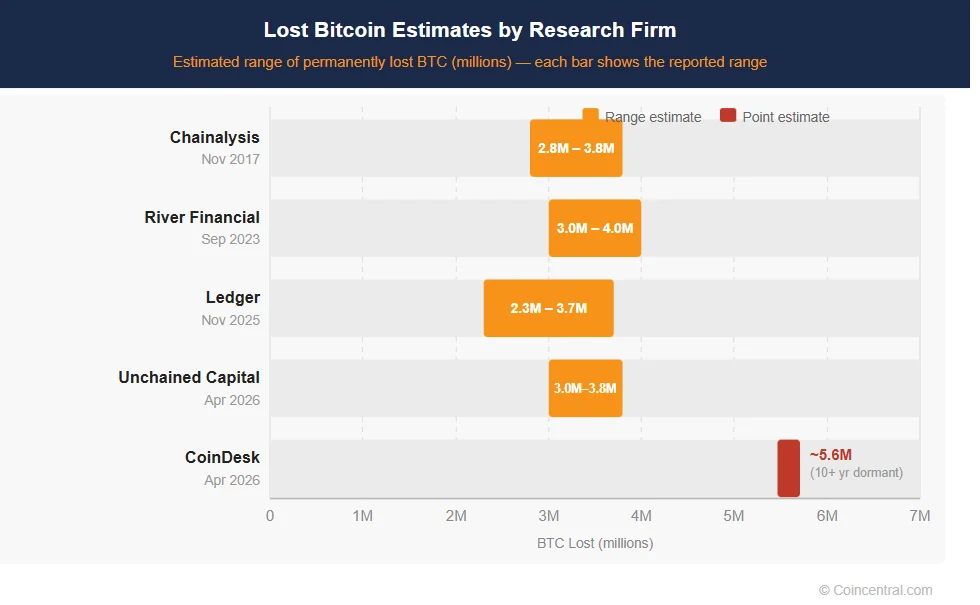
No research firm pins the exact number to a single precise figure. The blockchain records every transaction, but it cannot flag a wallet as abandoned or lost, so analysts must infer loss from long periods of silence. The figures that do exist come from some of the most closely watched names in on-chain research — Chainalysis, Glassnode, Unchained Capital, and Fidelity Digital Assets among them.
The range most analysts work with sits between 2.3 million and 4 million BTC. The most recent data, published by CoinDesk in April 2026, puts the number of coins untouched for over a decade at roughly 5.6 million. Every major firm that has studied the question has landed somewhere in the millions.
Table 1: Lost Bitcoin Estimates by Research Firm
The estimates vary because each firm applies a different definition of “lost” and a different time threshold for inactivity, but all of them point in the same direction. As of early 2026, approximately 19.8 million BTC had been mined. Subtracting the lower-end loss estimate of 2.3 million drops the effective circulating supply to around 17.5 million. At the higher estimate of 4 million lost, it falls further to 15.8 million.
What Counts as a Lost Bitcoin?
Bitcoin uses two keys: a public key, which serves as the address for receiving funds, and a private key, which acts as the password needed to spend them. Lose the private key, and the coins become permanently unreachable. There is no password reset option, no customer support line, and no central authority that can authorize access to someone else's wallet. The same design that makes Bitcoin secure also makes loss irreversible.
Analysts group lost coins into three types. Lost coins still exist on-chain, but the owner has lost the private keys and cannot access them. Dormant coins have not moved in years but may still be accessible to a long-term holder who simply chooses not to spend them — and they are impossible to tell apart from truly lost coins. Burned coins are deliberately sent to wallet addresses with no known private key, permanently removing them from circulation.
The core challenge for analysts is that dormant and truly lost coins look identical on the blockchain. A wallet untouched for ten years could belong to a careful long-term investor or to someone who discarded the wrong hard drive; the ledger shows exactly the same data in both cases. This is why every estimate of lost Bitcoin comes with uncertainty. Inactivity is the only available signal, and inactivity alone cannot confirm whether coins are gone for good.
How Analysts Estimate the Number
Because the blockchain cannot directly identify lost coins, analysts rely on indirect methods. The most widely used is dormant address analysis. A wallet address is flagged as potentially lost when it has not sent any coins for a set number of years. Most analysts use five years as a minimum threshold, and coins untouched for ten or more years are generally treated as permanently out of circulation.
The key measurement tool is the Unspent Transaction Output, or UTXO. Each time Bitcoin is received but not yet spent, it is recorded as a UTXO. Analysts track how old each UTXO is to model the probability that the associated coins are no longer accessible to anyone.
Research by Unchained Capital found that roughly 43% of all Bitcoin in circulation has not been transacted in three or more years. That figure includes both patient long-term holders and permanently lost coins — the data cannot separate them. Firms like Chainalysis and Glassnode go further, combining UTXO age data with clustering algorithms and full transaction history. Their models group related addresses into likely wallets and score the probability of loss, but every model carries built-in uncertainty, since inactivity can reflect choice just as easily as loss.
One piece of data stands apart from all the modeling. Bitcoin's creator, Satoshi Nakamoto, mined an estimated 1.1 million BTC in 2009 and 2010, and those coins have never moved. They represent roughly 5% of the entire supply and weigh heavily on every lost-coin estimate.
Table 2: Bitcoin's 21 Million — Where the Coins Are
The gap between the headline cap and the accessible supply is real and large. The 21 million figure is the theoretical ceiling. The pool of Bitcoin that can actually be bought, sold, or moved is well below it.
Famous Cases of Lost Bitcoin
The most prominent holder of potentially lost Bitcoin may be the currency's own creator. Satoshi Nakamoto mined roughly 1.1 million BTC in the network's earliest days, then went quiet. Those coins have sat untouched for more than 15 years. Whether Satoshi cannot access them or simply chose to disappear is unknown. Either way, most analysts treat them as permanently out of circulation, and any movement of those coins would immediately become one of the biggest events in the history of the asset.
James Howells: 8,000 BTC in a Landfill
James Howells, a British IT worker, discarded a hard drive in 2013 while clearing out his home. The drive held the private keys to 8,000 BTC and ended up buried in a landfill in Newport, Wales. He spent years trying to get permission to search the site, offering to fund the full excavation and share 25% of any recovered coins with the local council. The council refused, and a court dismissed his lawsuit in 2025. The coins remain buried under years of compacted waste. At current prices, those 8,000 BTC are worth hundreds of millions of dollars, and there is no realistic path to recovery.
Stefan Thomas: Two Guesses Remaining
Stefan Thomas, a software programmer, stored the private keys to more than 7,000 BTC on an IronKey hardware drive — a device engineered for extreme security. He wrote his password on a piece of paper, then lost the paper. The IronKey allows ten password attempts before permanently encrypting itself. Thomas has used eight, leaving two guesses remaining. Each one could unlock a wallet worth hundreds of millions of dollars — or trigger a final, irreversible lockout. The irony is that the device's security is working exactly as designed.
These are the most-cited cases, but the underlying is common across the entire network. Lost hardware and forgotten passwords are the two most frequent causes of Bitcoin loss everywhere.
Ancient Coins vs. New Mining: A Growing Imbalance
A 2025 report by Fidelity Digital Assets, using on-chain data from Glassnode, found that Bitcoin's “ancient supply” — coins untouched for ten or more years — is now growing faster than new coins are being created. More than 566 BTC per day are crossing the ten-year dormancy threshold. Following the April 2024 halving, miners produce only 450 BTC per day. More Bitcoin is aging into deep dormancy every single day than the network is generating in fresh supply.
Table 3: Daily Bitcoin Flow — New vs. Aging
The reasons for this dormancy span a wide range: lost private keys, deliberate cold storage by long-term holders, institutional holdings, and early adopters who are no longer active. The daily deficit of 116 BTC adds up to more than 42,000 coins per year drifting further out of practical reach. The next halving in 2028 will cut daily new issuance to roughly 225 BTC, making the imbalance wider still.
This is not a new phenomenon, but the data from Fidelity and Glassnode puts a concrete number on a trend that was previously harder to measure. The effective supply side of the Bitcoin market is contracting faster than most headline figures suggest.
What Lost Bitcoin Means for Price and Scarcity
Bitcoin's price is shaped by supply and demand. When demand rises against a fixed pool of available coins, prices move, and lost coins reduce that pool permanently. If the effective circulating supply is 15.8 million to 17.5 million BTC rather than the 21 million cap, the same buying pressure has fewer coins to work against. The result is that price moves can be sharper than the headline supply number would suggest.
Bitcoin's creator addressed this point directly. Satoshi Nakamoto wrote in an early post: “Lost coins only make everyone else's coins worth slightly more. Think of it as a donation to everyone.”
That effect grows with each halving. As new issuance slows, lost coins represent a larger share of the overall supply equation. The 2024 halving cut daily mining output to 450 BTC, and the 2028 halving will reduce that to around 225 BTC per day — roughly 82,000 BTC per year. If the rate of loss continues at current levels, the gap between nominal and usable supply will grow year by year.
It is worth noting that dormant coins can return to circulation. A long-term holder who has not moved Bitcoin in a decade might sell tomorrow, and ancient supply is not always the same as permanently lost supply. Because the ledger is public, any such movement would be immediately visible to anyone monitoring the chain. But the overall direction is clear: the accessible pool of Bitcoin is smaller than the numbers suggest, and it is shrinking over time.
Future Losses: Inheritance and the Risk Ahead
Lost Bitcoin is not only a historical problem. New coins are leaving circulation every year, and the pace may increase as the network ages and early holders die.
A 2020 survey by the Cremation Institute, covered in Bitcoin Magazine, found that nearly 90% of crypto holders were concerned about what would happen to their assets after death. Only a small fraction had made any formal inheritance plan. When a Bitcoin holder dies without passing on their private keys, the coins are gone. There is no bank to contact and no estate department to appeal to. Without clear documentation, even well-meaning family members have no way to access the funds.
By 2028, Bitcoin's annual new issuance will drop to roughly 82,000 BTC. If just 0.5% of current holders lose access to their coins each year — through death, hardware failure, or forgotten passwords — that alone would remove around 95,000 BTC from circulation annually, already exceeding what miners will produce. At a 1% annual holder loss rate, the figure rises to roughly 190,000 BTC per year — more than double Bitcoin's post-2028 yearly output from mining.
Table 4: Future Annual Loss Projections vs. New Issuance
For holders using regulated custodians or Bitcoin ETFs, estate transitions follow standard legal processes. The custodian manages the keys and handles the handoff through conventional channels. For self-custody holders, the risk is entirely personal. Without clear documentation, the coins may go with the holder, and planning ahead is the only solution available.
How to Prevent Losing Your Bitcoin
Bitcoin loss is preventable in most cases. The private key is the only thing that matters. As long as it is secured, backed up, and documented, the coins are accessible.
Back Up Your Seed Phrase
Every Bitcoin wallet generates a seed phrase — 12 to 24 words that can restore access on any compatible device. Writing this down and storing it safely, offline, is the most important step any holder can take. Keeping copies in two or more physical locations is far more resilient than relying on memory or a single device, and a fireproof safe or bank lockbox offers real protection against common risks.
Use Multi-Signature Wallets
A multi-signature setup requires more than one private key to authorize a transaction. If one key is lost, the others can still unlock the funds. This approach removes the single point of failure that causes most permanent Bitcoin losses, and it is one of the most effective tools available to anyone holding Bitcoin directly.
Store Backups in Multiple Locations
Holders with large amounts often keep key backups in separate physical locations. A fire, flood, or theft in one location does not affect the others. Geographic separation is a straightforward precaution that most holders overlook until it is too late.
Plan for Inheritance
Legal documents explaining where keys are stored and how to use them are the only tools beneficiaries will have. Without them, there is no one to call. A clear written record — kept alongside a will or in a fireproof location known to family — can prevent an unintentional loss from becoming a permanent one. For those who prefer not to manage keys directly, qualified custodians offer professional key management and built-in estate planning services, at the cost of direct control over the private keys.
The Bottom Line
Bitcoin is one of the most transparent assets ever built. Every balance is visible, and every transaction is permanent and public. Yet millions of coins are frozen in place — present on the ledger, but completely unreachable.
Analysts estimate that between 2.3 million and 5.6 million BTC are effectively gone. The pool of Bitcoin that can actually change hands is closer to 15 to 17 million coins than the 21 million cap most people associate with the asset. As new issuance slows with each halving and aging supply continues to accumulate, that gap between the cap and the usable supply is likely to widen further.
The practical point for any Bitcoin holder is straightforward. The network has no recovery mechanism. No company, no authority, and no algorithm can restore a lost private key. Key management and inheritance planning are not optional extras. For self-custody holders, they are the whole job.
Sources
- Chainalysis — Lost Bitcoin Research, November 2017
- River Financial — Bitcoin Supply Analysis, September 2023
- Fidelity Digital Assets — Ancient Supply Report using Glassnode data, 2025
- Unchained Capital — UTXO Age Analysis, April 2026
- Cremation Institute / Bitcoin Magazine — Crypto Inheritance Survey, 2020
This article is based on reporting originally published by CoinCentral.

