How Long Does a Bitcoin Transaction Take? Confirmation Times, Fees, and Delay Factors
Key Takeaways
- •Bitcoin targets an average block interval of roughly 10 minutes, so first confirmations usually arrive within that window, while the six-confirmation benchmark for substantial payments takes about one hour.
- •Transaction fees are determined by data size in virtual bytes multiplied by the fee rate in sat/vB, meaning the dollar value sent does not by itself raise the cost.
- •Coinbase Exchange documentation requires two confirmations for Bitcoin deposits and Kraken's October 2026 documentation lists three, equal to roughly 20 and 30 minutes under normal block production.
- •Lightning Network payments can settle within seconds, although Coinbase's pricing disclosure lists a 0.2% processing fee for sending Bitcoin through Lightning.
- •Unconfirmed transactions can stay pending for extended periods, with Bitcoin Core's default mempool expiry at 14 days, and stuck payments may often be accelerated using replace-by-fee or child-pays-for-parent.
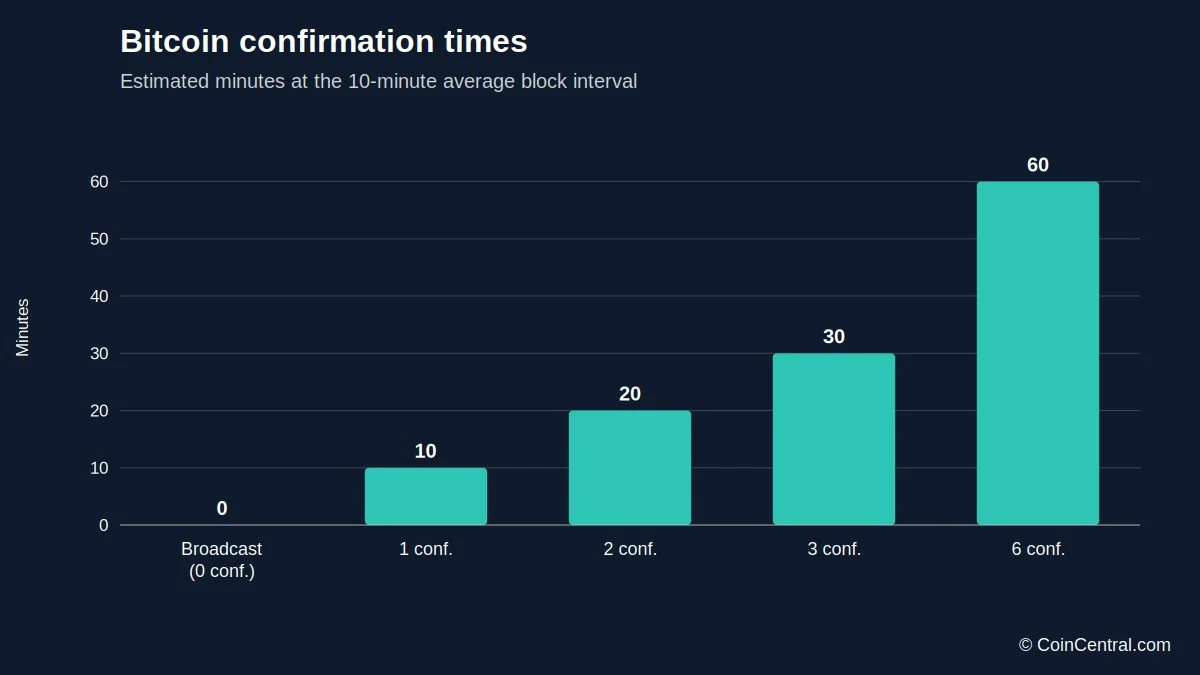
A Bitcoin transaction typically receives its first confirmation in roughly 10 minutes, though the actual wait can range from a few minutes to several hours or longer. Three variables drive the outcome: how much demand the network is facing, the fee the sender attaches, and how quickly miners manage to find the next block.
Bitcoin has no central processor. Miners compete to append new blocks, and the network is calibrated to produce one block approximately every 10 minutes on average. Individual blocks, however, can arrive considerably sooner or later than that target.
This article gathers the key figures behind Bitcoin confirmation times, transaction fees, exchange deposit processing, and Lightning Network payments. It also examines what the data reveals about transactions that become stuck. The numbers are drawn from official Bitcoin documentation, fee trackers, and exchange support pages. All fee examples use an illustrative Bitcoin price of $100,000 and should not be read as price forecasts.
Key Bitcoin Transaction Figures at a Glance
Each number below is examined in detail in the sections that follow.
- First confirmation: about 10 minutes on average
- Six confirmations, the benchmark for substantial payments: about one hour
- Suggested fee rates at the 28 October 2026 research check: roughly 1 to 2 sat/vB
- Default Bitcoin Core mempool expiry for unconfirmed transactions: 336 hours (14 days)
- Exchange deposit requirements: two confirmations in the Coinbase Exchange example; three confirmations for ordinary Kraken deposits (October 2026 documentation)
- Lightning Network settlement: within seconds
Bitcoin Confirmation Times
How quickly a Bitcoin payment clears depends on two things: the number of confirmations the recipient requires and whether the payment secures a place in the next available block. A confirmation is recorded the moment a transaction is written into a block on the blockchain.
A newly sent payment reaches the network within seconds of broadcast. At that stage it carries zero confirmations and joins Bitcoin's accepted history only once a miner adds a block that contains it.
These estimates assume the sender has paid a competitive fee and that blocks are being produced normally. A transaction set too low may sit unconfirmed for hours or days before the confirmation process even begins.
According to Bitcoin.org, blocks are produced roughly every 10 minutes on average, and no maximum waiting time is guaranteed. Because block discovery is random, one block may surface within a minute while the next takes 30 minutes or more.
How Many Confirmations Are Enough?
The appropriate count depends on the value of the payment and the level of risk the recipient is prepared to accept. One confirmation may be enough for a small personal transfer, while exchanges and businesses frequently require several.
Six confirmations is the benchmark named in Bitcoin's developer documentation for substantial payments. Because the first confirmation is the block that contains the payment, six confirmations in practice means five more blocks mined on top of it. It does not mean a transaction becomes impossible to reverse after exactly six blocks. Bitcoin exhibits what is known as probabilistic finality: the risk of reversal falls as more proof-of-work accumulates on top of the transaction. Accepting an unconfirmed payment, by contrast, carries a higher risk of double spending than waiting for a block.
Why Block Times Vary
The 10-minute figure is a target rather than a timer. Block discovery is a random process, so intervals shift from one block to the next — some arrive within a minute, others after half an hour.
The target holds steady over time because of a built-in recalibration: every 2,016 blocks — roughly every two weeks — the network adjusts mining difficulty so block production stays anchored to the 10-minute pace even as miners add or withdraw computing power.
That explains why a payment carrying a strong fee can still feel slow: the wait for the next block is identical for every transaction, regardless of how much it pays.
Bitcoin Transaction Fees
Bitcoin fees are not charged as a percentage of the amount sent. They are set by the size of the transaction's data and the fee rate the sender selects. Size is measured in virtual bytes (vB), and the rate in satoshis per virtual byte (sat/vB).
The calculation is straightforward: fee = transaction size (vB) × fee rate (sat/vB). One satoshi equals 0.00000001 BTC.
The worked examples below assume a hypothetical 150 vB transaction, with dollar values based on an illustrative Bitcoin price of $100,000. They are illustrative calculations rather than live quotes, since real transaction sizes and required fee rates vary from one payment to the next.
As of 28 October 2026, the Mempool Project showed suggested fee rates of around 1 to 2 sat/vB during the research check. That points to low network costs at the time, though fee suggestions can change within minutes.
Does Sending More Bitcoin Raise the Fee?
Not on its own. Sending $100 worth of Bitcoin can cost about the same as sending $100,000 when the two transactions share a similar structure, because the network prices data rather than value.
Structure still matters. A wallet filled with many small payments may need to bundle several unspent transaction outputs (UTXOs) to construct one larger transfer. A payment drawing on five inputs is bigger in data terms than one using a single input, and therefore costs more.
Address format plays a part too. SegWit and Taproot transactions benefit from Bitcoin's witness-data discount, although the actual savings depend on how each transaction is built.
How Users Can Lower Fees
The simplest saving is to skip high-priority confirmation when a transfer is not urgent. Checking current fee estimates before sending also helps prevent overpayment.
Wallets that support SegWit or Taproot may be more efficient than older address formats. Consolidating small UTXOs while fees are low can reduce the cost of later transactions, though the consolidation step is itself an on-chain transaction and can affect privacy.
Fee Rates and Delays
Most delays trace back to three causes: a fee set too low, a busy network, and the random timing of blocks. Exchange rules can add a fourth.
Miners generally favor transactions that pay more per unit of block space. Fees make up part of miner revenue alongside the block subsidy, which Bitcoin's issuance schedule sets to halve roughly every four years. When a transaction undercuts its competitors on fee rate, miners may keep passing over it in favor of other payments.
The data offers a clear illustration. A transaction offering 2 sat/vB may linger in the queue while most competing payments pay 20 sat/vB. It could still confirm later if demand drops, but no timeframe is guaranteed. For a 150 vB transaction, that gap amounts to 300 satoshis against 3,000 satoshis — a competing fee ten times higher.
Why Congestion Changes the Numbers
Bitcoin's block space is limited, and the ceiling is written into the protocol: since the SegWit upgrade, a block can carry at most 4 million weight units, with signature and witness data counted at a discount. When more people send transactions, more payments compete for the same room, and those that miss the cut wait for the next block. Heavy trading activity, speculative interest, and other blockchain use can all push demand upward.
Higher demand can raise the fee rate needed for quick inclusion. A fee that looked competitive when a payment was sent can become too low if demand rises afterward.
A Higher Fee Cannot Remove Block Timing
Even a payment with a high fee must wait for a miner to find a block. Bitcoin targets a 10-minute average, but an individual block might take 30 minutes or longer. A higher fee improves the chance of quick inclusion, yet it cannot promise confirmation within 10 minutes.
Fee tools such as mempool.space show suggested rates for each urgency level. These are predictions, not guarantees.
Exchange Deposit Times
Moving Bitcoin between exchanges adds steps. The sending exchange may need to process the withdrawal before it broadcasts the transaction, and the receiving exchange must then detect the payment and wait for its required number of confirmations.
Coinbase Exchange documentation gives an example that requires two Bitcoin network confirmations before a deposit is complete. At the average block interval, that is about 20 minutes after prompt inclusion. Requirements can differ between Coinbase products and may change.
Kraken's October 2026 documentation describes three confirmations for ordinary Bitcoin deposits, pointing to roughly 30 minutes under normal block production, assuming the transaction confirms quickly.
Neither exchange controls when miners find blocks, and account limits or security reviews can stretch the process further.
Confirmed on the Network, Pending on the Exchange
A transfer can be confirmed on the blockchain and still not appear in an exchange account. Centralized exchanges may run withdrawal reviews, security checks, or their own confirmation rules. These delays sit apart from Bitcoin's processing time.
Some exchanges also offer internal transfers between customers. These may bypass an ordinary Bitcoin transaction altogether, so funds can appear almost instantly and network fees may not apply. Such transfers rely on the exchange's own custody and accounting records rather than independent blockchain settlement.
Lightning Network Payments
The Lightning Network is a payment layer built on top of Bitcoin. Rather than recording every payment on the main blockchain, it routes transfers through connected channels. A successful Lightning payment can settle within seconds.
That speed suits everyday purchases, small payments, and frequent transfers. Both sides need compatible wallets or services, and the payment requires enough liquidity and a working route. Larger payments can fail if no suitable route is found.
Opening or closing a channel can involve on-chain Bitcoin fees. Those costs are easy to overlook when comparing Lightning with regular transfers.
Are Lightning Payments Cheaper?
They often are, but the cost depends on the provider. Some Lightning wallets charge only very small routing fees, while others add processing charges.
Coinbase's published pricing disclosure lists a 0.2% processing fee for sending Bitcoin through Lightning. On a $1,000 transfer, that is $2.
The comparison shows that a direct Bitcoin transaction can cost less when on-chain fees are low. At 20 sat/vB, the on-chain fee is higher than the Lightning fee in this example. Lightning is best judged on both speed and total cost.
Stuck Transactions
A Bitcoin transaction can stay pending when miners keep choosing payments with higher fees. Low-fee transactions can remain unconfirmed for 24 hours or longer. That does not mean the Bitcoin has disappeared.
While a transaction is unconfirmed, the funds have not been permanently moved on the blockchain, and the pending payment can remain visible across network nodes for a long time.
How Long Can a Transaction Stay Pending?
Bitcoin Core's default mempool expiry period is 336 hours, equivalent to 14 days. A node can drop an unconfirmed transaction after that time, or sooner if its memory fills up.
Expiry is not a network-wide cancellation. Other nodes may still hold the transaction, and someone could rebroadcast it. Users should check their wallet status before assuming a transaction is gone.
Ways to Move a Stuck Payment
Bitcoin Core has supported full replace-by-fee (RBF) relay by default since version 28.0, although wallet screens and network policies differ. A replacement must meet the relevant fee and relay rules.
With child-pays-for-parent (CPFP), miners can weigh the combined fees of both transactions and include them together. It helps most when the receiver controls an output from the pending payment.
Can a Bitcoin Transaction Be Reversed?
A confirmed Bitcoin transaction cannot normally be canceled through a wallet or exchange. Bitcoin has no chargeback system. An unconfirmed payment can sometimes be replaced, but only before the original confirms.
Once a transaction has built up confirmations, reversing it would take a blockchain reorganization or another exceptional step. A transfer to a wrong address can mean permanent loss, so checking the address matters.
How to Track a Pending Payment
Every transaction carries a unique identifier, often called a TXID or transaction hash. Most wallets and exchanges show it in the transaction details.
Entering the TXID in a blockchain explorer reveals the confirmation status, fee rate, amount, and addresses. It may also estimate when an unconfirmed payment could be included in a block. Zero confirmations means the payment is still waiting, not that it has failed.
Why Pending Is Not the Same as Lost
A payment that has not confirmed is still waiting in the queue. The sender still controls the funds until a block includes the transaction. This differs from sending Bitcoin to a wrong address, which can cause permanent loss once confirmed.
Telling the two cases apart matters. A delayed payment can often be fixed with a higher fee, while a mistaken transfer usually cannot be undone.
What the Bitcoin Transaction Time Numbers Show
Bitcoin transactions typically receive a first confirmation in around 10 minutes, and six confirmations take about one hour under normal conditions. These are averages, not promises.
Actual times depend on congestion, fees, block production, and the rules of the receiving service. A low-fee payment can take hours or days, while a competitive fee improves the chance of inclusion in an upcoming block.
The figures also underline how small on-chain fees can be. A 150 vB transaction costs $0.30 at 2 sat/vB and $3.00 at 20 sat/vB in the examples above. Fees hinge on data size and fee rate, not on the amount sent.
For people moving Bitcoin between wallets, checking current fee estimates is the simplest way to balance cost against speed. Those making frequent small payments may find Lightning useful if their wallets and receiving services support it.
The essential distinction is between a transaction being broadcast, confirmed on the blockchain, and credited by a receiving platform. Verify the recipient address, check network conditions, choose a suitable fee, and allow time for the confirmations required.
Sources
- Bitcoin.org: Bitcoin Frequently Asked Questions
- Bitcoin Developer Documentation: Payment Processing and Confirmations
- Bitcoin Developer Documentation: Bitcoin Transactions and UTXOs
- Mempool Project: Bitcoin Network Fees and Transaction Explorer
- Mempool Project: Transaction Fee and Confirmation FAQ
- Blockstream: Why Bitcoin Has Transaction Fees
- Blockstream: Replace-by-Fee Explained
- Bitcoin Design Foundation: Bitcoin and Lightning Transactions
- Lightning Labs: Lightning Network Payment Routing
- Coinbase: Pending Cryptocurrency Deposits
- Coinbase: Cryptocurrency Pricing and Fee Disclosures
- Kraken: Cryptocurrency Deposit Processing Times
- Bitcoin.org: Important Bitcoin Security Information
Disclaimer: This article is for educational purposes only. Bitcoin transaction fees and confirmation times change with network conditions. Examples and estimated processing times are not guarantees. Always verify live fees, receiving addresses, and platform requirements before transferring cryptocurrency.

