Bitcoin, DXY, Liquidity and Fed Policy: Why Macro Conditions Matter for BTC
Key Takeaways
- •Bitcoin traded around $71,666, rising sharply on the day, with a market capitalization above $1.43 trillion.
- •The FOMC held the federal funds target range at 3.5%-3.75% on July 29, 2026, passing the decision 9-3 as Hammack, Kashkari, and Logan dissented in favor of a 25 basis point hike.
- •Coinbase Institutional said its custom Global M2 Liquidity Index has risen about 5% since April to a new cycle high and tends to lead Bitcoin by roughly 110 days.
- •The Fed-sourced Nominal Broad US Dollar Index stood at 118.9028 on August 14, 2026, while the Fed's total assets were $6.76 trillion for the week ending August 12, 2026.
- •The Fear & Greed Index sat at 62, indicating 'Greed,' even as hawkish-Fed analysts warned that tighter policy raises carry costs for risk assets.
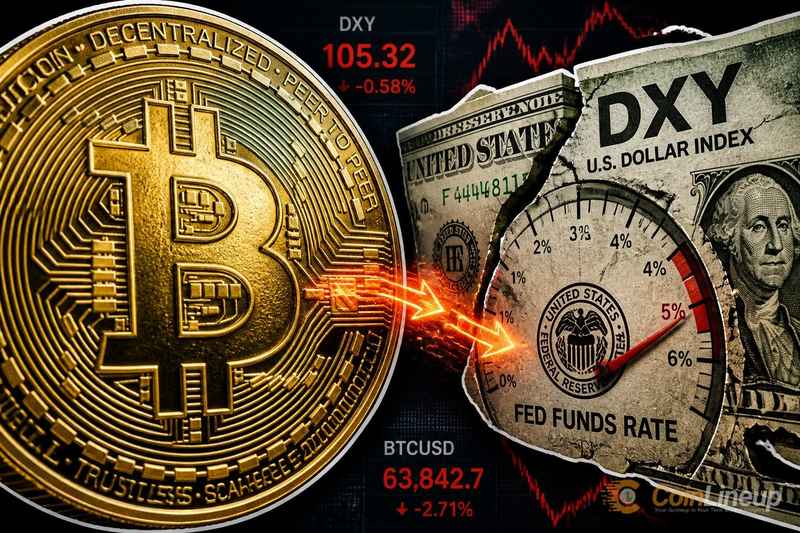
Understanding how DXY affects Bitcoin comes down to three connected forces: the strength of the US dollar, the availability of global liquidity, and the Federal Reserve’s policy stance, which influences both. With the Fed holding rates at 3.5%-3.75% and the broad dollar near multi-year highs, these macro channels are shaping BTC trading conditions.
Bitcoin was recently trading around $71,666, up sharply on the day and carrying a market capitalization above $1.43 trillion. That price comes against a backdrop in which the dollar and Fed policy are dominating the macro conversation for risk assets, especially because BTC’s sensitivity to macro conditions can affect how traders interpret moves that otherwise look purely technical. For related coverage, see Dollar Falls Over 1% as Global Central Banks Raise Inflation Alert.
Key takeaways
- A stronger US dollar generally pressures Bitcoin, but the inverse relationship is a tendency, not a fixed rule.
- Liquidity is the deeper driver; DXY is often the most visible signal of tighter or looser conditions.
- Fed policy sits upstream of both, although crypto-specific catalysts can still override the macro chain.
Why Bitcoin often moves opposite to the US Dollar Index
The US Dollar Index measures the dollar’s strength against a basket of major currencies. It is a gauge of how expensive the dollar is relative to its peers, not a direct Bitcoin indicator. For related coverage, see Citi Plans Bitcoin Custody Launch for Institutions by Year-End.
Global investors watch the dollar closely because most risk assets, including Bitcoin, are priced in it. When the dollar strengthens, holding non-yielding, speculative assets becomes relatively more costly, and risk appetite tends to cool. The Fed-sourced Nominal Broad US Dollar Index stood at 118.9028 on August 14, 2026, a firm reading that serves as the clearest official proxy for the DXY story.
A stronger dollar usually coincides with tighter financial conditions and lower demand for speculative assets, which is why traders treat dollar strength as a headwind for BTC. But the inverse relationship is common, not permanent. Bitcoin has rallied alongside a firm dollar before when crypto-specific demand was strong enough to outweigh the macro drag.
How liquidity conditions matter more than dollar headlines alone
Dollar strength and broad liquidity are related, but they are not the same. The dollar tells you the price of one currency; liquidity tells you how much capital is actually available to chase assets across markets.
Bitcoin tends to perform better when capital is easier to access and risk appetite expands. That liquidity can come from lower rates, easier credit, or an expanding central bank balance sheet. The Fed’s total assets stood at $6.76 trillion for the week of August 12, 2026, providing a direct measure of the liquidity backdrop feeding into markets.
This is why a dollar headline alone can be misleading. Coinbase Institutional said its custom Global M2 Liquidity Index had risen about 5% since April and that the gauge leads Bitcoin by roughly 110 days, framing liquidity as a forward driver of BTC rather than a same-day reaction. Dollar weakness without improving liquidity does not automatically produce a sustained rally, which is why traders often watch both the dollar and broader money conditions together.
“Our custom Global M2 Liquidity Index… has risen ~5% since April and now sits at a new cycle high.” — Colin Basco, Coinbase Institutional
Liquidity matters because it supports both spot inflows and leverage. When liquidity expands, capital can flow into crypto and traders can borrow more cheaply to add exposure; when it contracts, the reverse can squeeze positions. Recent moves such as divergent flows across spot Bitcoin ETFs show how sensitive allocation decisions are to the liquidity picture.
What Fed policy changes usually mean for BTC traders
The Federal Reserve sits upstream of both the dollar and liquidity, which is why its stance is the anchor of this framework. On July 29, 2026, the FOMC kept the federal funds target range at 3.5%-3.75% and said it would continue maintaining ample reserves in the banking system, according to the Fed’s statement: Federal Reserve press release.
Hawkish policy means leaning toward tighter money, higher rates, or slower easing, which supports the dollar and drains liquidity. Dovish policy means the opposite, favoring lower rates and easier conditions that can weaken the dollar and support risk sentiment. The July decision passed by a 9-3 vote, with Beth Hammack, Neel Kashkari, and Lorie Logan dissenting in favor of a 25 basis point hike, an unusually hawkish split that underscored the tightening bias.
The sequence runs from Fed stance to dollar and liquidity response, then to a possible BTC reaction. That chain was visible around the July meeting, when CoinDesk reported Bitcoin held near $64,000 through the decision while analysts described the hold as hawkish for risk assets. This dynamic echoes earlier episodes where a Fed decision left Bitcoin steady while bond yields moved, and where Fed minutes revealed a wider hawkish split.
“Tighter policy, less liquidity, [means] more expensive carry.” — Andrei Grachev, via CoinDesk
Sentiment reflects that split reading, with the Fear & Greed Index at 62, or “Greed,” even as hawkish-Fed analysts warn tighter policy raises carry costs. The framework is not mechanical: dovish shifts rarely lift BTC immediately, and Bitcoin can diverge entirely when crypto-specific catalysts take over. Macro sets the backdrop, but it does not guarantee the next move.
Disclaimer: This article is for informational purposes only and does not constitute financial or investment advice. Cryptocurrency and digital asset markets carry significant risk. Always do your own research before making decisions.

