House Passes Stop Insider Trading Act Targeting Congressional Stock Purchases
Key Takeaways
- •The Stop Insider Trading Act passed the House by a 232–198 vote and was received by the Senate for consideration on Thursday.
- •The bill would prohibit members of Congress and their immediate families from purchasing publicly traded stocks.
- •Violations would carry a fine of $2,000 or 10% of the transaction value, whichever is greater, plus forfeiture of any profits.
- •Senator Elizabeth Warren criticized the bill for allowing lawmakers to retain and sell stocks acquired before the ban.
- •The proposal does not apply to the president, the vice president, or their families.
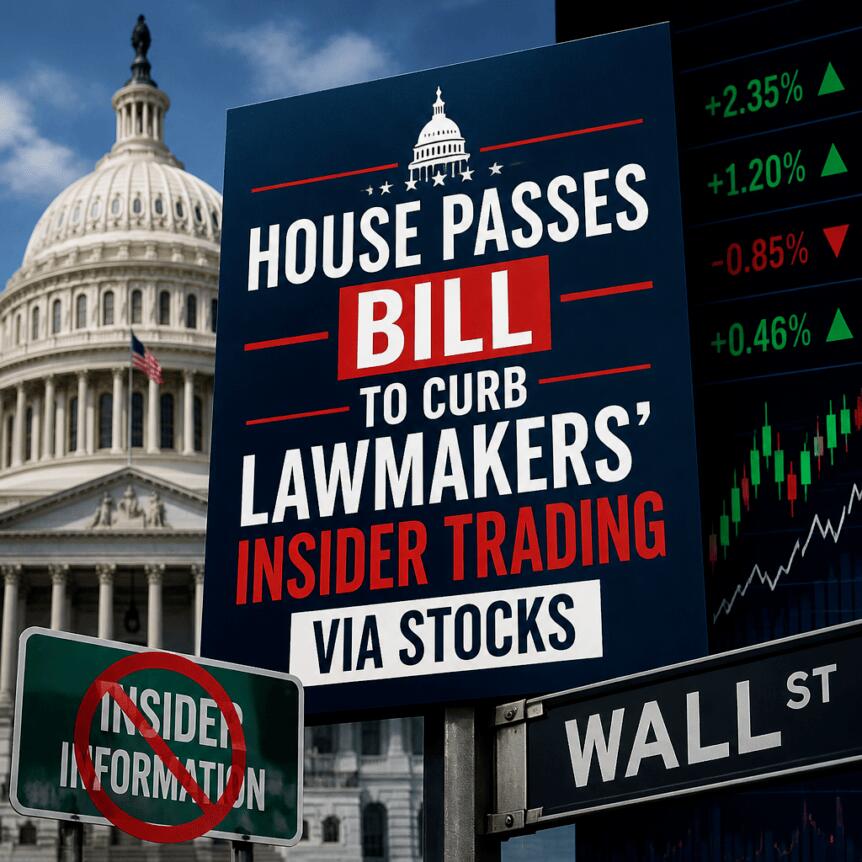
The US House of Representatives has officially passed the Stop Insider Trading Act, a legislative measure specifically designed to prevent members of Congress and their immediate families from purchasing publicly traded stocks. The bill successfully cleared the House on Wednesday, advancing with a vote of 232–198. The proposal now moves to the Senate for further deliberation, meaning the House vote is a significant procedural step but not the final word on whether the restrictions become law.
Sponsored by Republican Representative Bryan Steil, the legislation is designed to stop lawmakers from profiting from potential insider information obtained through their official duties and to establish strict penalties for any violations. Speaking on the House floor, Steil framed the measure as a significant first for the current congressional session, specifically targeting the issue of congressional stock trading. He emphasized that the bill's practical aim is to fundamentally reduce the possibility that lawmakers could benefit from non-public information. According to the official Congress.gov record, the chamber approved Steil’s bill, designated as HB 7008. In detailing how violations would be punished, Steil highlighted a comprehensive penalty structure. Violators would face a fine of $2,000 or 10% of the transaction value, whichever is greater, along with the complete disgorgement of any profits made. He reiterated that lawmakers who fail to comply with the legislation’s requirements will entirely forfeit their financial gains.
Despite the bill clearing the House, swift criticism emerged from Democratic lawmakers who argue that the legislation does not go far enough to eliminate fundamental conflict-of-interest concerns. Senator Elizabeth Warren stated on Thursday that the legislation contains major loopholes because it still allows lawmakers to own and sell stocks that they acquired prior to the ban. Warren’s primary concern is that allowing ongoing ownership and the subsequent sale of these assets—rather than implementing an outright ban on holding such equities—may not sufficiently address the underlying risk that creates incentives around insider information.
Steil responded to a portion of this critique by outlining a specific compliance mechanism designed for members who already hold stocks. He stated that the bill would require lawmakers to provide a mandatory seven days’ notice before selling any assets they currently own. Steil argued that this advance notice requirement would act as a powerful deterrent against trading that might be driven by private, non-public information. It remains to be seen exactly how the Senate will treat these competing positions. In practice, the central question will likely be whether the Senate views the seven-day notice and established penalties as adequate deterrence, or if senators will push for a much stricter model that extends the restrictions beyond merely banning new purchases to encompassing broader ownership rules.
Following its passage in the House, the Stop Insider Trading Act was officially received in the Senate for consideration on Thursday. The ultimate outcome in the upper chamber may heavily hinge on whether a sufficient number of senators support the bill’s relatively narrow scope, which is aimed squarely at members of Congress rather than applying to other senior federal officials. As written, Steil’s measure is strictly limited to restricting investment activities for members of Congress and their immediate families. Notably, it does not cover the president, the vice president, or their respective families. This specific distinction is critical to understanding how the proposal fits into a much broader debate regarding public official ethics, and whether such financial restrictions should be applied uniformly across both top executive and legislative roles.
This limitation stands in stark contrast to a separate, distinct Senate proposal associated with the Digital Asset Market Clarity Act. That particular crypto-market structure bill includes restrictions that reach public officials much more broadly, containing specific language that would explicitly bar certain officials from issuing or sponsoring digital tokens until the year 2029. While that crypto-market structure bill is entirely separate from the stock-trading measure, it effectively illustrates how ethics and market-related restrictions are currently being considered and debated across a variety of different legislative packages.
Furthermore, the House action on insider stock trading arrives shortly after Steil sponsored another related legislative effort specifically focused on prediction markets. Steil previously backed the Stop Lawmakers from Predicting Act, which was introduced in June. This parallel proposal aims to prevent certain public officials, as well as their spouses and dependent children, from wagering on public policy issues and political outcomes.
That prediction markets proposal initially drew significant public attention amid several high-profile, real-world incidents highlighted in earlier coverage. The source specifically points to an alleged episode involving a United States soldier who reportedly placed more than $400,000 betting on the political fortunes of Venezuela President Nicolás Maduro on the blockchain platform Polymarket. Additionally, there were reports that a teleprompter operator for former President Donald Trump allegedly made more than $100,000 by betting on Kalshi event contracts that were directly connected to specific words and phrases used in political speeches.
While these specific examples do not involve Congress members trading on traditional stocks, they reflect the same underlying thematic concern: lawmakers, government employees, and political insiders face special scrutiny when financial bets can appear to be tied to an information advantage or political influence. In that broader context, the prediction markets proposal closely mirrors the stock bill’s penalty framing, including the implementation of a $2,000 fee or 10% of the value of the prohibited bets placed on the relevant platforms.
Investors and builders operating within cryptocurrency and digital asset markets may view these parallel legislative efforts as part of a much wider regulatory pattern. Legislators are increasingly testing whether financial restrictions and ethical guardrails should reach political actors who utilize financial rails that operate entirely outside of traditional stock exchanges, even when the underlying mechanism is classified as betting or speculating on event outcomes rather than purchasing traditional equities. As the Stop Insider Trading Act continues to move through the Senate, the primary uncertainty remains whether senators will ultimately accept the bill’s current approach—banning new stock purchases while instituting notice requirements for existing holdings—or whether they will attempt to push for much stricter rules that go significantly further on ownership and trading restrictions.

