Government Shutdown Risk Delayed, Not Resolved, After House Passes Stopgap Funding Bill
Key Takeaways
- •The House approved a stopgap funding measure by a 220–205 vote on July 21.
- •The bill extends the government funding deadline from September 30 to December 4.
- •Kalshi and Polymarket contracts showed lower implied odds of an October 1 shutdown after the vote.
- •The legislation still requires Senate passage and the president's signature before becoming law.
- •The underlying disputes over defense spending, election-law riders, and baseline appropriations remain unsettled.
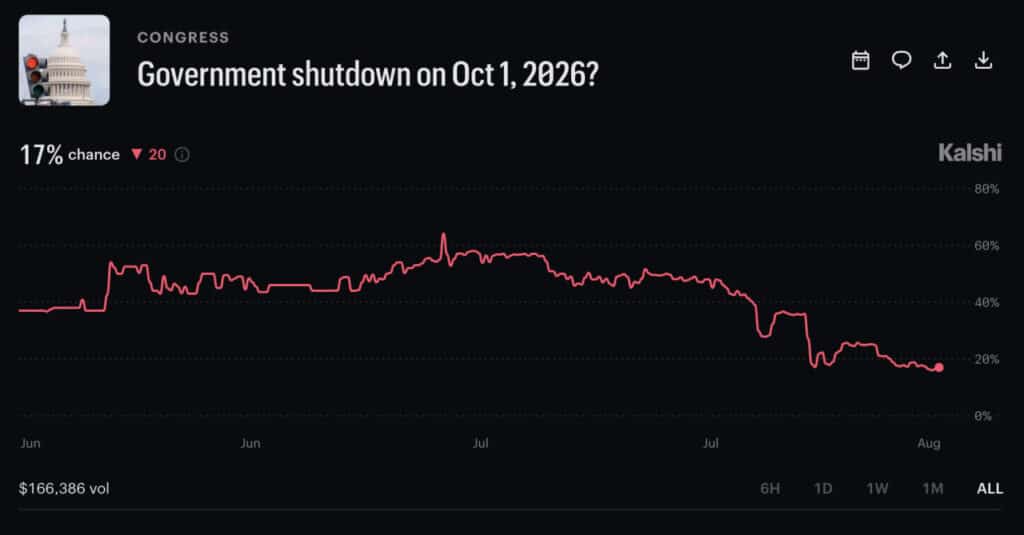
The House of Representatives passed a stopgap funding bill on July 21 by a 220–205 vote, extending the government's spending deadline from September 30 to December 4 and shifting it past this fall's midterm elections. The move immediately reshaped conversations around government shutdown probability across both political and cryptocurrency communities, as federal funding lapses can reduce operations at agencies like the SEC and CFTC that oversee digital asset regulation.
The vote triggered a rapid repricing in prediction markets that track the likelihood of a US government shutdown. Contracts on both Kalshi and Polymarket showed lower implied odds for an October 1 funding lapse compared to pre-vote levels.
However, a lower probability does not equate to a resolved dispute. The bill still requires Senate passage and presidential signature before it becomes law, and prediction markets moved quickly to discount the immediate deadline risk even as the underlying fight over defense spending, election-law riders, and baseline appropriations levels remains unsettled. For traders pricing in political stability, the House vote may represent a delay rather than a definitive fix. This pattern is familiar: continuing resolutions have become Congress's standard mechanism for avoiding shutdowns, as lawmakers have not passed all regular appropriations bills on time in over two decades.
What the Kalshi and Polymarket Contracts Indicate
Prediction markets such as Kalshi and Polymarket operate event contracts that pay out $1 if a defined outcome occurs and $0 if it does not. These function as a real-time odds line on binary political questions.
The specific contract in question asks whether the government shuts down on October 1, 2026. If lawmakers maintain funding under a continuing resolution through that date, the contract resolves as “No,” regardless of what transpires later in the year.
This distinction is critical. A House vote alone does not settle the contract — the bill still needs to clear procedural hurdles before the funding lapse date, and any shift in the legislative timeline could move the market price again.
In the days following the House vote, the implied probability of an October 1 shutdown initially fell from approximately 59% to 48%. However, cross-platform comparisons later showed contracts diverging by more than 12 percentage points, a spread indicating that traders remain divided on how much risk was actually removed.
Inside the Vote: Reactions from Johnson, Scott, and Democrats
Speaker Mike Johnson framed the bill as a deliberately accelerated deadline, warning Democrats who opposed it that they would bear responsibility for any fallout: "Then they alone are going to own the chaos that ensues if the government shuts down after September 30."
Rep. Austin Scott defended the timing in more direct terms, stating, "I think it's kind of smart to go ahead and take the potential chaos of a shutdown off the table because of the amount of damage that does to the American citizens." Scott added that he believed a shutdown "probably works to the advantage of Democrats politically."
Democrats largely voted against the measure. Rep. Rosa DeLauro, the ranking Democrat on the House Appropriations Committee, was among those in opposition.
According to reports, GOP leadership's primary focus for the House's remaining 16 legislative days before the deadline is a separate $95 billion package covering Iran-related defense spending, farm aid, and elements of President Trump's elections overhaul. This means the core funding fight over the government's baseline spending levels has effectively been shelved, not settled — leaving December 4 as the next pressure point with the same unresolved disputes set to resurface.

