Hot Inflation Report Sends Treasury Yields Higher as House Republicans Elect Jim Jordan
Key Takeaways
- •The 10-year Treasury yield spiked about 12 basis points to 5.0% after a hotter-than-expected October CPI report cut short a brief bond relief rally.
- •The Bureau of Labor Statistics omitted the annual inflation rate from its October report because the government shutdown prevented collection of comparable 2025 base-period data, and a reconstructed estimate put year-over-year inflation at 4.0%, double the Fed's 2% target.
- •October food costs accelerated 0.5% for the month, while electricity prices climbed 0.9%, a rise the column links to AI's growing demand for power.
- •Chicago Fed President Austan Goolsbee described the report as distressing, and Philadelphia Fed President Anna Paulson said inflation is going the wrong way and that further gradual tightening seems appropriate.
- •Rep. Jim Jordan was elected the next head of House Republicans following the party's election losses, while Democrats are moving to continue the House Oversight Committee's Epstein inquiry, citing more than 2.5 million Justice Department documents they say remain withheld.
Hot Inflation Report Sends Treasury Yields Higher as House Republicans Elect Jim Jordan
Column by David Haggith, publisher and editor-in-chief of The Daily Doom, via GoldSeek
The bond market's brief respite ended almost as soon as it began. A hotter-than-expected consumer price index (CPI) report for October jolted Treasury yields back upward, vindicating a warning issued days earlier: if the bond market could not sustain even a modest relief rally, that would be a worrisome sign in its own right. The CPI tracks the average change in the prices consumers pay for a basket of goods and services; hotter readings matter to bondholders because inflation erodes the purchasing power of a bond's fixed interest payments, and investors seek higher yields as compensation.
In his previous column at GoldSeek, commentator David Haggith had advised readers to ignore the drop in bond yields as money poured out of the AI bubble and out of stocks generally, seeking a place to rest, "because inflation will quickly send interest rates back up." That, he noted, is precisely what happened: a slightly higher-than-expected CPI report jolted bond yields even as money continued to seep out of stocks.
The warning that came due
That earlier column highlighted an article by economist Wolf Richter at Wolf Street, "Would Be a Worrisome Sign for the Bond Market if Treasury Yields Turn Higher Next Week". Richter's thesis: "If the rally ends here with a 40-basis-point drop, and yields turn higher from here, that would be another worrisome sign for the bond market, because it would show that it can't even get a decent relief rally together."
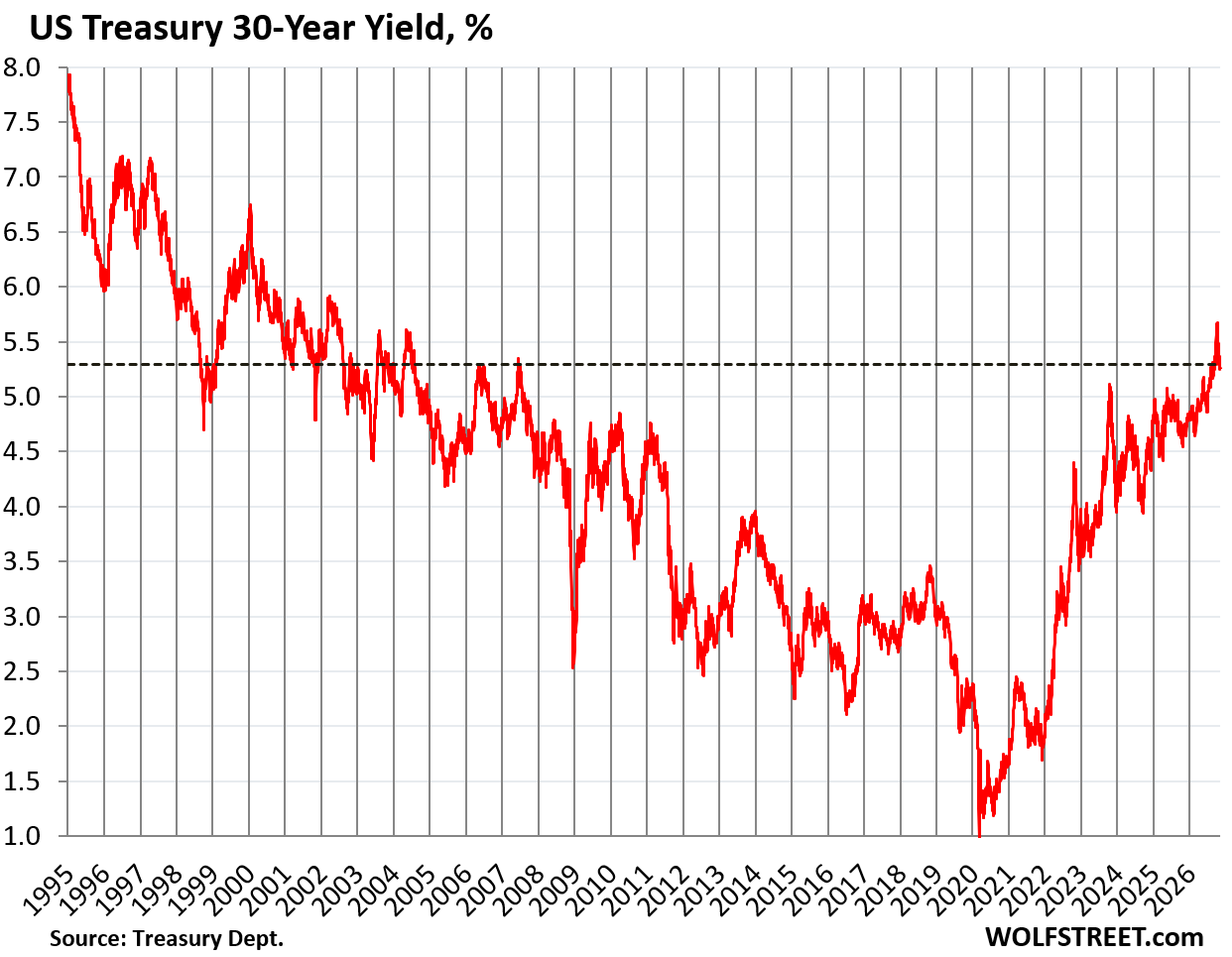
The worrisome sign, Haggith wrote, appears to have arrived in the headlines. Charts accompanying the coverage showed the short-lived rally — the final downstroke at the end of the line — before yields turned back up: an illustration of the common pattern that there are no straight lines to anywhere in economics, at least not for long. The bond rally did not get far before inflation spun it around, even with money still ebbing out of stocks. A 10-year yield heading higher from there, Richter had said, would also be another bad sign for the bond market. "So, the bad signs are all back," Haggith observed at The Daily Doom.
He counseled patience before declaring victory on the rebound, however. It remains to be seen whether yields, having tested their return higher, climb further this week — especially when producer price inflation is reported again. The producer price index measures the prices domestic producers receive before goods reach consumers, which is why market watchers treat it as an early read on cost pressures building upstream of consumer prices. In the meantime, he expected the market to tread water while awaiting that release; the market was closed for Veterans Day.
A hot print — with a missing annual rate
Richter followed up with a second Wolf Street article on the market's reaction to the report: "The 10-year Treasury yield spiked by about 12 basis points to 5.0% at the moment, upon the release of the hot CPI data this morning which showed that inflation has seeped deeply into the economy, especially non-housing services, but also food, core goods, and still energy." (A basis point is one-hundredth of a percentage point.) A chart of recent hourly moves captured the spike at the moment the inflation report came out.
One peculiarity of the coverage stood out to Haggith: CNBC's inflation article mentioned only the smaller monthly number and said nothing about the annual inflation rate, which is usually the focus. He admitted to wondering, mischievously, whether the annual number was simply too bad to publish. The actual reason was procedural: the Bureau of Labor Statistics (BLS), the agency that compiles the CPI each month, did not estimate a yearly rate in its October inflation report at all. The government shutdown last year prevented the bureau from collecting sufficient data in October 2025, so there is no comparable base-period figure to use. The report did, however, include annual figures for some individual items where data collection was possible.
To reconstruct the missing baseline, Richter applied a standard solution: he averaged the mean annual rate from the month before the missing month with the mean from the month that followed it, establishing a benchmark. Off that benchmark, he calculated the current year-over-year "all items" increase at 4.0%. "And that's hot," as Haggith put it — double the Federal Reserve's 2% target, the central bank's long-run inflation goal.
Food and electricity stand out
Food — the category that, as Haggith noted, hits home for everyone — looked a little worse still. Food costs accelerated 0.5% for the month, pushed higher by increases of 1% for snacks, 0.9% for beef, and 0.5% for meats, poultry, fish and eggs. Those are big numbers for one-month increases.
Electricity prices rose 0.9%, which the column flags as a potential complication of the AI story, given the technology's growing demand for power.
Despite recently moderating gasoline prices, Fed officials have expressed concern that the impacts of the Iran war and President Donald Trump's tariffs are becoming embedded in the economy. Inflation has been running above the Fed's 2% target for roughly five and a half years. For Haggith, that stretch shows how serious inflation becomes once it gets out of control — and how hard it is to get the inflation genie back in the bottle.
Fed officials: 'Distressing' and 'going the wrong way'
The report drew pointed comments from regional Fed presidents. "It's another distressing report, borderline disturbing," Chicago Federal Reserve President Austan Goolsbee told PBS News Hour. He said the impact of tariffs on prices should have faded by now, yet it still continues. "Perhaps the most troubling part is that services inflation is not coming down, and is probably not mostly driven by oil prices or tariffs or things that might be transitory," Goolsbee noted.
Haggith greets the return of the word "transitory" with skepticism — the framing, he argues, that contributed to the current predicament in the first place — though he concedes there is not much the Fed can do about tariffs and war.
Philadelphia Fed President Anna Paulson was blunter about the direction of travel: "We must get inflation back down to target, and it's going the wrong way at this point." She believes "further gradual tightening seems appropriate" for now, as "inflation pressures are still very much with us," and said tariffs, energy and AI have all been pushing prices up. "Tariffs look like they're fading. Energy supply and AI demand pressures are harder to call. What matters for monetary policy is where inflation ends up once the effects of these shocks run their course," she said.
The new head of House Republicans
The column's second thread turns to Congress, where Rep. Jim Jordan was elected the next head of the House Republicans following the party's huge election losses. House party conferences choose their leaders by internal vote before each new Congress convenes, and the post carries the conference's legislative strategy and public messaging. In Haggith's assessment, the conference chose as its leader one of its most partisan and feistiest members — a decision he reads as a vote for two years of political combat heading into the next election rather than a change of course after the losses. He expects bitter, acrimonious battles that put party over country, and, in his view, bury corruption within Jordan's own party.
Jordan summarized the coming approach in a letter to colleagues: "I am battle-tested on the oversight front and I know the Democrats' playbook." To Haggith, the statement signals that things will remain all about party plays, notwithstanding an election that demanded otherwise. He calls the ascent remarkable for a member who has spent two decades in Congress and was once regarded as a conservative bomb-thrower.
The column also revisits Jordan's time as an assistant wrestling coach at Ohio State University (OSU). Former students brought forward allegations of sexual abuse by the team's doctor, Dr. Richard Strauss, who abused hundreds of men over decades according to an independent investigation; Strauss died in 2005. Jordan has repeatedly denied any knowledge of the abuse. In July 2018, a group of former wrestlers accused Jordan of failing to stop it, saying it was common knowledge. Haggith argues Jordan's response amounted to stonewalling, and cites the episode in support of his expectation that the coming two years will feature partisan "battle charades" with little to guide the nation toward a better path.
The Epstein report: closing the book?
That skepticism extends to the committee on which Jordan sits. A widely publicized Republican release of a report on the Epstein scandal — issued by the House Oversight and Government Reform Committee — purported to close the book on the panel's 15-month investigation into the late, convicted sex offender. Haggith's rejoinder: the book should finally be opened, not closed.
Rep. Robert Garcia (D-Calif.), the incoming Oversight Committee chair, decried the GOP report as "based on an incomplete investigation and zero public hearings," noting that the Justice Department "continues to illegally withhold over 2.5 million pages of documents." Democrats are now discussing recalling witnesses to testify under oath and issuing subpoenas — among the committee's core investigative tools — to major banks that helped finance Epstein's trafficking of young women and girls for years.
For Haggith, both parties pretend to fight for justice by attacking the other side while doing all they can to protect their own, which is why the Epstein inquiry has gone nowhere through years of stonewalling. In his telling, the oversight spectacle is designed to dominate attention rather than deliver accountability. He wonders whether the election will kick Democrats into gear hard enough to move the matter forward, and anticipates that plenty on both sides will argue for "getting on with the business of governing the country" — an argument he attributes to members who are either implicated in the files or allied with those who are.
About the author
David Haggith is the publisher and editor-in-chief of The Daily Doom, a non-partisan daily collection of the most consequential economic, social and political news of the times from multiple sources around the world, along with daily editorials. This column appeared on GoldSeek.

