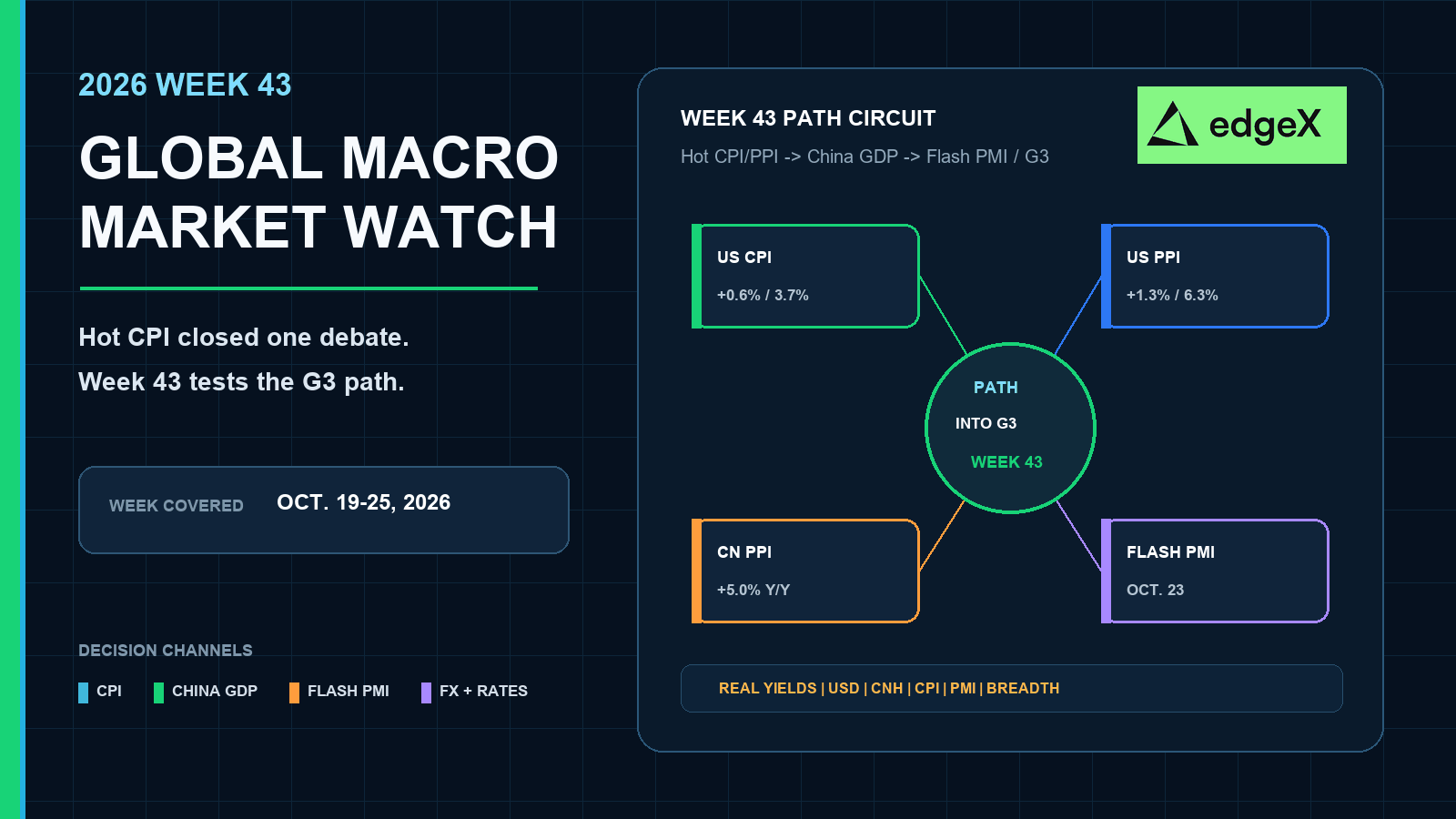
Hot CPI Closed One Debate. Week 43 Tests the Path Into G3
Key Takeaways
- •China's October 19 release package of Q3 GDP, industrial production, retail sales and fixed-asset investment provides the first test of whether domestic demand can absorb its recent producer-price surge.
- •Flash PMIs for Japan, the euro area, the United Kingdom and the United States on October 23 will show whether global demand breadth still validates sticky prices ahead of the G3 meetings.
- •Week 42 established a hot-price baseline, with U.S. CPI up 3.7% annually, U.S. PPI up 6.3%, and China's producer prices jumping 5.0% while consumer inflation stayed mild at 0.9%.
- •Europe combines weak industrial production with HICP inflation of 3.8%, while Japan's export and import prices remained firm even as its domestic CGPI cooled on the month.
- •If China's growth data and the PMI cluster weaken together, markets could revive the policy-freeze debate before the October 28–30 FOMC, ECB and BOJ meetings.
Quick Answer
Trade Week 43 as a growth-breadth confirmation week, not another CPI reprint. Keep duration and cyclicals light until China’s October 19 activity package and the October 23 flash PMIs show whether demand still validates the hot price impulse into the October 28–30 G3 cluster. If China growth holds and PMIs stay firm, price stickiness remains the base case. If both soften together, the market can reopen a freeze path - but only after breadth fails, not before.
Why Week 43 Is a Global Path Week
The price debate from incomplete Week 42 is already banked. Soft U.S. labor cooled the hiring scare. Then U.S. consumer and producer prices, China’s producer-price jump, Japan’s still-hot trade prices, and Europe’s soft industry beside sticky inflation cleared a global split: activity looks uneven, prices do not look soft. That is the setup. It is not the Week 43 job.
Week 43’s job is preparation for the path into late-October G3. Traders need a working map across four regions, not a China-only note and not a second U.S. inflation essay. China’s October 19 package is the first growth check. The October 23 flash PMI cluster then tests whether Japan, Europe, the U.K., and the United States resolve the same soft-activity / sticky-price tension in the same direction. The practical question is global: does demand breadth still support sticky prices into the FOMC, ECB, and BOJ meetings, or does growth soften enough across regions to reopen a freeze path?
Week 43 Global Macro Calendar
| Date | Region | Scheduled event | Why traders must prep it |
|---|---|---|---|
| Oct 19 | China | Q3 GDP; September IP, retail sales, fixed-asset investment | First test of demand against hot producer prices |
| Oct 19 | United Kingdom | Consumer Sentiment Index | Early household-confidence read into Europe’s PMI day |
| Oct 23 | Japan | Flash PMI | Checks whether export-price heat still has activity behind it |
| Oct 23 | Euro area / Germany / France | Flash PMI | Tests whether soft industry is stabilizing or still sinking |
| Oct 23 | United Kingdom | Flash PMI | Links U.K. demand into the Europe signal |
| Oct 23 | United States | Flash PMI | Tests whether soft labor and firm spending still coexist |
| Oct 28–30 | G3 adjacency | FOMC, ECB, BOJ; U.S. GDP/PCE on Oct 29 | Destination for the Week 43 path, not this week’s centerpiece |
United States: Prep Soft Labor Against Still-Open Demand
The decision question
For the United States, Week 43 is not about reprinting CPI. The consumer and producer price updates are already out. The live question is whether soft labor starts to hit demand before the FOMC, or whether spending breadth still coexists with sticky prices into the October 23 U.S. flash PMI.
How to score the U.S. leg
Prep the week around coexistence, not nostalgia for the CPI print. Retail has cooled from the prior month without collapsing, and secondary wraps show spending outside autos and gasoline slowing more than the headline. If the U.S. flash PMI holds up, sticky prices stay demand-supported. If the PMI rolls over while labor stays soft, the freeze debate returns even without a new CPI day. Soft labor alone is no longer enough cover for duration.
| U.S. Week 43 prep | What to watch | Confirm read | Fail read |
|---|---|---|---|
| Banked prices | CPI/PPI already hot | Sticky-price base case stays live | Only fades if growth breadth fails |
| Demand backdrop | Retail still open after cooler control signal | Spending can coexist with soft labor | Fuel costs start crowding out demand |
| Oct 23 U.S. flash PMI | Activity vs soft payrolls | Coexistence holds into FOMC | Soft labor starts hitting output |
Europe and the U.K.: Prep Soft Factories Against Sticky Inflation
The decision question
Europe enters Week 43 from the opposite side of the same split. Industrial production has been soft, with weakness concentrated in household goods rather than a uniform shutdown. At the same time, euro-area inflation remains sticky enough that soft activity has not delivered an easy disinflation story. The U.K. consumer-sentiment print on October 19 and the Europe/U.K. flash PMIs on October 23 test whether that mix is stabilizing.
How to score the Europe leg
Prep Europe as a breadth and composition problem. Capital goods have held up better than non-durable consumer goods, and country performance is uneven. One soft national PMI is not enough to call the continent broken; one firm print is not enough to call inflation pressure dead. If Europe’s PMI cluster stabilizes, the ECB path stays constrained by prices even with soft industry. If PMIs roll over again, Europe becomes the clearest soft-activity branch of the Week 43 mix.
| Europe / U.K. prep | What to watch | Confirm read | Fail read |
|---|---|---|---|
| Banked setup | Soft IP beside sticky HICP | Same global split as the U.S. | Soft activity still not buying disinflation |
| Oct 19 U.K. sentiment | Household confidence bridge | Demand not collapsing into PMI day | Confidence softens before Europe PMIs |
| Oct 23 Europe / U.K. PMIs | Factory stabilization vs another downside leg | Soft industry stops getting worse | Household-goods weakness spreads |
Japan: Prep Hot Trade Prices Against Activity
The decision question
Japan’s Week 43 prep starts from trade prices, not from a soft domestic PPI headline. Domestic CGPI cooled on the month, but export and import prices stayed firm enough to keep the late-October BOJ meeting live. The October 23 Japan flash PMI has to show whether that external price heat still has activity behind it.
How to score the Japan leg
Do not treat a softer domestic PPI as the whole Japan story. Soft food and fuel inputs explain much of the monthly CGPI relief, while export prices kept the external channel hot. If Japan’s flash PMI holds, trade-price persistence still has activity behind it into the BOJ window. If it slips, Japan becomes an early warning that hot trade prices are outrunning demand. Because Japan prints first on October 23, a weak open can color Europe and U.S. PMI reception before those releases hit.
| Japan Week 43 prep | What to watch | Confirm read | Fail read |
|---|---|---|---|
| Banked CGPI mix | Domestic cooling, hot trade prices | BOJ window stays live | Soft domestic PPI alone does not settle it |
| Export-linked activity | Electronics and trade impulse | Activity validates external price heat | Trade prices rise into weakening demand |
| Oct 23 Japan flash PMI | First Asia breadth check | Sets a firm tone for the PMI day | Soft open hits global cyclical beta early |
China: Prep Growth Against Hot Producer Prices
The decision question
China is one major Week 43 lever, not the whole article. The market already knows consumer inflation stayed mild while producer prices jumped. October 19 answers whether domestic demand can live with that producer impulse.
How to score the China package
Score the mix, not one GDP line. Q3 growth, September industrial production, retail sales, and fixed-asset investment together say whether the producer-price shock is landing on an economy that is still moving. A firm package supports industrial-margin pressure, CNH sensitivity, and commodity demand into the PMI day; a soft package says the same PPI print is more supply-shock theater than demand confirmation. China’s read also sets the handoff into Europe and the United States.
| China Oct 19 prep | What to watch | Bull-path read | Bear-path read |
|---|---|---|---|
| Q3 GDP | Growth still absorbing producer heat? | Demand validates sticky prices | Soft landing under hot PPI |
| September IP | Factory momentum vs margins squeeze | Industry still turning | Output buckling under costs |
| Retail / FAI | Household and investment follow-through | Growth breadth intact | Domestic demand fading into G3 |
Positioning Prep Into Late-October G3
Week 43 is not the meeting week. It is the week that scores the global path into the meetings. That means positioning should stay contingent until China and the multi-region PMI cluster print.
If China and PMI breadth confirm demand, sticky prices stay live: front-end yields and the dollar supported, duration-heavy growth vulnerable, oil and industrial metals bid. If both soften, the freeze debate returns and risk should de-lever before the statements. The mixed case is harder: firm China with soft Western PMIs supports commodities while duration stays jumpy; soft China with firm U.S. PMIs puts the burden back on domestic demand. Secondary FedWatch color around the cutoff still left a meaningful chance of an October 28 hike and a high chance of at least one more move by year-end. That is market color, not a primary lock, but it explains why the global growth checks matter first.
| Week 43 mix | Crypto | Equities | Commodities | FX and rates |
|---|---|---|---|---|
| Hot prices + firm China/PMIs | Favor BTC/ETH beta only on dips; fade pure liquidity trades | Prefer quality balance sheets over duration-heavy growth | Keep oil/industrial metals supported; watch refining cracks | USD and front-end yields stay bid; curve struggles to bull-steepen |
| Hot prices + soft China/PMIs | Risk-off first; delever beta until breadth stabilizes | Rotate toward defensives and cash-flow compounders | Energy can stay firm even as cyclicals wobble | Supportive for quality USD; hurts EM and high-beta FX |
| Soft prices + soft growth | Policy-relief bid becomes available again | Duration and growth can catch a bid | Metals split: gold up, industrial soft | Front-end yields fall; USD softens selectively |
| Soft prices + firm growth | Best risk-on mix if confirmed | Broad risk appetite improves | Balanced commodity bid | Bear-flattening pressure eases |
What Would Confirm the Week 43 Signal?
Week 43 confirms a sticky-price path into G3 if three things line up: China’s October 19 package shows growth holding against producer-price heat; the October 23 flash PMI cluster keeps the United States and euro area above stagnation without Japan losing export-linked momentum; and market pricing stops treating soft payrolls as freeze cover once global growth breadth stays intact. The path fails if China activity undershoots hard and flash PMIs roll over together. Then hot September prices become a lagging shock rather than a live demand story, and the October 28–30 meetings reopen the freeze debate.
Week 42 Review: Soft Labor Met Hotter Prices
Week 42 is still incomplete at the October 16 cutoff, but the decisive sequence is already on the tape. Soft labor had reduced one upside risk to policy. Then the global price complex raised the other. That is the setup Week 43 inherits. It is not the Week 43 forecast itself.
The week opened in Asia with Japan’s CGPI. Domestic producer prices cooled on the month, which looked like relief at first glance. Trade prices did not cooperate. Export and import prices stayed firm enough to keep the late-October BOJ meeting live, so Japan entered the rest of the week as an external-price story rather than a soft-pipeline story.
October 14 then delivered the core global inflation package. U.S. CPI reaccelerated, with energy doing the loud work while core and shelter refused to give a clean pass. The same day, China printed mild consumer inflation beside a hard producer-price jump. That split mattered immediately: China was not exporting a household CPI scare, but it also stopped looking like an easy source of producer-price relief.
October 15 completed the confirmation set. U.S. retail sales held up enough to keep the demand channel open against soft payrolls. U.S. PPI surged and broadened the price impulse beyond the consumer shelf. Euro-area industrial production slipped again, with weakness concentrated in household goods while inflation stayed sticky enough that soft factories did not buy an easy disinflation narrative.
Put together, the causal channel is clear. Soft labor had lowered one policy risk. Week 42’s price complex raised the other across regions. Energy led in the United States, core did not collapse, China’s producer side heated up, Japan’s trade prices stayed firm, and Europe kept soft industry beside sticky inflation. Markets can still argue about how fast the energy shock fades. They cannot argue that the week cleared the global inflation debate to the soft side.
The unfinished October 16–18 items—euro-area CPI final details, U.S. trade prices, and industrial production—can refine the story. They are unlikely to reverse it before the October 19–23 growth tests. That is why this review concludes the big headlines without pretending Week 42 has already closed, and why Week 43 has to move from price confirmation to demand-breadth confirmation.
| Banked Week 42 setup | Evidence | What Week 43 inherits |
|---|---|---|
| U.S. CPI | +0.6% / +3.7%; gasoline +9.1%; core +0.3%; shelter +0.4% | Price scare already confirmed |
| U.S. PPI | +1.3% / +6.3%; goods +2.6%; upstream still hot | Pass-through risk still live |
| U.S. demand | Retail +0.8%; soft payrolls banked | Demand open, but fuel may crowd out |
| China split | CPI +0.9%; PPI +5.0%; purchasing +6.9% | Mild CPI, no producer-price relief |
| Japan / Europe | CGPI cooled m/m but trade prices hot; EA IP soft beside HICP 3.8% | Same global split outside the U.S. |
Trade with an Edge
In fast-moving markets, execution matters just as much as direction. That's why more traders are turning to decentralized venues like edgeX for perpetuals and spot trading.
Unlike traditional centralized platforms, edgeX is built around self-custody, meaning you keep control of your assets and authorize fund movements yourself. For active traders, that offers a meaningful advantage: market access without handing custody to an exchange.
edgeX also combines the core benefits of DeFi with a trading experience designed for serious execution. The platform emphasizes deep liquidity, high-speed order matching, and low-slippage performance, helping traders stay responsive during volatile conditions. With support for high leverage, it gives experienced market participants more flexibility in how they express macro views and manage risk.
Beyond execution, decentralized trading infrastructure can offer structural advantages: greater transparency, on-chain verification, and reduced dependence on centralized intermediaries. For traders who want performance without giving up control, that model is increasingly compelling.
edgeX is built for that balance: bringing together a professional trading experience with the core principles of decentralized markets.
Traders looking to explore a more capital-efficient, self-custodial way to trade can take a closer look at edgeX.
Frequently Asked Questions
What should traders prepare for in Week 43?
A global path into G3: China’s October 19 GDP/activity package, then the October 23 flash PMI cluster across Japan, Europe, the U.K., and the United States. Those prints score whether demand breadth still supports sticky prices into the October 28–30 meetings.
Is Week 43 another inflation week?
No. The major U.S. CPI and PPI updates are already out. Week 43 is a global path-prep week. The forecast work is multi-region growth breadth, not another CPI reprint.
Why review Week 42 if the week is not over?
Because the decisive Week 42 price prints are the setup, not the forecast. Soft labor met hotter prices across the U.S., China, Japan, and Europe. Week 43 has to test whether demand still validates that impulse. Remaining October 16–18 items are unfinished adjacency.
What is the single most important Week 43 print?
China’s October 19 package is first because it tests demand against a hot producer-price impulse. The October 23 flash PMI cluster is the second necessary confirmation across Japan, Europe, the U.K., and the United States.
How should traders treat the October 28–30 meetings this week?
As the destination, not the main event. Week 43’s job is to score the global path into those meetings. Do not front-run the G3 statements with Week 42 price data alone.

