Charles Hoskinson Says Quantum Computing Threat Could Challenge Bitcoin’s Dominance
Key Takeaways
- •Hoskinson said Bitcoin’s difficulty in making major changes could become a weakness if quantum computing threatens its cryptographic foundations.
- •Bitcoin developers are examining BIP-361 and other post-quantum proposals, including new address formats, hybrid signatures, and recovery mechanisms.
- •Cardano’s post-Plomin governance system lets ADA holders vote directly or through DReps, with a constitutional committee and stake pool operators also involved.
- •Cardano has not migrated to quantum-resistant infrastructure, and recent governance disputes show that formal voting does not eliminate the need for broad agreement.
- •A Bitcoin post-quantum transition would require large-scale coordination to move funds without causing a network split or conflicting ownership rules.
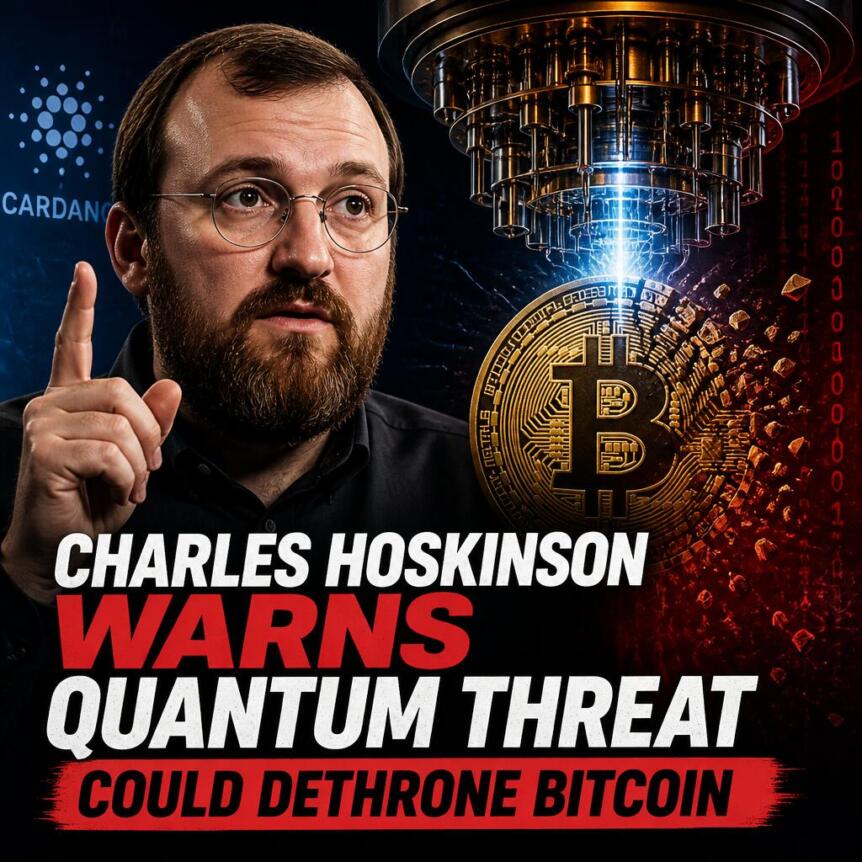
Cardano co-founder Charles Hoskinson has warned that Bitcoin could risk losing its position as the leading cryptocurrency if its governance process and community cannot coordinate an effective response to the threat posed by quantum computing.
Bitcoin developers are already examining post-quantum approaches, including BIP 361, a proposal that would move the network away from ECDSA and Schnorr signatures after a post-quantum system is chosen. The issue is not that today’s quantum computers are known to be capable of breaking Bitcoin’s signatures, but that blockchains often need years to standardize, implement, and coordinate major cryptographic migrations across wallets, exchanges, miners, custodians, and users.
Hoskinson Says Bitcoin Is “Frozen in Time”
Hoskinson made the comments during an interview with The Starting Block, where he described Bitcoin as being “stuck in time” because any major changes to the network require broad agreement among users, miners, node operators, developers, and other stakeholders.
According to Hoskinson, frustration with Bitcoin’s rigidity and limited ability to adapt was one of the factors that led to the creation of Ethereum. Hoskinson was one of Ethereum’s original co-founders, alongside Vitalik Buterin. During the interview, he said, “The issue with Bitcoin is it’s frozen in time. It’s very difficult to change anything.”
Bitcoin relies on elliptic-curve cryptography to prove ownership of funds. In theory, sufficiently advanced quantum computers could derive private keys from public keys and authorize transactions without the owner’s knowledge or consent. Hoskinson said that this risk could become a significant challenge for Bitcoin and its $1.3 trillion market capitalization if the network is unable to adapt its governance process while preserving the features that give Bitcoin its value.
“What made Bitcoin so strong is it survived external threats … including the loss of its founder. Quantum computers are yet another threat … if Bitcoin’s governance is such that it’s impossible actually to make meaningful progress, or they compromise the core reason to use Bitcoin, I don’t think Bitcoin’s going to stay the number one cryptocurrency,” Hoskinson said.
Cardano’s Governance Model
Hoskinson argued that Cardano’s formal on-chain governance structure and its capacity to approve protocol upgrades leave it better positioned to respond to technical threats such as quantum computing.
“Cardano is, in many ways, a spiritual successor [to Bitcoin]. It reflects correcting a lot of things that I think that Satoshi couldn’t get around to because of expertise or time but was directionally moving there,” he said.
Cardano moved to full community governance after the Plomin hard fork in January 2025. Under that system, ADA token holders can vote directly or delegate their votes to representatives known as DReps. A constitutional committee and stake pool operators also take part in major decisions.
The governance framework allows Cardano to approve hard forks and treasury decisions on-chain. Hoskinson said Cardano could use this process to vote on a migration away from infrastructure that may be vulnerable to quantum computing.
Hoskinson also said Cardano is preparing for its largest upgrade, which he said would make the network “60-times faster.”
Governance Challenges Remain
Cardano has not yet undertaken or completed a migration to quantum-resistant infrastructure. Such a process would require its governance system to assess technical designs, approve funding, and coordinate users, developers, and service providers.
The network’s governance process has also seen disputes. Cardano delegates recently rejected and challenged several proposals connected to Hoskinson and Input Output, including a proposal to research Leios scaling and quantum-resistant cryptography. Those disputes underscore that formal voting mechanisms can clarify how decisions are made, but they do not remove the need for broad technical and social agreement on high-risk protocol changes.
Bitcoin Developers Consider Post-Quantum Proposals
Bitcoin’s governance model allows developers to propose code changes, but users and node operators ultimately decide whether to run the software. Miners, exchanges, and wallet providers also play an important role in shaping implementation and adoption.
That structure helps Bitcoin avoid frequent changes, but it can make rapid coordination difficult. The Bitcoin community is tracking BIP-361, which proposes phasing out legacy ECDSA and Schnorr signatures as part of an effort to protect the network from quantum-related risks.
Other proposals are also being discussed, including approaches involving new address formats, hybrid signatures, and recovery paths. Any post-quantum transition would require wallets, exchanges, custodians, and dormant holders to migrate funds without splitting the network or creating conflicting ownership rules.

