Hong Kong Passes Crypto Tax Reporting Law Requiring Data Collection From 2027
Key Takeaways
- •Hong Kong's Legislative Council passed legislation on Nov. 4 adopting the OECD's Crypto-Asset Reporting Framework to bring digital assets into standardized international tax disclosure.
- •Covered crypto service providers must collect customer identifying details and transaction information beginning January 1, 2027, and retain records for six years after the relevant return deadline.
- •Hong Kong's Inland Revenue Department will start exchanging crypto-related tax records with overseas authorities in 2028 through reciprocal arrangements with partners meeting confidentiality and data security requirements.
- •Amendments to the Common Reporting Standard take effect in 2028, with exchanges under the updated standard beginning in 2029.
- •The law imposes disclosure obligations only and does not introduce a separate cryptocurrency tax rate.
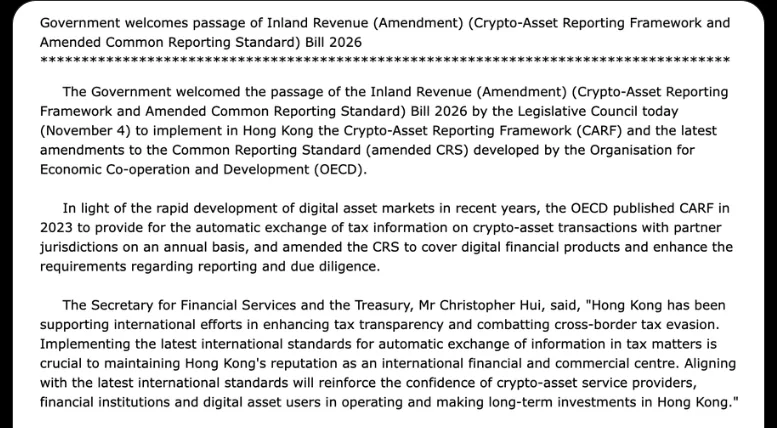
Hong Kong's Legislative Council passed new crypto tax reporting legislation on Nov. 4, extending international disclosure rules to digital assets. The law adopts the Organisation for Economic Co-operation and Development's (OECD) Crypto-Asset Reporting Framework (CARF) and requires covered crypto service providers to collect customer and transaction information from 2027. Under the timetable, the Inland Revenue Department will begin exchanging qualifying records with overseas tax authorities in 2028. Lawmakers also approved amendments to the Common Reporting Standard (CRS), which take effect in 2028, with exchanges under the updated standard starting in 2029.
New Law Sets Collection Rules for 2027
The crypto tax legislation adopts CARF, which the OECD developed to help tax authorities obtain information about cryptocurrency activity involving residents of different jurisdictions. Published by the OECD in October 2022, the framework brings digital asset transactions into the same standardized automatic-exchange system long used for traditional financial account data, and dozens of jurisdictions have committed to adopting it. Hong Kong will use the framework to establish common reporting requirements for businesses that handle crypto transactions on customers' behalf, with those duties applying from January 1, 2027.
The government introduced the bill after consulting financial institutions, professional groups and digital asset businesses between December 2025 and February 2026. Officials published the legislation in May and presented it to the Legislative Council in June.
Secretary for Financial Services and the Treasury Christopher Hui said the changes support international efforts to address cross-border tax evasion. The law establishes disclosure duties but does not introduce a separate cryptocurrency tax rate.
Exchanges and Brokers Must Collect Customer Details
The requirements cover service providers that arrange exchanges between digital assets or convert cryptocurrencies into traditional currencies. Covered businesses include trading platforms, brokers, dealers and certain cryptocurrency ATM operators. Companies fall within scope when their operations meet Hong Kong's reporting connection criteria, which include local tax residence, management presence or business presence in the city.
Affected providers must obtain customers' identifying details, including names, addresses, tax residences and taxpayer identification numbers. They must also gather relevant transaction information and verify customer declarations under due diligence procedures. The framework covers cryptocurrency purchases, sales, crypto-to-crypto exchanges and certain transfers to external wallets, and companies must retain records for six years after the relevant return deadline.
CARF covers transferable digital assets that people can use for payments or investment, including qualifying non-fungible tokens. The framework excludes central bank digital currencies, specified electronic money products and crypto assets that cannot serve payment or investment purposes.
The reporting duties arrive as Hong Kong continues formalizing its digital asset sector. Centralized virtual asset trading platforms have been required to hold Securities and Futures Commission licenses since June 2023, and a licensing regime for stablecoin issuers took effect in August 2025. The new law layers cross-border tax transparency obligations onto that regulatory structure for businesses with a Hong Kong reporting connection, and covered providers will need collection and verification processes in place before duties begin on January 1, 2027 — weeks after the law's passage.
Overseas Data Sharing Starts in 2028
Hong Kong's Inland Revenue Department will receive the information from covered service providers and exchange qualifying records with partner tax authorities annually. The first international exchanges under CARF will begin in 2028, following the collection of information from 2027. Authorities will use customers' tax residence information to determine which jurisdictions should receive relevant records.
Hong Kong will share information only through reciprocal arrangements with eligible partners that meet confidentiality and data security requirements. The reporting system will give participating tax authorities access to standardized transaction records for their residents, along with annual totals for covered transaction types and the quantities of crypto assets involved.
Amended Financial Reporting Rules Begin in 2028
Lawmakers also adopted amendments to the Common Reporting Standard, which governs international exchanges of financial account information. The revised rules will take effect in 2028, while exchanges under the updated standard will start in 2029. Hong Kong has used the existing standard to exchange information with partner jurisdictions since 2018.
The amended rules extend coverage to certain central bank digital currencies, electronic money products and financial instruments linked to crypto assets. Financial institutions must provide additional details about account holders, controlling persons and relevant accounts.
The Inland Revenue Department plans to issue further implementation guidance and technical reporting specifications for affected businesses. Officials have established a dedicated team to answer industry questions on compliance and provide technical support.
Source: The Market Periodical | Official announcement: Hong Kong Government press release.

