240 UK Taxpayers Reported Over £1 Million in Crypto Gains as HMRC Prepares to Receive Provider Data
Key Takeaways
- •The 240 largest crypto gainers in the HMRC dataset averaged close to £3 million each, while the remaining individuals averaged about £38,000.
- •HMRC treats sales, swaps, spending crypto on goods or services, and some gifts as disposals that can create taxable gains or losses.
- •Cryptoassets are generally subject to Capital Gains Tax using Section 104 pooling, same-day and 30-day matching rules, and allowable costs such as fees and certain professional expenses.
- •CARF data collection in the UK began on January 1, 2026, with the first provider reporting deadline expected on May 31, 2027.
- •HMRC plans no-gain, no-loss treatment for certain qualifying DeFi loans and liquidity-pool arrangements from April 6, 2027.
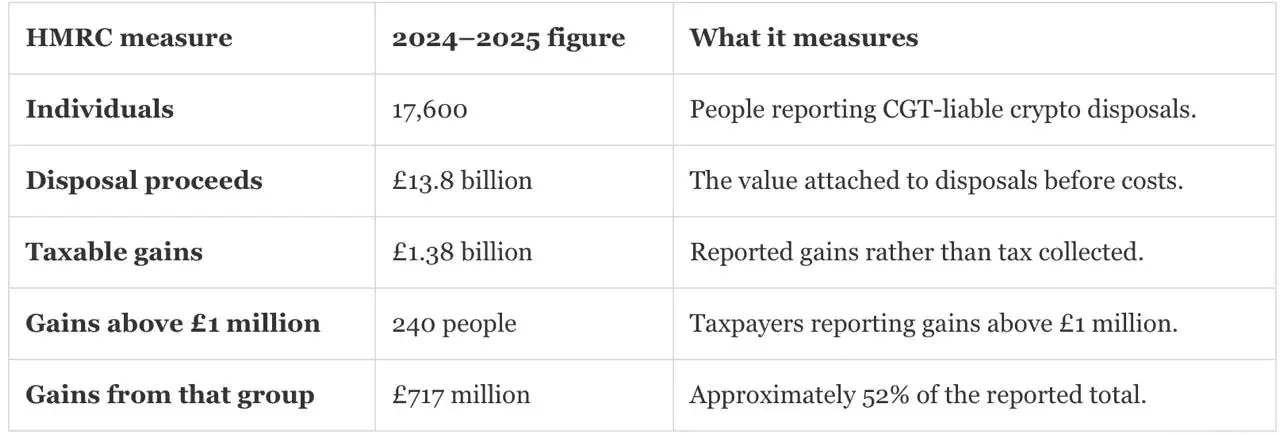
Newly released HMRC statistics show that a small cluster of UK taxpayers accounted for roughly half of all cryptoasset gains declared in Self Assessment, while a far-reaching change to data collection begins in 2027, when the tax authority starts receiving customer and transaction information directly from cryptoasset service providers.
The 240 taxpayers at the top of the dataset made up approximately 1.4% of the individuals covered, yet generated around 52% of total gains. Swapping one cryptocurrency for another can produce a taxable gain even before any pounds reach a bank account, and the Crypto-Asset Reporting Framework (CARF) will hand HMRC additional records against which such transactions can be checked.
This article addresses individual UK taxpayers. Separate rules may apply to companies, trustees, people trading as a business and anyone whose tax residence lies outside the UK.
Half of the reported gains came from a small group
The figures cover individuals who declared Capital Gains Tax-liable cryptoasset disposals in the dedicated section of their 2024–2025 Self Assessment returns.
According to HMRC’s rounded totals, the 240 largest gainers averaged close to £3 million each. The other 17,360 individuals in the dataset averaged approximately £38,000. That skew explains why the £78,000 average across the full dataset does not describe a typical taxpayer.
The £13.8 billion in proceeds is a measure of disposal value, not profit and not tax due. Acquisition costs, qualifying expenses and capital losses all shape the eventual taxable figure. The dataset also omits crypto income reported elsewhere in the tax return as well as activity that was never declared.
The figures and their scope are set out in the official HMRC release.
A token swap can trigger Capital Gains Tax
Cryptoassets attract Capital Gains Tax because HMRC treats them as property rather than currency, which places each disposal inside the chargeable-assets framework that also governs shares and other investments. Within that framework, HMRC treats a disposal as considerably broader than a conventional sale. An individual can create a taxable gain or loss by:
- Selling cryptoassets for pounds or another fiat currency.
- Exchanging one type of cryptoasset for another.
- Using cryptoassets to pay for goods or services.
- Giving cryptoassets to another person, subject to exceptions covering transfers to a spouse, civil partner or qualifying charity.
How a crypto-to-crypto gain arises
Consider an investor who buys ETH for £2,000 and later swaps it for £3,500 of USDC. The ETH is worth £3,500 at the moment of disposal, producing a preliminary gain of £1,500 before allowable expenses and the applicable cost-matching rules.
The calculation relies on the sterling market value at the time of the exchange. Taking another token instead of pounds does not defer recognition of the ETH gain.
Stablecoin activity can multiply the records involved. Swapping Bitcoin for USDC disposes of the Bitcoin, and later spending or exchanging the USDC can constitute a further disposal. A fee settled in tokens must also be treated separately, because those tokens leave the owner.
The recordkeeping challenge is not confined to the UK. Our report on South Korea’s 2027 crypto tax shows how another major market likewise treats token-to-token swaps as taxable events, though its rates, allowances and loss rules differ from Britain’s.
Transfers of the same asset between wallets held under one person’s beneficial control are generally treated differently, since ownership does not change. That beneficial-ownership condition becomes important when assets move into custodial services, lending arrangements or decentralized protocols. HMRC defines the relevant transactions in its cryptoassets manual.
The purchase price may not be the taxable cost
The single-purchase ETH example illustrates the underlying principle, but real calculations are often more involved because HMRC generally places each token type in its own cost pool, known as the Section 104 pool.
Acquisitions add to a pool’s total cost, and each disposal removes a corresponding proportion. Distinct matching rules govern tokens acquired on the same day or within 30 days after a disposal, mirroring the identification rules long applied to share disposals and preventing taxpayers from choosing whichever purchase produces the smallest gain.
Allowable deductions can include the original sterling acquisition cost, transaction fees and certain professional or valuation expenses. Reported capital losses may reduce gains where the relevant conditions are met. HMRC publishes calculation and recordkeeping details in its guidance for individuals.
Crypto obtained through employment, self-employment, mining, staking or lending may fall under Income Tax first and, in some cases, National Insurance. A later rise in value can produce a capital gain when those tokens are eventually disposed of.
For the 2026-2027 tax year, the individual Capital Gains Tax annual exempt amount is £3,000. Individual rates are generally 18% or 24%, with the applicable rate determined by taxable income, other gains and how much of the taxable gain falls within the available basic-rate band.
Planned DeFi change: an HMRC policy paper establishes no-gain, no-loss treatment for certain qualifying cryptoasset loans and liquidity-pool arrangements from April 6, 2027. Before that date, users should apply the rules governing the tax year in which each transaction occurred and seek professional advice where beneficial ownership is unclear.
CARF hands HMRC provider-supplied records
The tax obligations described above predate the Crypto-Asset Reporting Framework. CARF was developed by the OECD and extends to cryptoassets the automatic information-exchange model already applied to cross-border bank accounts under the Common Reporting Standard, and a broad group of jurisdictions is adopting it alongside the UK. It widens the customer and transaction data available to HMRC:
- January 1, 2026: UK implementation and provider data collection began.
- May 31, 2027: the first UK provider reporting deadline is expected.
- September 30, 2027: the UK plans its first exchanges with participating foreign tax authorities.
CARF is one strand of a broader expansion of UK crypto oversight. Coindoo has separately examined how Britain’s incoming crypto rules interact with its banking-access problem, an issue shaped by financial-services and risk rules rather than tax reporting.
Service providers gather details such as a customer’s name, date of birth, address, country of residence and tax identification number. Their annual submissions also cover reportable cryptoasset activity.
The international framework extends to participating overseas providers. Data on a UK resident can pass from a foreign tax authority to HMRC, while the UK can send records concerning foreign residents back to their home jurisdictions.
Provider records capture only part of a taxpayer’s history. A platform may lack the acquisition cost from another exchange, activity conducted through separate wallets, previously reported losses, or the income information needed to establish the applicable rate. HMRC can use CARF data to flag discrepancies, but the taxpayer still produces the final calculation.
Further detail appears in HMRC’s CARF implementation policy.
The records UK crypto users should preserve
Exchange exports are a starting point. A complete calculation may require records from every platform and wallet used during the relevant period:
- Transaction exports from every exchange.
- Dates, quantities and token types.
- Sterling values at acquisition and disposal.
- Trading, network and platform fees.
- Wallet addresses and self-custody histories.
- Pooled costs before and after disposals.
- Mining, staking, lending and employment income.
- Evidence supporting transfers between personally controlled wallets.
HMRC states that qualifying income and gains for the 2025–2026 tax year must be reported through Self Assessment by January 31, 2027. Downloading records early lowers the risk of losing access if an exchange closes an account, restricts historical exports or stops operating.
Taxpayers who identify unpaid crypto tax from earlier years can use HMRC’s Cryptoasset Disclosure Service. Complicated histories involving DeFi, business activity, large gains or several jurisdictions may call for a UK-qualified tax professional.
The transaction matters before the withdrawal
The event to track is the disposal: a sale, swap, purchase or transfer of ownership. CARF will give HMRC more provider data for checking those events from 2027 onward, but accurate reporting will still rest on the taxpayer’s sterling valuations, pooled costs and complete transaction history. The dates to watch cluster in 2027: the January 31 Self Assessment deadline for 2025–2026, the start of no-gain, no-loss treatment for qualifying DeFi arrangements on April 6, the first UK provider reports on May 31 and the first exchanges with foreign tax authorities on September 30.
Methodology: The article uses HMRC’s August 27, 2026 release, its cryptoasset guidance and manuals, current Capital Gains Tax rates and allowances, and official CARF implementation documents. Calculations derived from the published statistics are approximate because HMRC rounds its figures.
This article provides general information and does not constitute tax, legal or financial advice. Tax treatment depends on individual circumstances and can change. Readers should consult HMRC guidance or a qualified UK tax professional where necessary.
Source: Coindoo
