HLB's Liver Cancer Drug Push Regains Momentum After First US FDA Approval
Key Takeaways
- •The FDA approved Lyrfigtu on Sept. 23 for previously treated advanced bile duct cancer with FGFR2 fusions or rearrangements, marking HLB's first US approval of a cancer drug.
- •HLB has failed three times—in May 2024, March 2025, and July 2025—to secure FDA approval for rivoceranib, an oral targeted therapy being developed with camrelizumab from Chinese partner Jiangsu Hengrui Pharmaceuticals as a first-line treatment for unresectable or metastatic hepatocellular carcinoma.
- •The rivoceranib-camrelizumab combination achieved a median overall survival of 23.8 months in a global phase 3 trial, but the clinical data alone did not win over FDA reviewers.
- •The FDA issued Voluntary Action Indicated classifications for both manufacturing facilities tied to the liver cancer therapy in July and earlier this month, removing a major obstacle to Elevar's planned resubmission of the new drug application.
- •HLB shares sank 30 percent to their daily low on the Kosdaq after each FDA rejection but jumped 30 percent to the daily high on Sept. 28 once the Lyrfigtu approval became known.
HLB's first US approval of a cancer drug has injected fresh momentum into the Korean developer's long-running bid to bring rivoceranib, a repeatedly delayed liver cancer therapy, to market, as it again seeks a green light from the US Food and Drug Administration following three failed attempts.
The FDA on Sept. 23 approved Lyrfigtu, a treatment developed by Elevar Therapeutics, HLB's US subsidiary, for patients with previously treated advanced bile duct cancer harboring FGFR2 fusions or rearrangements.
Beyond the approval itself, the milestone gave Elevar and HLB firsthand experience of navigating the FDA review process — an asset in a sector where outcomes, as HLB's own recent history shows, can hinge on inspection findings and documentation rather than clinical results alone. Meanwhile, recent inspections at two manufacturing facilities tied to rivoceranib have cleared a major hurdle standing in the way of a renewed application.
Rivoceranib, an oral targeted therapy, is being developed in combination with camrelizumab, an immunotherapy from Chinese partner Jiangsu Hengrui Pharmaceuticals, as a first-line treatment — meaning it would be used as an initial therapy — for unresectable or metastatic hepatocellular carcinoma, the most common form of liver cancer. The pending filing is a bid to add a second FDA-approved oncology product to the group's portfolio alongside Lyrfigtu.
The pairing delivered a median overall survival of 23.8 months in a global phase 3 trial, but the encouraging clinical data have not been sufficient to win over FDA reviewers. HLB has now fallen short three times in its quest to secure approval for the liver cancer drug.
The most recent rejection, in July, centered on deficiencies found during an inspection of a manufacturing facility linked to rivoceranib. In earlier reviews, the FDA raised manufacturing concerns involving camrelizumab, underscoring HLB's dependence on its Chinese partner to satisfy US regulatory standards.
The outlook has improved since then. In July, the FDA classified Hengrui's active pharmaceutical ingredient manufacturing facility as Voluntary Action Indicated, or VAI. Earlier this month, the facility that produces the finished drug received the same designation.
A VAI classification means inspectors identified issues that warrant voluntary corrective action but did not recommend formal regulatory measures. The classifications remove a substantial source of uncertainty, though they do not guarantee approval or preclude further questions from the FDA — and they speak to the inspection deficiencies that derailed the July review.
"The VAI classification is the result of Jiangsu Hengrui Pharmaceuticals' all-in efforts to remove the issues from the on-site inspection," an HLB official said. "Elevar will soon finish the preparations for resubmitting the liver cancer drug's (new drug application) in close cooperation with Jiangsu Hengrui Pharmaceuticals and thoroughly deal with the FDA's review."
The resubmission is the next test. Rivoceranib's regulatory setbacks have repeatedly hammered HLB shares. The stock sank 30 percent to its daily low on the Kosdaq after each of the FDA rejections — first in May 2024, then in March 2025 and again in July this year.
But once Lyrfigtu's approval became known, HLB shares jumped 30 percent to the daily high on Sept. 28, reflecting renewed confidence in the company's US drug-development capabilities.
"Elevar has now taken a cancer drug through the FDA application and review process to approval," said an official at a Korean pharmaceutical firm. "That experience could help the company manage regulatory submissions and respond to FDA requests more effectively in future applications… but it does not mean rivoceranib will receive the same treatment, as the two drugs have different targets, indications and regulatory dossiers."
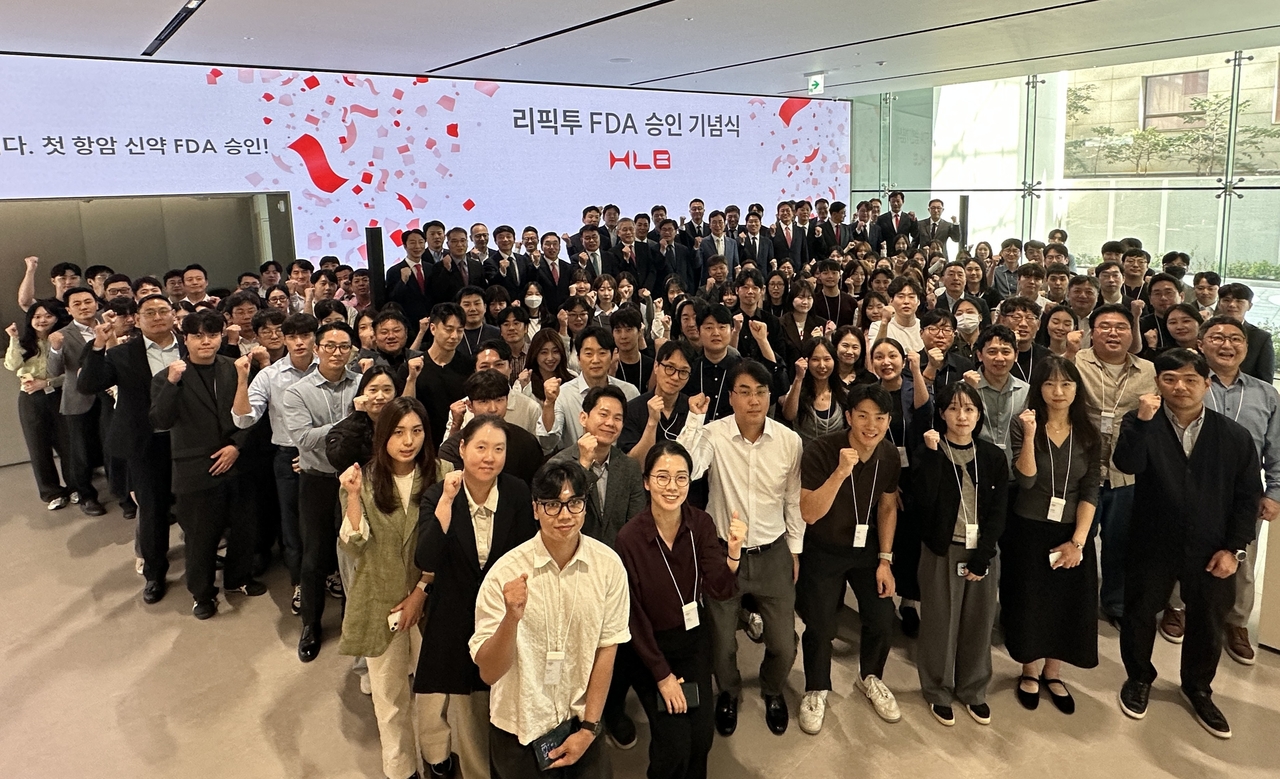
HLB last month held a celebration of the FDA's approval of Lyrfigtu at its office in Seoul, where HLB Group Chairman Jin Yang-gon framed the achievement as a turning point in the company's globalization.
"What we accomplished is not just a single milestone with a bile duct cancer drug but the foundation and capability to continuously produce new drug successes in the future," he said. "Starting with Lyrfigtu, we will sequentially deliver more achievements, including treatments for liver cancer, keratitis, and CAR-T therapies, to prove the value of HLB Group in the global market."

