Retired Lt. Gen. Mark Hertling Says Trump's UN Speech Amounted to a Public Admission of a War Crime
Key Takeaways
- •Retired Lt. Gen. Mark Hertling said Trump's UN General Assembly remarks referencing a 'war' and 'to the victor belong the spoils' could constitute a public admission of pillage, which is a war crime.
- •Hertling cited the 1907 Hague Regulations, the 1949 Geneva Conventions, the 1998 Rome Statute, and a 2005 International Court of Justice ruling in Congo v. Uganda as establishing that pillaging another nation's resources is prohibited under international law.
- •Hertling disputed Trump's claim that the U.S. and Venezuela together hold over 60 percent of the world's oil, saying the potential share applies to the Western Hemisphere, with roughly 65 billion barrels tied to a 100-year concession across 17 Venezuelan oil fields.
- •The Wall Street Journal and the U.S. Energy Information Administration have reported that major oil companies are hesitant to invest in Venezuela due to costly equipment needs, deteriorated infrastructure after years of sanctions, and a history of changing terms and expropriating assets.
- •Hertling emphasized that the statements were made publicly at the UN rather than in private, and argued that victory alone does not create a legal entitlement to Venezuelan oil without agreements signed by its government.
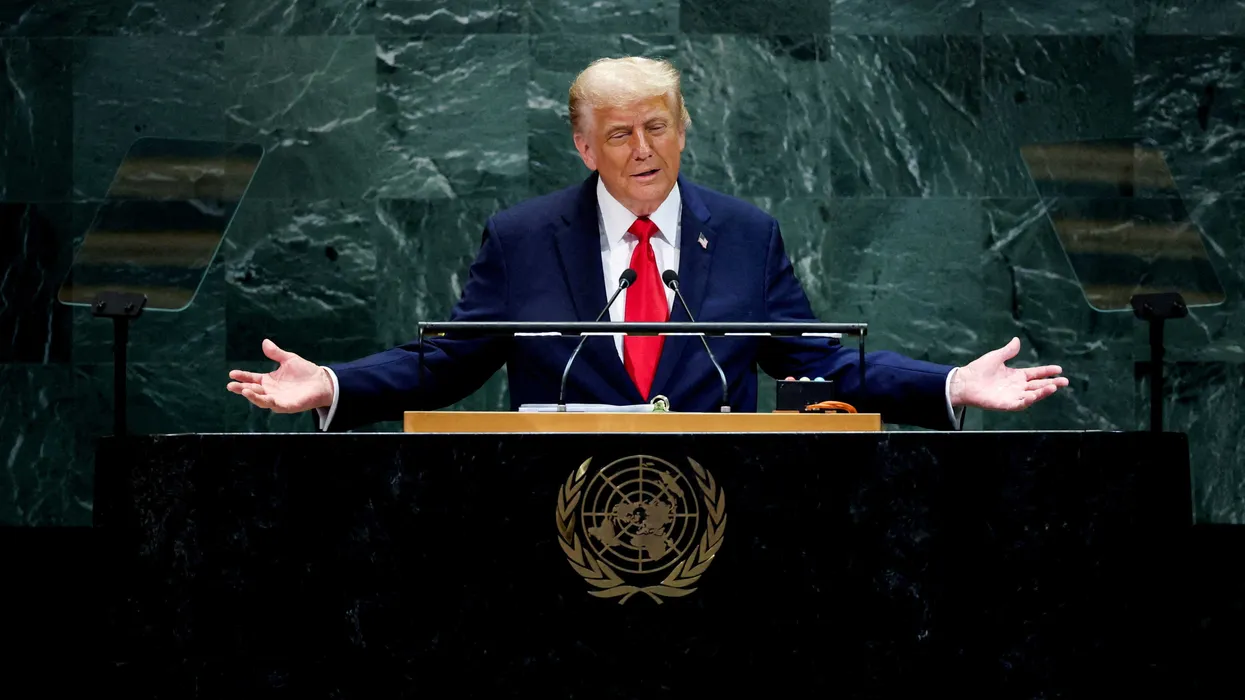
Retired Lt. Gen. Mark Hertling cautioned that President Donald Trump appears to have publicly confessed to a crime, pointing to remarks the president made during his address to the United Nations General Assembly, the annual forum where the body's member states gather and speak on the record.
Appearing on The Bulwark's "Command Post" podcast with host Ben Parker (video), Hertling examined Trump's UN speech, which Parker said would leave the two of them ready to "bash our heads against the wall."
At one point in the address, Trump declared that if Venezuela and the United States were combined, "we have more than 60 percent of the oil in the world. So, it's perhaps the biggest deal — it was a war — it was perhaps the biggest deal ever made. To the victor belong the spoils. You've all heard that."
"So, just to be clear, it was a war," Parker said, quoting Trump. "He just said it was a war. In how many different ways did he just admit to an international crime?"
Hertling answered that there were "several" issues, but said he wanted to focus first on the claim about the two countries holding 60 percent of the world's oil.
"I mean, we may hold close to — between the two countries — they may have the potential for 60 percent of the oil in the Western Hemisphere, but not the world," Hertling said. He added that the "65 billion barrels of oil that the president keeps talking about are in Venezuelan reserves that involve a 100-year concession for 17 oil fields. All of that stuff is underground, and there aren't a whole lot of oil companies rushing to the breach to say we want to pull that out the ground."
That caution is reflected in industry reporting. The Wall Street Journal reported earlier in September that "big oil" companies are "wary" of getting involved in Venezuela's oil patch. Production often requires costly equipment, and the country's oil infrastructure has deteriorated after years of U.S. sanctions. Venezuela's history of changing terms, expropriating assets, and political instability has also left companies concerned that they could invest billions and then lose control of projects or be unable to move and sell the oil, as the U.S. Energy Information Administration has explained. That gap between the speech's arithmetic and the industry's caution frames the legal argument Hertling went on to lay out.
"But Ben, I think you want to get to the to the victors go the spoils comment," Hertling said. "That is a war crime."
He cited the 1907 Hague Regulations — a cornerstone of the modern laws of war — quoting Article 33, which states that "pillage is prohibited." "Occupation of a nation does not simply make the conqueror owner of occupied property," Hertling read.
He then outlined the broader legal framework. Under the 1945 UN Charter, the international system is organized around sovereign equality, territorial integrity, and restrictions on the use of force. The 1949 Geneva Conventions, the core treaties of international humanitarian law, prohibit pillage in four different articles. A 1962 UN General Assembly resolution affirmed that peoples and nations possess permanent sovereignty over their natural resources, and the 1998 Rome Statute, the treaty that established the International Criminal Court, expressly identifies pillage as a war crime repeatedly. Hertling also pointed to a 2005 International Court of Justice decision in Congo v. Uganda, issued by the UN's principal judicial organ, which held a state internationally responsible for its armed forces' looting, plundering, and exploitation of another country's natural resources — a case, he noted, in which "people went to jail for that."
In Hertling's view, the legality of who controls Venezuelan oil "cannot be determined from Trump's rhetoric." "The Venezuelan government, unless they sign deals with providing oil for price, [it] cannot be pillaged or looted. Victory does not create a legal entitlement to another nation's oil," he said.
Parker observed, "It's several war crimes, and he just admitted it and he said we did it. And, ugh, God, I don't know, we're going to be talking about this for a long time."
Hertling closed by stressing where the remarks were made. "But — and here's the important part, Parker. The good news is he admitted it at the UN! I mean this wasn't just a press conference from his office. This was from the U.N.! It wasn't a secret tape someone has to get their hands on."
Source: Alternet

