Hemlo Mining Aims to Extend Ontario Gold Mine Life to 20 Years by Filling Mill Capacity
Key Takeaways
- •Hemlo Mining plans to invest $130 million this year in drilling, mine development, and new equipment to support a roughly 20-year extension of its Ontario gold mine.
- •Throughput targets call for increasing production to 4,800 tonnes per day by year-end 2025 and 6,000 tonnes per day by end of 2027, well below the mill's 10,000-tonne-per-day capacity.
- •The expansion strategy is a key test of Hemlo's acquisition of the 40-year-old mine from Barrick Mining in a deal valued at up to $1.09 billion.
- •The company's June resource estimate reported 4.8 million ounces of contained gold across 96.9 million measured and indicated tonnes grading 1.55 grams per tonne.
- •An updated mine plan expected in approximately 12 months will serve as a critical milestone for investors evaluating whether the Barrick acquisition can deliver Hemlo's targeted production profile.
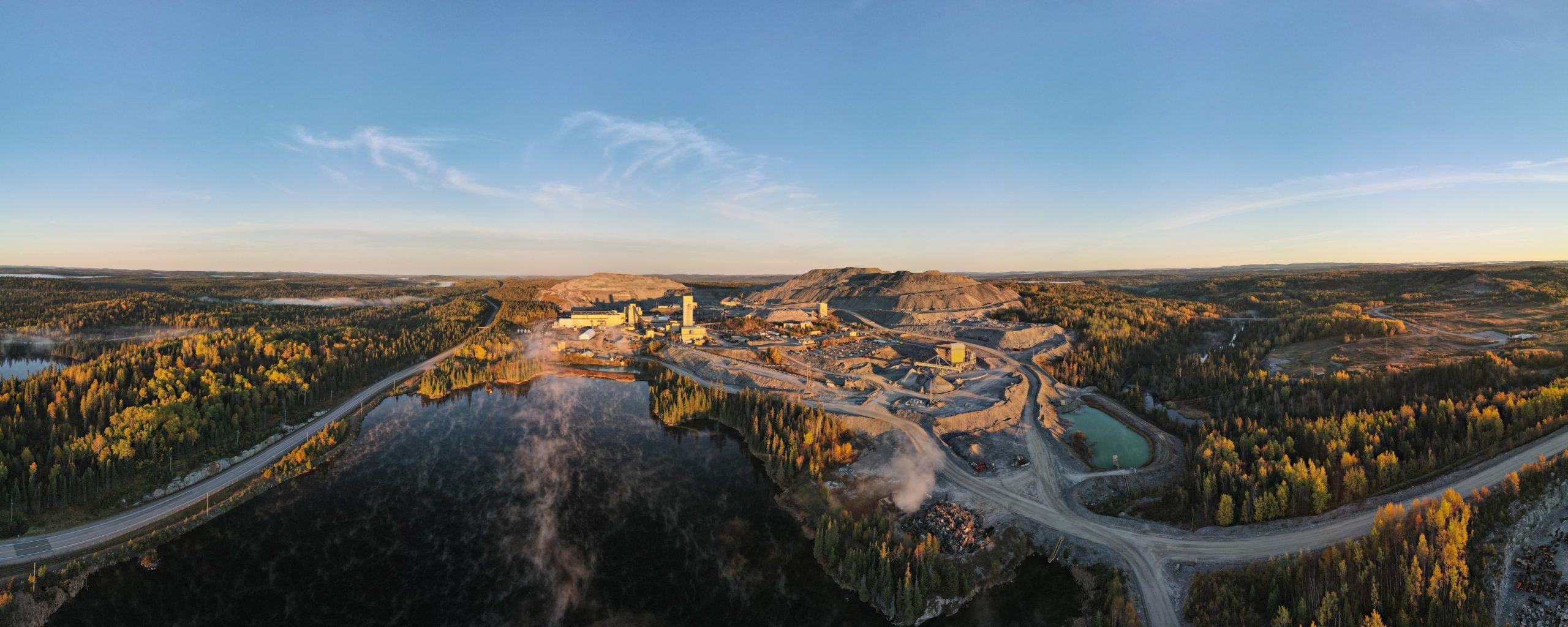
Hemlo Mining (TSX: HMMC; US-OTC: HMMCF) is targeting a roughly 20-year extension of its namesake gold mine in northwestern Ontario by increasing output and utilizing a mill currently operating at just 40% of its capacity.
The company plans to invest $130 million (C$183 million) this year across 130,000 metres of drilling, mine development, and new equipment at the operation, located approximately 800 km northwest of Toronto. The Hemlo gold camp, one of Canada's most historic gold-producing regions, has been mined continuously since the 1980s.
Throughput targets call for an increase to 4,800 tonnes per day by the end of this year and 6,000 tonnes per day by the end of 2027. The mill has the capacity to process up to 10,000 tonnes per day, according to Hemlo Executive Chair Jonathan Awde.
"Our strategy is quite simple: fill the mill. The geology's there," Awde told The Northern Miner's Western Editor, Henry Lazenby, during an interview at the Rule Symposium on Resource Investing in Boca Raton, Fla. "Our objective is to show how we can sustain something north of 6,000 tonnes per day for something close to two decades."
The strategy represents a key test of Hemlo's acquisition of the 40-year-old mine from Barrick Mining (TSX: ABX; NYSE: B), a deal valued at as much as $1.09 billion. Barrick, one of the world's largest gold producers, had operated the Hemlo complex for decades before divesting the asset. The transaction reflects a broader pattern of major gold producers spinning off mid-tier and legacy assets to focus on larger, lower-cost operations, while providing acquisition-hungry smaller companies with established infrastructure and known geology.
Increasing production toward 200,000 ounces of gold per year without constructing a new mill could allow Hemlo to spread fixed costs across a greater number of ounces, a lever that becomes especially meaningful given that building new processing facilities in remote Canadian jurisdictions can cost hundreds of millions and take years of permitting. The company's June resource estimate reported 96.9 million measured and indicated tonnes grading 1.55 grams of gold per tonne, containing 4.8 million ounces. This resource base provides the foundation for an updated mine plan expected in approximately 12 months, which will be a closely watched milestone for investors evaluating whether the Barrick acquisition can deliver the production profile Hemlo has outlined.

