Helius Deploys Solana Privacy Rings on Mainnet With Encrypted Transfers and Private DeFi
Key Takeaways
- •Helius's Solana Privacy Rings are now live on mainnet, encrypting balances and transfer amounts as zero-knowledge proofs that are verified natively on the network.
- •The permissionless Ring supports SOL, SPL, and Token-2022 tokens, keeps wallet addresses publicly visible, and allows users to decrypt their own balances with viewing keys.
- •Early adopters of the system include Decrypt, Ore, and Aurora Intents, while BackPack, DFlow, Jupiter, Squads, and Titan are working on integrations.
- •Custom Rings for financial institutions will offer compliance controls such as approved participant lists, address blocking, and view-only auditor keys, with a planned mainnet launch in Q4 2026.
- •Helius has released TypeScript and Rust SDKs, privacy-aware RPC methods, and zero-knowledge tools, and its core programs have been audited by Certora, ZK Security, and OtterSec.
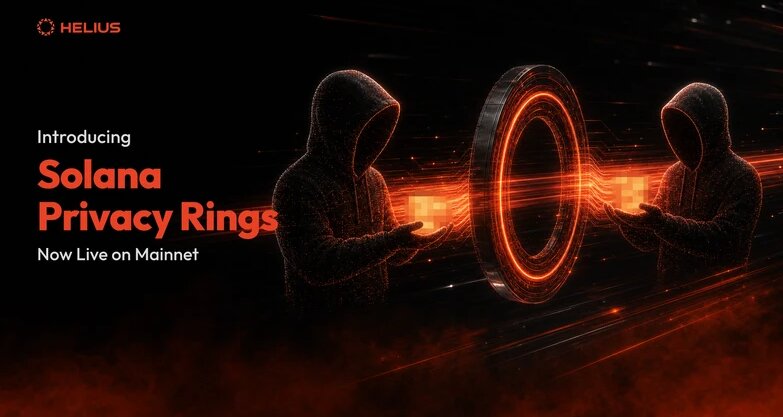
Helius has officially deployed its Solana Privacy Rings on mainnet, bringing programmable privacy for payments, decentralized finance (DeFi), and upcoming institutional applications directly into the Solana network. The system maintains balances and transfer amounts as encrypted zero-knowledge proofs — cryptographic commitments that can be verified without exposing the underlying data — a capability that Helius says has not previously been performed natively on Solana, according to the company's announcement.
Native Confidential Transfers on Solana
Privacy Rings are programmable shielded pools implemented directly on Solana. The default permissionless Ring encrypts both the amount and the assets being transferred, while wallet addresses remain publicly visible. Each user can decipher their own balance using a viewing key. On public blockchains, balances and transfer amounts are ordinarily recorded in plain view, so encrypting those values is what allows payment activity to stay confidential while the network can still verify each transaction's validity.
Support extends to SOL, the network's native asset, as well as SPL and Token-2022 tokens. Private transactions take place directly on Solana, and users' private data stays on the Solana network ledger.
Helius claims that its zero-knowledge proofs can verify private transactions in just milliseconds, which means users can now transfer funds without having to wait on a separate sidechain or an external privacy network.
Privacy Extends Beyond Payments
Developers can implement more elaborate applications using private escrows as well. Helius said the initial use cases include private swaps, lending, staking, yield products, and conditional payments. With a single transaction, private balances can communicate with other programs on Solana and act as liquidity providers to one another — meaning shielded positions can still take part in on-chain activity rather than sitting isolated from the rest of the network.
According to Helius, the system is already being used by Decrypt, Ore, and Aurora Intents, while BackPack, DFlow, Jupiter, Squads, and Titan are among the teams currently working on integrations.
Custom Rings Target Institutional Use
Helius is also working on Custom Rings for financial institutions that require privacy without compromising compliance obligations. Participants can be made visible or invisible, and institutions will be able to specify their approved participants, block specific addresses and activity, or require additional signatures.
Auditor keys may be issued so that auditors can view balances and transactions without being able to control funds. Because that access is limited to viewing, it gives institutions a way to accommodate audit and reporting requirements while keeping balances shielded from the broader public. Individual transactions can also be selectively disclosed using dedicated viewing keys.
Custom Rings are currently being audited, and their launch on Solana mainnet is planned for Q4 2026.
Helius Opens Privacy APIs to Solana Developers
Helius's APIs and software development kits enable developers to begin integrating Privacy Rings. The tooling consists of TypeScript and Rust SDKs, Blueshift privacy-aware RPC methods, and zero-knowledge development tools. Helius is also in the process of developing an on-chain wallet that will allow users to hold both public and private balances.
The core programs and zero-knowledge circuits have already undergone audits by Certora, ZK Security, and OtterSec, and the formal verification process will continue through the end of 2026.
With the deployment live on mainnet, Helius said Privacy Rings bring programmable privacy to Solana payments, DeFi, and institutional applications, with Custom Rings and continued formal verification efforts to follow through the end of 2026.
This article was originally published by Crypto Ninjas.

