Helium's HNT Surges 113% as Traders Bet the Celina, Texas Wi-Fi Offload Model Can Scale
Key Takeaways
- •HNT climbed 113.39% this week from about $0.3292 to a high near $0.7026 before pulling back to $0.633, with a four-hour RSI around 90.5 indicating an extremely stretched advance.
- •Helium's August 28 Celina, Texas update, which connected existing public-building and downtown-business Wi-Fi to its carrier-offload system carrying about 100 GB of data daily, is a plausible catalyst for the rally.
- •Celina's roughly 100 GB of daily traffic would generate only about $10 per day at Helium's published $0.10-per-GB rate, far too small to explain HNT's roughly $121.1 million market capitalization, meaning the rally reflects expectations of repeating the model in more cities.
- •HNT recorded about $180.3 million in 24-hour trading volume against a $121.1 million market capitalization, a turnover of roughly 149% that confirms intense speculative activity but not net buying.
- •HNT holders have no contractual claim on Helium's revenue, and the rally's durability depends on more municipal deployments, higher per-location traffic, additional carrier participation, and rising Data Credit demand.
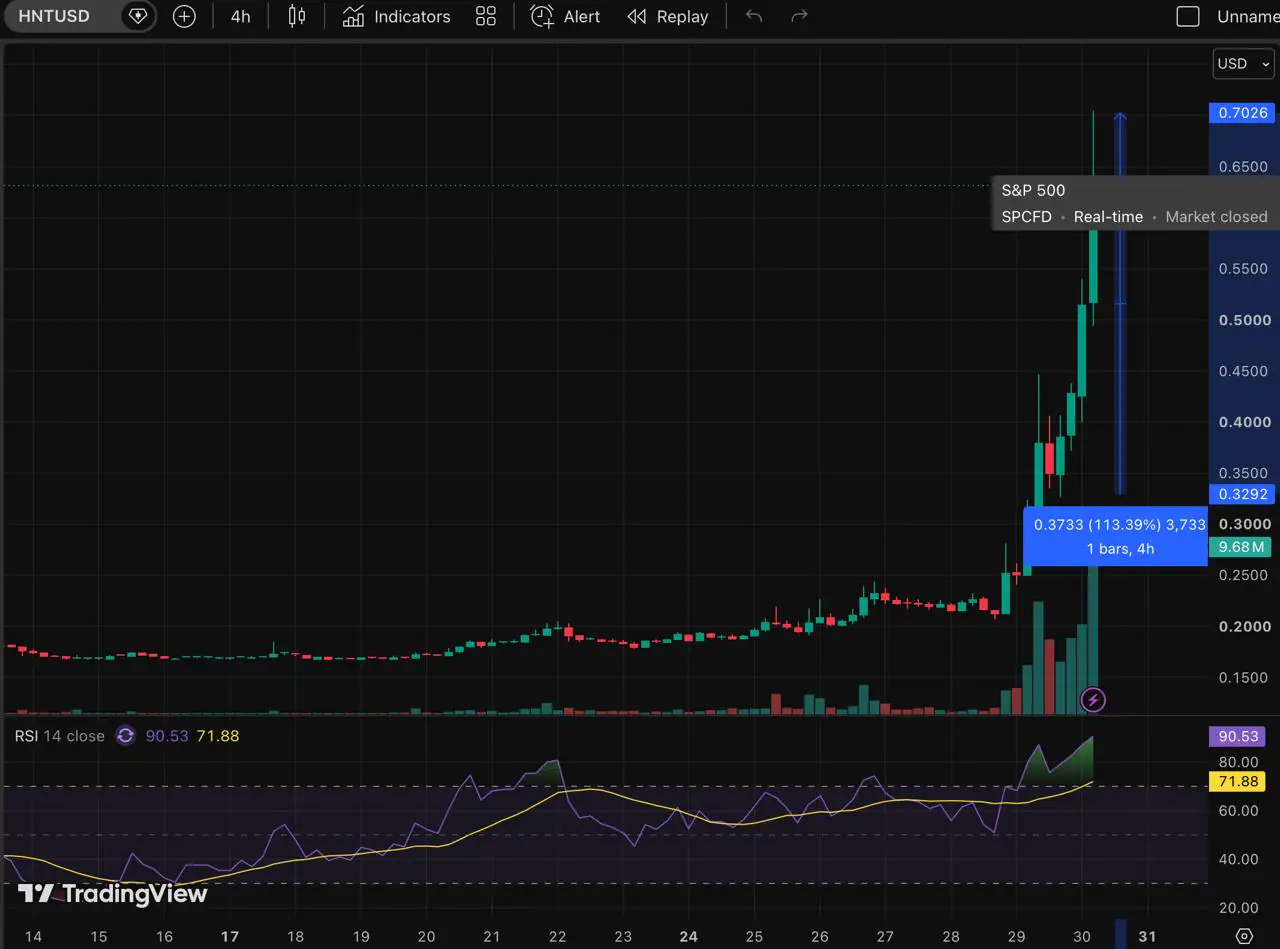
Helium's protocol token HNT rallied sharply this week, climbing 113.39% from roughly $0.3292 to a four-hour high near $0.7026 before pulling back. At $0.633 at the time of writing, the token traded 9.9% below its peak but remained approximately 92% above its starting point. CoinGecko's rolling 24-hour percentage may differ because its comparison price updates continuously.
Momentum metrics signal a stretched advance
The four-hour Relative Strength Index reached approximately 90.5. RSI measures the speed and magnitude of recent price changes; readings above 70 indicate unusually strong momentum, while a reading of 90 signals an extremely stretched advance. Such a level cannot pinpoint the exact reversal point, but it makes abrupt profit-taking and wide price swings more likely.
Helium published its Celina update on August 28, while HNT's strongest acceleration came afterward. The sequence makes the rollout a plausible catalyst, although trading data cannot isolate its effect from momentum buying and profit-taking.
The chart now faces a separate test. Recovering $0.70 would indicate that buyers absorbed the first round of selling. Continued failure below the high, especially after RSI reached 90.5, would leave the spike exposed to a deeper retracement.
How Helium turns Wi-Fi into carrier capacity
Helium coordinates independently operated Hotspots and participating Wi-Fi locations that provide IoT connectivity and mobile carrier offload, placing the project in the decentralized physical infrastructure (DePIN) category — a broader class of crypto projects that use token incentives to coordinate physical assets such as wireless networks, mapping data, and compute capacity. The network began with connectivity for low-power Internet of Things devices and later expanded into mobile coverage. Rather than constructing every access point itself, the protocol uses token rewards to coordinate infrastructure supplied by many participants.
The underlying concept, offloading cellular traffic onto Wi-Fi, is an established practice among conventional carriers seeking to relieve congestion on their licensed spectrum. Helium's variation is that the Wi-Fi capacity is contributed by third parties — municipalities, businesses, and individual hosts — and coordinated through token rewards rather than owned outright by the carrier.
HNT is not the token carriers spend
HNT is Helium's protocol token. Hotspot hosts and network operators can receive it for providing useful coverage and carrying traffic. The token has operated on the Solana blockchain since Helium migrated from its own chain in 2023.
Businesses use Data Credits rather than HNT to pay for data transfer. Each credit is a non-transferable unit fixed at $0.00001 and can only be created by burning HNT, according to Helium's documentation. The fixed value keeps data bills predictable, while the burn mechanism links usage to HNT.
Burning HNT does not produce an equal permanent reduction in supply. Helium's capped net-emissions mechanism can reissue part of the burned amount, and HNT's market price remains determined by buyers and sellers. Higher data use can increase Data Credit demand without producing an equivalent price increase.
How Celina reused Wi-Fi instead of building towers
Celina, Texas, did not build a new cellular network from the ground up. The city connected Wi-Fi already operating in public buildings and participating downtown businesses to Helium's carrier-offload system. Phones belonging to participating carrier customers connect automatically, with no app download, sign-in, or settings changes required.
The deployment includes locations such as the Celina Public Library and the Ralph O'Dell Senior Center. It is already carrying approximately 100 GB of data per day, with additional locations scheduled to come online during the fall, according to Helium's official announcement.
Reusing installed Wi-Fi lets a fast-growing city add coverage without waiting for new towers to be permitted and constructed, avoiding the cost and delay of a conventional network buildout. Celina is one of the fastest-growing cities in North Texas, a growth profile that makes permitting and construction timelines for conventional infrastructure a pressing constraint — which is part of why the city was receptive to the approach.
Helium has used the approach elsewhere, naming Redondo Beach, New Orleans, and Sausalito among municipalities connected to its network. The company reports a wider US footprint of more than 42,000 locations serving over 2.5 million people daily. These are Helium's own reach estimates, not independently verified counts of paying subscribers.
The price is betting on repetition, not 100 GB
Celina's current traffic puts the market reaction in perspective. At Helium's published rate of $0.10 per GB, 100 GB would generate roughly $10 in daily protocol charges if all reported traffic were billable at that rate. Helium may have other commercial arrangements, so the calculation should not be read as total revenue.
One deployment at that scale cannot explain a token market capitalization near $121.1 million. The rally instead reflects expectations that Celina's model can be repeated across more cities, bringing additional Wi-Fi locations, carrier traffic, and Data Credit demand.
HNT holders have no contractual claim on Helium's revenue or municipal agreements. Their economic exposure runs through token rewards, Data Credit demand, and the HNT burned during credit creation.
$180M in volume reveals the speculative side
HNT traded at $0.633 at the time of writing, while CoinGecko showed roughly $180.3 million in 24-hour volume against a market capitalization near $121.1 million — turnover equal to about 149% of the token's circulating market value. Reported trading during a single day was nearly one and a half times the value of all circulating HNT.
That figure does not represent $180.3 million of new capital: the same tokens can change hands repeatedly, and the total combines trades across multiple venues. The number confirms intense turnover, not its cause or direction. It cannot separate trades responding to the Texas update from momentum strategies and profit-taking, and it offers no insight into net buying or the depth of individual exchange order books.
What would confirm the Texas bet
The rally's thesis now rests on four measurable outcomes:
- More municipal deployments. Additional cities would show that Celina is a repeatable model rather than an isolated agreement.
- Higher traffic per location. Growth beyond Celina's current 100 GB daily would show that available coverage is translating into real use.
- More carrier participation. Additional offload partners would expand the number of phones able to use Helium automatically.
- Greater Data Credit demand. Rising usage fees and HNT burns would connect physical network growth more directly with the token economy.
The next city matters more than the first
Celina has removed one uncertainty by demonstrating that existing municipal Wi-Fi can carry carrier traffic without waiting for new towers. Scale remains unanswered. Additional cities paired with rising traffic and Data Credit spending would give HNT's repricing a measurable network foundation. If the rollout remains isolated, the move's strongest confirmed feature will be its exceptional trading turnover.
This article is for informational purposes only and does not constitute financial or investment advice. Cryptocurrency prices are highly volatile, and readers should verify current market and network data independently.

