Heima (HEI) Is Listed on edgeX: How Omni Accounts and Smart Routing Power Cross-Chain Trading
Key Takeaways
- •edgeX launched the HEI/USDC perpetual market on August 6, allowing eligible traders to take long or short price exposure to HEI without owning the underlying token.
- •Heima rebranded from Litentry in 2025 and operates as a cross-chain coordination protocol built on a Substrate-based Layer 1, combining omni accounts, intent-based routing, gas abstraction, and automated agents.
- •HEI replaced LIT through a 1:1 token migration in February 2025, with circulating supply expected to grow from roughly 66 million to 100 million over a 20-month period.
- •Heima's community approved a burn of 16.5 million HEI from an ecosystem allocation tied to the former Polkadot parachain model, and the burn was executed on July 17.
- •The HEI/USDC perpetual contract on edgeX provides price exposure only and does not confer token ownership, governance participation, or staking benefits.
Quick Answer
Heima is a coordination protocol for cross-chain trading and automated on-chain activity. A user states an outcome, such as buying an asset at the best available price, and Heima's routing and execution stack selects the path, handles chain-specific accounts, and abstracts gas. HEI is the network's utility and governance token. The HEIUSDC market on edgeX offers long or short perpetual exposure, but it does not provide ownership of HEI or governance rights.
HEI Comes to edgeX as Cross-Chain Trading Moves Behind the Interface
Cross-chain trading still asks users to think like infrastructure operators. They manage wallets on several networks, hold native gas assets, compare bridges, find liquidity, and approve a sequence of transactions before reaching the trade they originally wanted. Heima's proposition is that most of this machinery should disappear from the user experience.
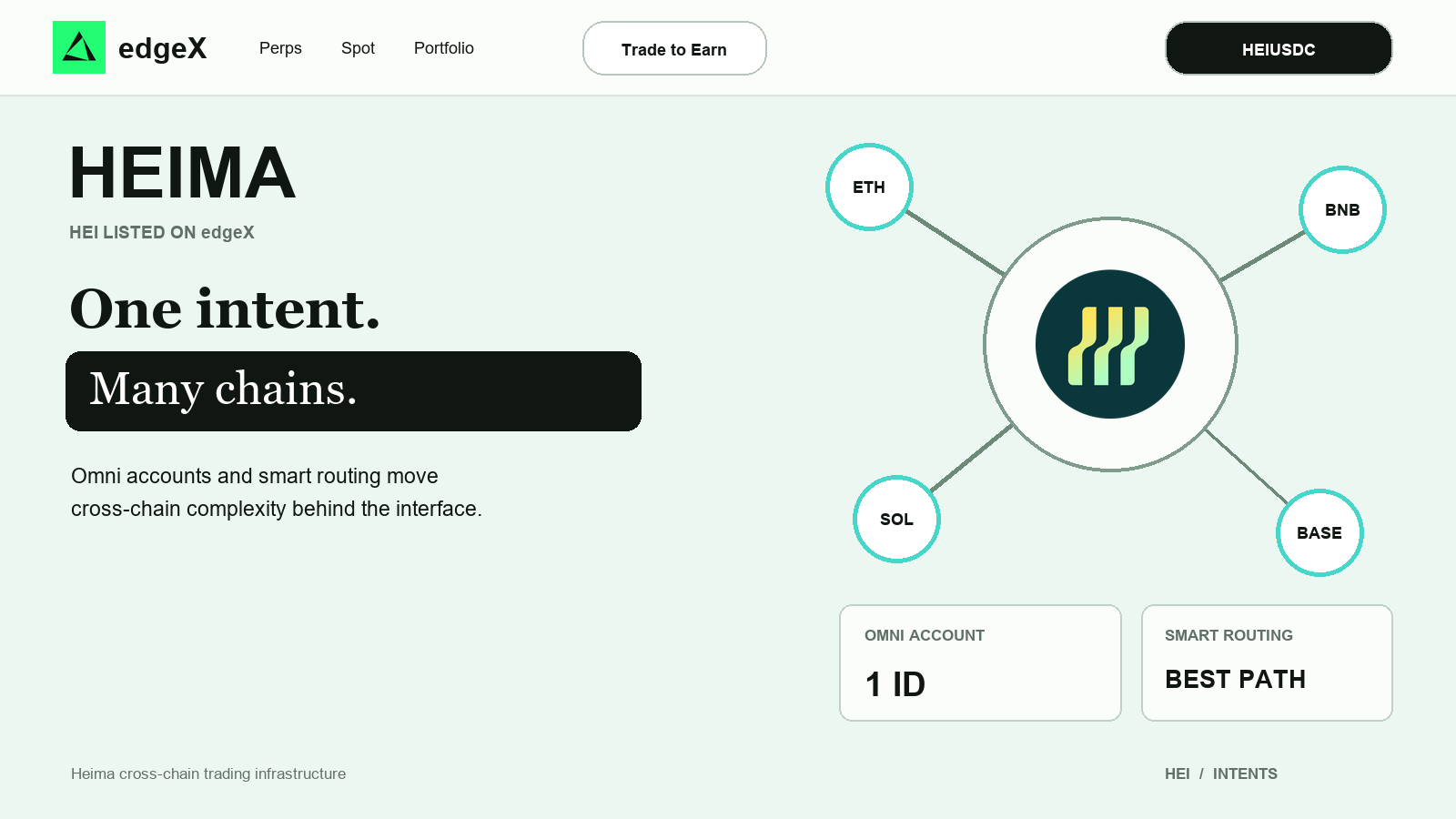
That proposition now has a new derivatives venue. edgeX announced the HEIUSDC perpetual on August 6, describing Heima as cross-chain trading infrastructure for decentralized exchanges with omni accounts and smart routing. The timing gives traders a direct way to follow whether chain abstraction can become a practical product category rather than another interoperability label.
The listing does not settle the investment case. Heima must prove that its account system, intent fillers, routing engine, and liquidity design can deliver reliable execution across networks with different security assumptions. HEI also carries a supply history shaped by the Litentry migration and a large community-approved burn.
https://x.com/edgeX_exchange/status/2085304562815263162
What Is Heima Network?
Heima is a full-stack coordination protocol built to simplify activity across accounts, blockchains, and automated agents. The project evolved from Litentry, an identity-focused network, and rebranded around a broader chain-abstraction thesis in 2025. Its current documentation positions Heima as infrastructure that decentralized exchanges and applications can integrate without rebuilding their entire stack.
The protocol uses its own Substrate-based Layer 1 as a coordination and registry layer. It records actors, intents, execution steps, and attestations while supporting EVM and WASM environments. Around that chain sit omni accounts, cross-chain routing, proxy handlers, relayers, trusted execution environments, liquidity pools, and an agent marketplace.
The goal is not to create one more destination chain. It is to make several chains feel like one execution environment. Users express what they want to accomplish; Heima's infrastructure determines which accounts, assets, routes, and services are needed to complete it.
How Heima Works
From One Intent to a Multi-Chain Execution
A Heima transaction begins with an intent rather than a rigid sequence of instructions. A user might request a token swap at the best available price, fund a purchase with an asset held on another chain, or automate a recurring strategy. The intent defines the desired result and any limits, while the execution network constructs the route.
The omni account supplies a unified identity across supported chains. Heima can connect Web3 wallets and familiar authentication methods to chain-specific proxy accounts. A delegated omni-executor then consults routing services, liquidity sources, intent fillers, and relayers. Depending on the route, execution may use an on-chain DEX, an off-chain request-for-quotation process, a bridge, or a combination of services.
Heima's Layer 1 anchors the process. Registered actors and signed execution records are designed to make the lifecycle auditable, including actions completed on external networks or in trusted execution environments. Gas abstraction lets the backend obtain or sponsor the native asset required by each target chain, so the user can pay with a supported token instead of maintaining a separate gas balance everywhere.
| Component | Role in the Heima Stack | Main Investor Checkpoint |
|---|---|---|
| Omni account | Connects one user identity to proxy accounts across networks | Security, recovery, permissions, and user adoption |
| Intent and routing layer | Converts a desired outcome into an execution path | Price quality, latency, failed transactions, and supported liquidity |
| Intent fillers and relayers | Sponsor gas and complete cross-chain tasks | Competition, reliability, incentives, and concentration |
| Heima Layer 1 | Registers actors and anchors execution records | Validator security, uptime, governance, and auditability |
| Agent hub | Lets automated agents monitor conditions and execute strategies | Code quality, permissions, data integrity, and real usage |
Omni Accounts Reduce Wallet Friction
Heima's omni-account design is the user-facing foundation. Instead of treating every address as an unrelated identity, the system links projected accounts under one authorization framework. The documentation describes support for wallet logins alongside email, passkeys, phone numbers, and social authentication through partner services.
Convenience creates a security trade-off. Proxy permissions, signer design, authentication providers, and trusted hardware become critical. A unified account can reduce user error, but a badly scoped permission or compromised authorization path can also expose activity across more than one network.
Smart Routing Chooses the Execution Path
The routing layer separates the user's goal from the mechanics. It can compare markets, select liquidity, arrange gas, and send instructions through the appropriate handlers. This is valuable for decentralized exchanges that want cross-chain reach without forcing every customer to bridge manually.
Execution quality is the test. A router must consistently find a competitive path after fees, slippage, bridge costs, and latency. Quoted prices can change while a multi-step transaction is in flight, and the weakest external dependency can determine whether the overall trade succeeds.
Agents Add Automation
Heima's agent hub is designed for bots that monitor markets, rebalance positions, execute trades, or respond to external signals. Agents can register capabilities and interact with omni accounts through permissioned execution. The network proposes staking-based guarantees and rewards for successful work.
This expands the addressable market from one-off swaps to persistent strategies. It also raises familiar automation risks: faulty code, malicious inputs, compromised data feeds, excessive permissions, and strategies that behave poorly during volatility.
Where Heima Can Be Used
Cross-Chain DEX Trading
The clearest application is a DEX interface that accepts funds from several chains and routes a trade to the best available venue. A user could pay with USDT on one network, buy an asset on another, and avoid manually sourcing gas or choosing a bridge. Heima provides the account, routing, authorization, and settlement coordination behind that experience.
PumpX Shows the Integration Model
Heima presents PumpX as its main case study. PumpX began as a Solana-focused meme-token venue. According to Heima's documentation, integrating the protocol added Web2-style onboarding, an omni account, cross-chain payment options, unified dollar pricing, gas abstraction, and routing across markets including Solana, BNB Chain, and Base.
The case study is useful because it makes the architecture concrete. It is still project-reported evidence rather than an independent measurement of volume, savings, or retention. The stronger proof will be sustained user activity and measurable execution quality after incentives and launch attention fade.
Embedded Infrastructure for Exchanges and Apps
Heima also targets exchanges, wallets, and applications that want account abstraction or routing as a service. Partners can retain their own signer, use a custodian, or integrate Heima-supported signing modules. They can also use existing intent fillers or supply their own execution logic.
This modular approach lowers integration barriers, but it creates a distribution challenge. Infrastructure becomes valuable when developers adopt it and users generate recurring transactions. Technical completeness alone does not guarantee that Heima becomes the routing layer applications choose.
HEI Tokenomics: Utility, Migration, and the Burn
HEI is the native utility and coordination token of Heima. Official documentation identifies three primary roles: governance, settlement within the gas-abstraction system, and coordination of cross-chain liquidity. The token is deployed across the Heima parachain, Ethereum, and BNB Chain.
HEI holders can participate in governance proposals, council elections, and referenda. Intent fillers and other network operators can receive compensation for sponsoring gas and performing execution work. HEI can also mediate liquidity pools designed to acquire native assets on target chains and reduce the cost of completing cross-chain operations.
The LIT-to-HEI Migration Reset the Supply Path
HEI replaced Litentry's LIT token in February 2025 at a 1:1 conversion ratio. Binance's migration notice said HEI circulating supply would rise from approximately 66 million to 100 million over 20 months. That schedule matters because supply expansion can dilute holders even when protocol usage is improving.
The picture changed again in 2026. Heima's community approved a proposal to burn 16.5 million HEI from an ecosystem allocation originally associated with the Polkadot parachain model. Reports described 12.05 million as locked and 4.45 million as unlocked but unused. Current project updates say the burn was executed on July 17.
| Tokenomics Event | Verified or Reported Terms | Why It Matters |
|---|---|---|
| LIT migration | 1 LIT converted into 1 HEI in February 2025 | Connected Heima's token history to the former Litentry network |
| Planned supply path | Circulating supply expected to move from about 66 million toward 100 million over 20 months | Created a material issuance and dilution schedule |
| Community burn | 16.5 million HEI approved for permanent removal from an ecosystem allocation | Reduced a pool that could otherwise have entered circulation |
| Current diligence | Verify circulating supply, completed burns, emissions, and treasury balances from current official records | Maximum or planned supply alone does not show tradable supply |
The burn is economically relevant, but it should not be translated into a simple price conclusion. Traders still need to reconcile issued supply, remaining emissions, tokens on each supported chain, treasury holdings, staking, and bridge accounting. A smaller allocation does not create demand by itself.
What the Supply Figures Do and Do Not Show
The available figures describe a supply path, not a complete real-time float calculation. The LIT migration established the conversion basis, Binance's notice outlined a move from roughly 66 million circulating HEI toward 100 million over 20 months, and the July burn removed 16.5 million tokens from one ecosystem allocation. Those events are material, but they cannot simply be added and subtracted to produce today's circulating supply. Tokens may sit across several chains, treasury wallets, staking contracts, liquidity programs, or bridge representations, and the timing of remaining emissions still matters.
For investors, the practical dashboard is therefore broader than a maximum-supply number. It should include circulating supply from current official records, the amount still scheduled for release, treasury and ecosystem balances, staking participation, bridge reconciliation, and any governance proposal that changes issuance or distribution. Demand indicators matter just as much: paid execution, gas sponsorship, liquidity usage, and recurring application activity determine whether new supply is being absorbed by actual network use.
What Could Strengthen or Break the HEI Thesis
The constructive case is that users want cross-chain access without managing every underlying step. If Heima gives DEXs better onboarding and routing, transaction activity could create demand for execution, gas sponsorship, liquidity, and governance. PumpX offers a visible integration template, while the agent layer creates room for recurring automated activity.
The bearish case begins with competition. Wallets, bridges, solvers, intent networks, aggregators, and chain-abstraction protocols are all trying to simplify the same fragmented market. Heima must offer better execution or easier integration, not merely comparable features.
Security spans several layers. Smart contracts, proxy permissions, bridges, relayers, trusted execution environments, signers, authentication providers, and external chains can each fail. Cross-chain systems inherit dependencies that a single-chain application can avoid.
Token economics add another risk. The migration created an expansion schedule, while the burn removed one allocation. Investors should focus on the net supply actually reaching markets and whether usage grows fast enough to absorb it. Perpetual traders face additional funding, leverage, liquidity, and liquidation risk.
Trade HEI Perpetuals on edgeX
The HEIUSDC perpetual market on edgeX lets eligible traders take long or short exposure to HEI without receiving the token. Before trading, check the live market page for leverage limits, funding, fees, liquidity, contract specifications, and regional availability.
A perpetual contract does not provide HEI governance rights, staking participation, or ownership of assets used by the network. Leverage can amplify losses, and liquidation can occur during sharp moves. Position size should reflect the volatility and liquidity of the contract rather than the ambition of the underlying technology.
The Bottom Line
Heima is trying to make cross-chain trading feel like one transaction instead of a chain of infrastructure decisions. Omni accounts unify authorization, intents define the outcome, smart routing finds an execution path, and the Layer 1 records the process. PumpX illustrates how that stack can be embedded in a trading application.
HEI gives the system an economic and governance layer, but its migration and burn history require careful supply analysis. The edgeX listing makes the thesis tradable around the clock. The durable question is whether Heima can deliver secure, competitive execution that DEXs and users choose repeatedly.
Frequently Asked Questions
What is Heima Network?
Heima is a cross-chain coordination protocol that combines omni accounts, intent-based routing, a Substrate-based Layer 1, liquidity infrastructure, and automated agents.
What is HEI used for?
HEI supports governance, network gas settlement, intent-filler incentives, and cross-chain liquidity coordination.
Is HEI the same token as Litentry's LIT?
HEI replaced LIT through a 1:1 token migration in February 2025. HEI is the active token for the rebranded Heima Network.
What are omni accounts?
Omni accounts connect authorization and projected accounts across supported networks so users can interact with multiple chains through one identity framework.
What does smart routing mean in Heima?
Smart routing converts a user's desired outcome into an execution path using available DEXs, liquidity, relayers, bridges, and intent fillers.
Is HEIUSDC the same as owning HEI?
No. HEIUSDC on edgeX is a perpetual derivative. It provides price exposure but does not confer token ownership, staking benefits, or governance rights.
Where can readers verify the current HEI price and supply?
Use the live edgeX market page and current official Heima or reputable market-data sources immediately before making a decision. This article does not state a live HEI price.

