Defense Secretary Hegseth Makes Unannounced Venezuela Visit as Pentagon Stays Silent
Key Takeaways
- •Defense Secretary Pete Hegseth traveled unannounced to Caracas on November 18, 2026, for meetings with Venezuela's interim authorities, including acting President Delcy Rodríguez, while the Pentagon declined to acknowledge a trip that Venezuelan state media has broadcast.
- •The visit is the third cabinet-level trip to Venezuela, following journeys by the Interior and Energy secretaries, and reflects the administration's recurring focus on restarting Venezuelan oil production and securing rare earth mineral deals.
- •Hegseth met with Alejandro Betancourt of North America Blue Energy Partners, an oil company in which the U.S. acquired a stake through the Defense Department's Office of Strategic Capital, giving the Pentagon a direct financial interest in Venezuela's oil sector.
- •Any commitments discussed during the visit would be negotiated with a leadership operating past its court-allowed mandate, since Rodríguez's term expired in July yet she continues to serve as Venezuela's head of state after Maduro's capture.
- •American energy companies remain reluctant to revive Venezuelan oil operations due to the oil's limited appeal, past nationalizations that seized assets, damaged infrastructure, political instability, shifting sanctions, and unclear contract guarantees.
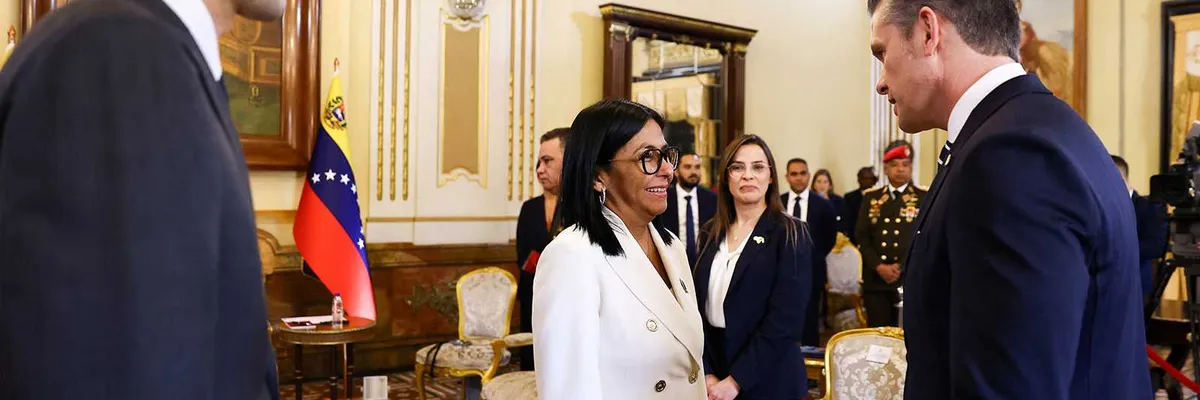
U.S. Defense Secretary Pete Hegseth made an unannounced trip to Caracas on Wednesday, November 18, 2026, for meetings with Venezuela's interim authorities, including acting President Delcy Rodríguez. The Pentagon has neither confirmed nor denied that the secretary is conducting the diplomatic visit.
Venezuelan state television, however, is broadcasting footage of Hegseth's meeting with Rodríguez at the presidential palace, even as the Pentagon remains silent about the trip. Military.com, which reported the visit, recalled that President Donald Trump said in August that Hegseth helped broker a sweeping deal for the U.S. to take control of some Venezuelan oil reserves.
Washington Post Pentagon reporter Dan Lamothe addressed the discrepancy in a post on X: "Yes, Secretary Hegseth is in Venezuela right now. No, the Pentagon is not acknowledging it at the moment. Yes, Venezuelan state media is. More to come as it becomes clear."
Wednesday's visit follows trips to Venezuela last year by the Interior and Energy secretaries, both of whom met with the country's leadership. Those efforts have centered on restarting oil production in Venezuelan fields and striking deals over rare earth minerals. The successive cabinet-level trips — Interior, Energy, and now Defense — show how Venezuela's oil and mineral wealth has become a recurring item at the top of the administration's agenda.
The region has drawn heightened U.S. attention since Trump staged a late-night raid to seize then-President Nicolás Maduro and transport him to a prison in New York. Part of the administration's focus has been curbing drug sales from Venezuela. The Pentagon began bombing boats traveling in the Gulf of Mexico and the eastern Pacific, and at least 240 people have been killed so far. The visit thus puts Hegseth in a dual position: leader of the department conducting those strikes and, by Trump's account, a broker of the U.S. oil arrangement in Venezuela.
According to Military.com, Hegseth's visit comes at a time of uncertainty for Venezuelans over who will lead the nation in the coming months and years. Rodríguez, a Maduro ally, took over after Maduro's capture, and although her court-allowed term expired in July, she continues to function as Venezuela's head of state. The Associated Press has also reported on Rodríguez's interim leadership. Any commitments discussed during the visit would therefore be negotiated with a leadership operating past its court-allowed mandate.
Bloomberg News reported that among those Hegseth met with was Alejandro Betancourt, who runs North America Blue Energy Partners, one of the oil companies operating in Venezuela. The U.S. "acquired" a stake in the company through the Defense Department's Office of Strategic Capital in order to secure oil supplies from the country, according to the AP. That office functions as the Pentagon's investment vehicle, giving the department Hegseth runs a direct financial interest in Venezuela's oil sector.
While in China, Trump described the Venezuelan relationship as an "acquisition, whether people like to say that or not."
Trump also seized some of the oil being shipped from Venezuela to Cuba and said it was sold. The administration claimed that nearly 99 percent of the oil money from that sale—about $12 billion—was returned to Venezuela, the AP reported last week.
Trump has also claimed that Maduro handed the U.S. control of Venezuela's immense oil reserves, though it remains unclear whether that was before or after Maduro's capture. The AP has reported on open questions surrounding the arrangement.
Meanwhile, Trump is working to persuade American energy companies to revive oil operations in Venezuela. A central obstacle is the quality of the oil itself, which holds limited appeal for many U.S. firms, according to Reuters. Companies remain wary of investing in the country because past nationalizations seized assets and left their investments unpaid. In addition, damaged infrastructure would require enormous investment, political instability persists, sanctions change frequently, and it is never clear whether contracts can guarantee returns. Whether the talks change any of that, and whether the Pentagon publicly acknowledges a trip Venezuelan state media has already broadcast, are the details to watch next.

