Conservative Commentator Warns GOP That Hegseth Impeachment Could Lead to 'the Hague'
Key Takeaways
- •House Speaker Mike Johnson adjourned the chamber two weeks early for recess, which Luke Nicastro of The American Conservative interpreted as an effort to evade Rep. Thomas Massie's impeachment resolution against Defense Secretary Pete Hegseth.
- •Massie's measure contains eight articles accusing Hegseth of unauthorized hostilities in Iran, Venezuela, and Yemen, violating the War Powers Resolution of 1973, ordering extrajudicial killings in the Caribbean and Eastern Pacific, ignoring civilian casualty protections, and retaliating against Sen. Mark Kelly.
- •Nicastro estimated the impeachment had a real chance of success, citing Hegseth's conflicts with Republican lawmakers and polling indicating that a majority of Americans support his impeachment.
- •Nicastro warned that a Democratic midterm win and a potential 2028 White House victory could escalate into investigations, impeachments, and prosecutions of Hegseth and other Pentagon officials, potentially in cooperation with the Hague.
- •Regardless of the GOP's delay, Nicastro concluded that impeachment will eventually be considered by the House, with the next procedural window opening when the chamber reconvenes after the November midterms.
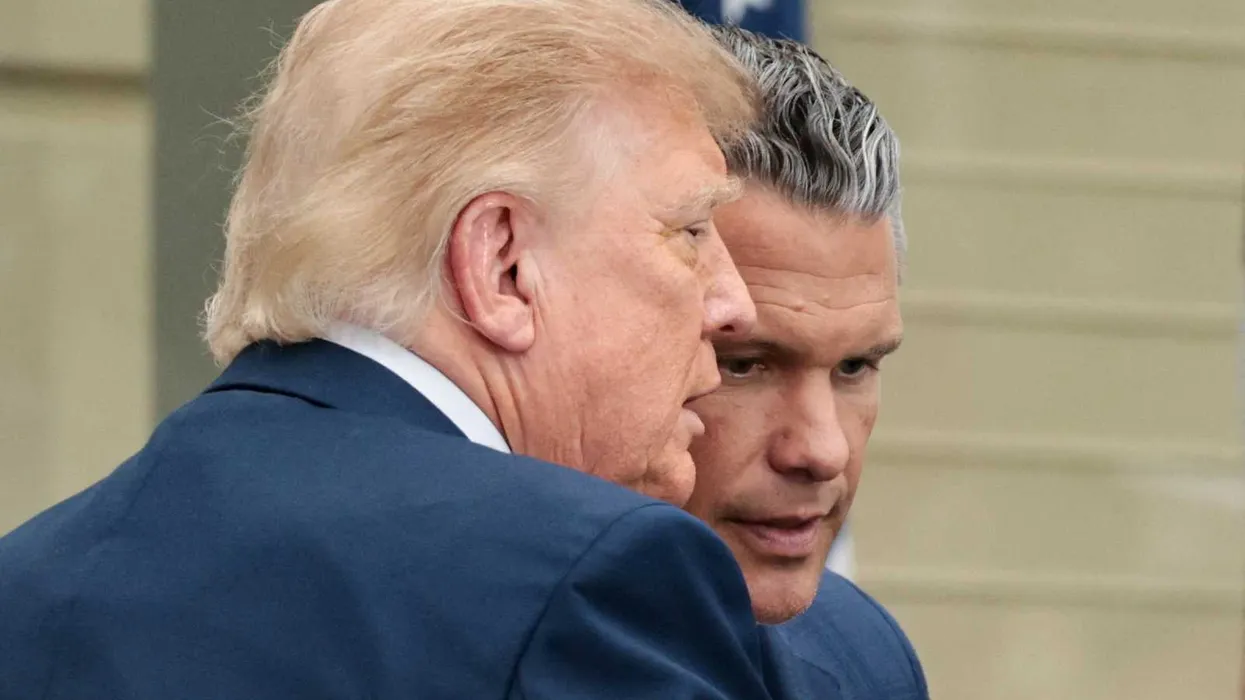
A prominent conservative commentator warned on Wednesday that Republican leaders are scrambling to head off impeachment proceedings against officials in President Donald Trump's administration — above all, embattled Defense Secretary Pete Hegseth — cautioning that if Democrats regain power, successful impeachments could put Trump administration collaborators on the path to "the Hague."
Luke Nicastro, a senior editor at The American Conservative who previously served as national security advisor to MAGA-oriented Sen. Josh Hawley, made the case in a piece published Wednesday, pointing first to the House's abrupt early exit. House Speaker Mike Johnson (R-LA) recently adjourned the chamber for its recess two weeks early, breaking an earlier promise to "work all the way through September and every day that's on the calendar."
An early recess and an avoided vote
In Nicastro's telling, the motive was transparent. Rep. Thomas Massie (R-KY) was attempting to force a vote on Hegseth's impeachment, and it was "obvious," Nicastro wrote, that Johnson "wanted to avoid that impeachment vote. Massie's measure had a 48-hour timer baked into it, and it was introduced on a Tuesday. Johnson sent his members home on Wednesday night, thus punting consideration of impeachment until the House gavels back in after the midterms."
Impeachment is a political remedy rather than a criminal one: a simple House majority can approve articles, but removing an official from office requires a two-thirds Senate vote after a trial. And because impeachment resolutions are typically filed as privileged measures — subject to a fixed window for floor action that only runs while the chamber sits — the timer Massie attached meant the vote could not be deferred indefinitely with the House in session.
A measure with real odds
In Nicastro's estimation, the impeachment stood a good chance of success. "Hegseth has antagonized Republican lawmakers to an unusual degree," he wrote, "including by summarily dismissing senior defense officials and military officers, failing to offer details on how he'll spend the gargantuan sums for which his department is asking, and generally exhibiting what might charitably be called an indecorous manner. And more than any other administration figure — excepting only the president himself — Hegseth owns the least popular war in American history. Indeed, polling suggests a majority of Americans support Hegseth's impeachment. It's therefore not inconceivable this might have passed. And even an unsuccessful impeachment measure would be politically embarrassing, both for Johnson and the White House."
The are procedural as much as political: all 435 House seats are on the ballot in November, and the outcome will decide chamber control — and with it, the power to set the floor agenda.
But Nicastro suggested the GOP had a second, longer-term reason for such drastic action. "Assuming a blue wave in the midterms," he explained, "this would start next year with congressional investigations, hearings, and impeachments. If a Democrat were to win the White House in 2028, these efforts would quickly escalate to encompass the full machinery of government. Hegseth is likely to be among the highest-priority targets. His record reads like it was cooked up in a lab to enrage liberal sensibilities: He is a former Fox News host who has been accused of sexual assault, a brash and crude culture warrior who delights in what progressives call 'punching down,' and a combination hype man/executive agent for the president's various military interventions. Dozens of Democratic lawmakers have openly said he is guilty of war crimes."
Eight articles, and a wider net
Democrats are not alone in raising the prospect of criminal conduct. Massie's impeachment attempt, Nicastro argued, "could significantly bolster such a case. For his effort isn't hastily drawn-up hackwork; it consists of eight separate articles, each of which is specific and serious. The articles accuse Hegseth of illegally using U.S. forces for hostilities not authorized by Congress in Iran, Venezuela, and Yemen; contravening the War Powers Resolution of 1973; ordering extrajudicial killings in the Caribbean and Eastern Pacific; ignoring legislation requiring the minimization of civilian casualties; and using his department to retaliate against Sen. Mark Kelly (D-AZ) in violation of the latter's First Amendment rights. And while most of the charges essentially amount to carrying out illegal orders from his commander-in-chief, two of them — ignoring responsibilities for protecting civilians and targeting Kelly — concern things that Hegseth seems to have done on his own."
The War Powers Resolution of 1973, enacted over President Richard Nixon's veto, requires a president to notify Congress within 48 hours of introducing armed forces into hostilities and generally bars deployments continuing past 60 days without congressional authorization.
What's more, Nicastro asserted, "Dems are unlikely to be content with bagging Hegseth; others further down in the Pentagon bureaucracy could be in legal jeopardy as well. Nor is the American justice system the only worry. One increasingly hears speculation that a liberal administration could manifest its enthusiasm for the 'rules-based international order' by working with the Hague on this."
The Hague is home to the International Criminal Court, which prosecutes individuals for war crimes; the United States has never ratified the Rome Statute that created the court.
In his view, having the articles debated, memorialized in the public record, and voted upon — even if ultimately rejected — would "give substance to prospective future prosecutions, both domestic and international. The whole affair is also likely to spook those currently running the war, especially if the president at some point decides to make good on his perennial threats to 'annihilate' Iran."
Such concerns, Nicastro noted, would be well grounded: the United Nations recently found there are "reasonable grounds" to believe the U.S. military has committed war crimes in Iran.
Regardless of the GOP's delays, Nicastro concluded, "impeachment will sooner or later be considered by the House. And these are unlikely to be the last charges lodged against Hegseth." The next procedural window opens when the House reconvenes after the midterms, and any renewed attempt to bring the articles to the floor would land in a chamber reshaped by November's vote.

