Hawaii to Prohibit Cash Deposits at Cryptocurrency ATMs Beginning October 1
Key Takeaways
- •Hawaii will ban cash deposits at cryptocurrency ATMs starting October 1 under House Bill 1642 enacted through the 2026 legislative session.
- •The restriction applies only to cash-funded transactions, while non-cash payment methods such as debit cards remain available at compliant kiosks.
- •Crypto ATM operators in Hawaii must modify machine configurations to exclude cash acceptance or withdraw non-compliant units from the state.
- •Federal authorities including the FBI and FTC have identified cash-funded crypto kiosks as a significant vector for consumer fraud schemes.
- •Hawaii's cash-deposit prohibition differs from approaches taken by other jurisdictions, which have implemented measures such as daily transaction caps and mandatory consumer warnings.
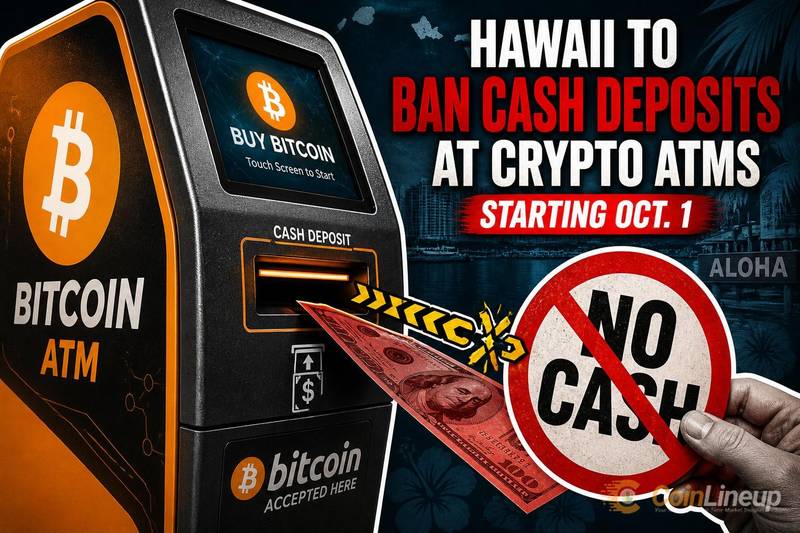
Hawaii will ban cash deposits at cryptocurrency ATMs starting October 1, following the passage of House Bill 1642 through the 2026 legislative session. The measure alters how consumers can purchase digital assets at kiosks and forces operators to modify their machines to comply with the new state-level requirements. The prohibition specifically targets cash — the funding method most commonly linked to fraud schemes in which scammers direct victims to convert physical currency into digital assets at kiosks, a pattern documented by both the FBI and the Federal Trade Commission in consumer fraud reports.
Scope of the Ban
The restriction stems from Hawaii House Bill 1642, which moved through the 2026 legislative session and targets cash-funded crypto purchases at kiosks. Importantly, the rule is not a blanket shutdown of crypto ATMs. As Hawaii News Now reported, the legislation limits cash crypto transactions at kiosks rather than prohibiting all crypto ATM activity within the state. Non-cash funding methods, such as debit card transactions, remain available at compliant machines.
The October 1 effective date applies to signed bills tracked through Hawaii's official record of acts for 2026 on the state capitol data portal.
Who Is Affected
The most immediate impact falls on Hawaii residents who rely on cash to fund cryptocurrency purchases at ATM kiosks. After October 1, that payment method will no longer be available at these machines, requiring users to seek alternative funding channels such as debit-card-enabled kiosks or online exchange platforms.
Crypto ATM operators conducting business in Hawaii also face compliance obligations. Companies will likely need to update machine configurations and consumer disclosures to align with the new rule, a shift that mirrors broader adaptations across the cash-to-crypto services industry. Operators that cannot retrofit existing machines to exclude cash acceptance may need to withdraw those units from Hawaii locations.
Broader Regulatory Context
Hawaii's restriction comes amid heightened scrutiny of crypto ATMs at the federal level. Authorities have identified the kiosks as a significant vector for fraud, as detailed in an FBI IC3 public service announcement. The FTC has separately reported that losses from scams involving cryptocurrency ATMs have grown substantially in recent years, with median individual losses often exceeding those of other payment-method frauds. State-level measures like Hawaii's contribute to an ongoing national debate over how cryptocurrency ATMs should be regulated, a question that remains unresolved alongside broader uncertainty surrounding U.S. digital asset oversight. Other jurisdictions have pursued different approaches, including daily transaction caps and mandatory consumer warnings, making Hawaii's cash-deposit prohibition a notably distinct regulatory model.
For now, the concrete development is Hawaii's October 1 change to how kiosks accept cash — a targeted restriction rather than an outright ban on crypto ATM operations.

