HashKey Merges Regional Crypto Exchanges Into Single User Platform
Key Takeaways
- •HashKey customers in Hong Kong, Global, Singapore and the Middle East will access exchange services through the same application.
- •The company said compliance requirements will continue to be applied according to each user’s jurisdiction.
- •The consolidation combines HashKey Exchange and HashKey Global into one platform while preserving localized regulatory controls.
- •A shared interface does not mean identical services, as verification, products, disclosures and access limits may still vary by location.
- •The move aligns with similar industry models where exchanges offer unified user experiences while managing legal responsibilities by region.
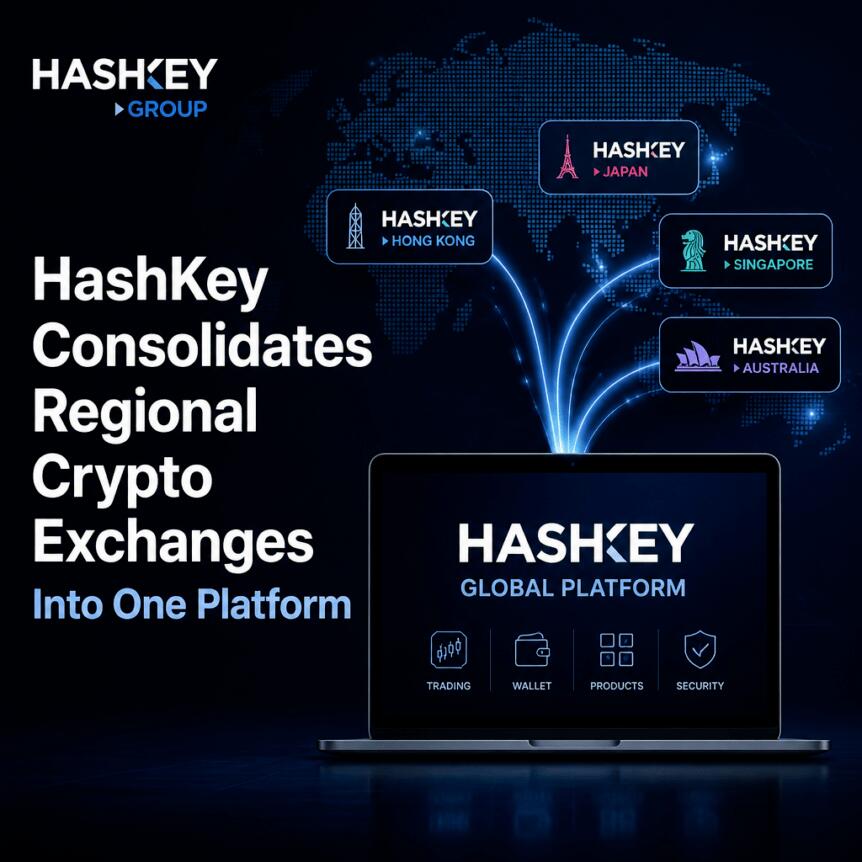
HashKey Holdings has consolidated its exchange operations into a single user-facing platform, combining apps that previously served different regions into one application.
In an announcement released Monday, the Hong Kong-based digital asset services firm said customers in Hong Kong, “Global,” Singapore, and the Middle East (Dubai) will use the same app, while compliance controls will continue to be applied according to each jurisdiction’s legal requirements. HashKey described the operating model as “unified entry, localized compliance.”
The change brings together HashKey Exchange and HashKey Global under one platform for users across multiple regions. It also reflects a broader move in the crypto exchange sector away from earlier “regional silo” structures, where licensing, applications, and customer-facing products were often separated by market to reduce compliance complexity.
One application, localized compliance
HashKey said it has brought core jurisdictional hubs — including Hong Kong, Singapore, the Middle East (Dubai), and Bermuda — under a single platform and application. The company emphasized that the front-end user experience is being unified, while the platform is designed to manage compliance requirements in line with each user’s jurisdiction.
Under the model, customers download and access the same application, but the platform applies localized compliance handling across the Hong Kong, Global, Singapore, and Middle East regions. The result is a single entry point for users, even though legal and regulatory obligations continue to differ by geography.
That distinction is important for crypto exchanges because a common interface does not necessarily mean identical services in every market. User verification, onboarding requirements, available products, disclosures, and access restrictions can still vary depending on where a customer is located and which regulated entity or rule set applies.
HashKey’s announcement presents the consolidation as an evolution from the early stages of virtual asset trading, when many licensed exchanges operated through separate regional structures. Those models typically involved different platforms, applications, and operational setups, allowing firms to compartmentalize regulatory obligations by jurisdiction.
According to HashKey, the updated structure is intended to retain jurisdiction-specific compliance controls while reducing friction for users who operate across, or move between, markets. Instead of requiring separate customer-facing products for each region, compliance is managed within the unified platform.
For traders and liquidity providers, a single application may reduce confusion over which interface, account type, or supported features apply in a particular jurisdiction. For the operator, consolidating the customer entry point may streamline product development and onboarding workflows while keeping jurisdiction-specific controls in the background.
Similar models at other exchanges
HashKey is not the only exchange moving toward a centralized user experience paired with jurisdiction-specific legal coverage. Other major exchanges have adopted structures that present a unified interface to users while routing legal and regulatory responsibilities according to customer location.
OKX, for example, presents its website and mobile applications as one platform. However, OKX’s terms reportedly assign customers to different providers based on residence. In that structure, the customer-facing “one app” experience is paired with a legal routing layer that maps users to the appropriate entity depending on where they are located.
Kraken offers another comparison. The announcement referenced that Kraken consolidated Dutch broker entity BCM into its platform after acquiring it in September 2024. Kraken has also expanded its European offering through a MiCA structure. The firm reportedly began serving the EEA through its Irish MiCA entity in August, indicating a model in which compliance alignment is managed within a broader operational framework.
These examples show that the “single platform” approach can be implemented in different ways. The central issue is how an exchange connects a unified front end to jurisdiction-appropriate regulatory responsibility, whether by assigning users to distinct providers behind the scenes or by applying compliance processes localized to each customer’s jurisdiction.
User migration and regulatory controls remain key issues
HashKey’s move to one application across multiple regions raises practical questions for customers, including how onboarding flows will change, how jurisdiction-specific feature access will appear in the user experience, and whether account management will remain seamless when users encounter region-specific compliance requirements.
For regulators and industry observers, the consolidation may serve as a test case for whether exchanges can maintain compliance controls while combining products and codebases. The approach may become more relevant as regulatory regimes mature and operational efficiency becomes a greater priority for crypto trading platforms.
Further details on the rollout mechanics will be important, including how HashKey handles migration from previously separate platforms and how the unified application communicates jurisdiction-dependent restrictions, if any. As exchange regulation continues to tighten, the ability to centralize the user interface without weakening regulatory obligations remains a key operational consideration.

