Harmony Proposes Sunsetting Its Layer-1 Blockchain and Reissuing ONE as an ERC-20 Token on Ethereum
Key Takeaways
- •Harmony proposes converting ONE into an ERC-20 token on Ethereum, eliminating its validator set and relying on Ethereum's proof-of-stake security.
- •The August exploit involved cross-shard receipt replay that Verichains said pushed the ONE supply to nearly three trillion, prompting a network rollback.
- •Users must withdraw assets from smart contracts, liquidity pools, and multisig safes before September 10; personal wallet holders will receive the new token via an automated snapshot and airdrop.
- •Harmony allocated $1.37 million for validators who qualify as governors in its new AI video venture, The Remix Economy.
- •TRM Labs recorded 207 crypto hacks stealing $972 million in the first half of 2026, with about $577 million linked to two North Korea-related incidents.
Harmony has proposed shutting down its layer-1 blockchain and migrating ONE to Ethereum, citing concern that threats from state-sponsored hackers and AI agents have grown too large for the project to counter on its own.
The proposal puts a price on something independent chains normally handle by themselves: security. By converting ONE into an ERC-20 token, Harmony would eliminate its validator set and instead rely on the proof-of-stake (PoS) security of the Ethereum blockchain, whose far larger validator base and staked-ether pool backstop settlement for thousands of existing tokens and applications. The trade-off is that ONE would give up the native capabilities of a standalone chain — such as its own block production, sharded throughput, and native staking — and exist instead as a guest asset whose activity depends on Ethereum's fees and congestion. As Cryptopolitan previously reported, Harmony had considered a full token migration before its August incident but ultimately chose a rollback. The shutdown proposal now presents that fallback plan as the primary option.
Why the team says it is pulling the plug
According to reports, the proposal is non-binding. In its September 6 announcement, Harmony stated that "the threats posed by state actors and AI agents are too great," adding that it was "time to fully sunset the Harmony network."
The AI warning is not purely hypothetical. A year-long study by Anthropic covering 832 accounts banned for cybercrime activities found that the share of accounts rated medium risk or higher rose from roughly 33% in the first half of the study to 56% in the second half. Separately, OpenAI claims that GPT-6 Astra has reached "Critical" cybersecurity capabilities, illustrating how quickly frontier AI models can discover and exploit vulnerabilities in computer programs.
The exploits behind the exit
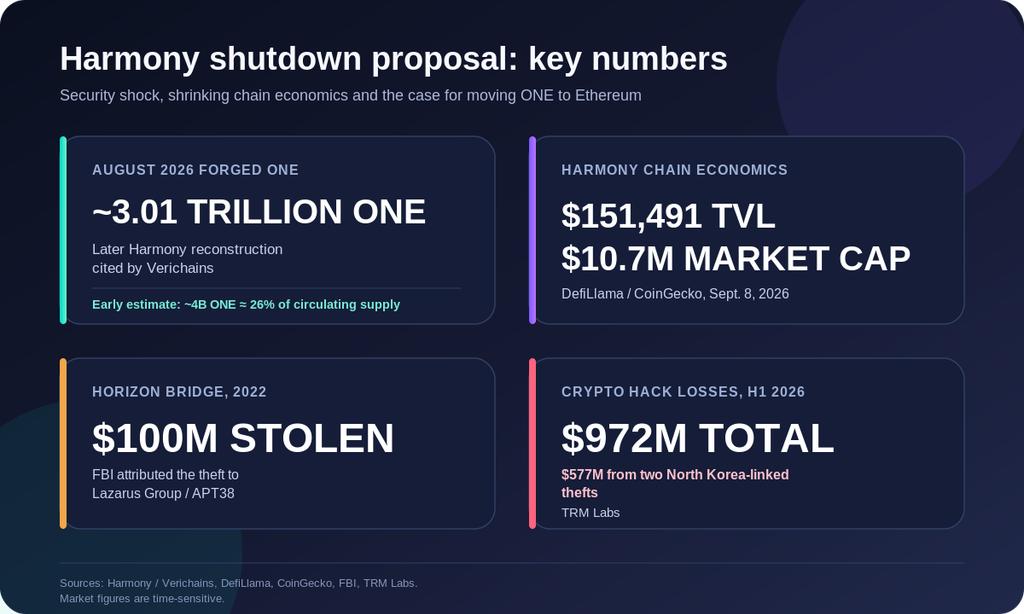
Harmony's history helps explain the burden it faces. An initial report on the August breach indicated that roughly four billion ONE coins — about 26% of the existing supply — had been created illegally. However, Verichains claimed that the total amount of ONE had reached nearly three trillion because the same cross-shard receipts were credited multiple times without corresponding source-side debits. Harmony ultimately rolled the network back to its pre-breach state.
The project had already suffered a major breach in 2022, when the FBI attributed the roughly $100 million Horizon Bridge theft to North Korea's Lazarus Group, also known as APT38. That earlier incident targeted a cross-chain bridge — historically among the most attacked components in crypto because they custody assets across chains — while the 2026 exploit struck Harmony's own consensus and cross-shard accounting. The broader threat environment remains significant: TRM Labs reported 207 crypto hacks in the first half of 2026, with $972 million in funds stolen. Approximately $577 million of that was tied to two incidents linked to North Korea.
What holders and validators need to do
According to Harmony, regular token holders do not need to file claims. The plan is to take a snapshot of balances at the final block, airdrop the new ONE to the same Ethereum wallets, and update exchange listings. Delegated stake and unclaimed rewards would be moved into private governor vaults, according to reports.
A more pressing concern is funds locked in smart contracts. Users cannot retrieve assets from multisig safes, liquidity pools, and on-chain applications, so they must exit those contracts before September 10. Starting at 7 a.m. Pacific time that day, validators will be able to deactivate their nodes. Harmony has also allocated $1.37 million for validators who meet the company's conditions and become "governors" in its new AI video venture, The Remix Economy.
Part of a wider retreat from layer-1
Harmony is not the first project to abandon its standalone blockchain. BounceBit discontinued its layer-1 in August after the theft of 286.5 million BB and reissued the token on the BNB Blockchain.
The significance of Harmony's proposed migration lies less in its size and more in what the decision signals. CoinGecko puts ONE's market capitalization at around $10.7 million, while DefiLlama shows roughly $151,000 in total value locked in Harmony DeFi. These figures suggest Harmony itself is unlikely to pose systemic risk, but they highlight the economics smaller layer-1s face: paying for validators, infrastructure, and security becomes harder to justify as activity and capital decline. For token holders, the September 10 deadline for exiting smart contracts is the most immediate decision point, while holders keeping assets in personal wallets face an automated snapshot-and-airdrop process.
Migrating ONE to Ethereum does not mean Harmony's applications or chain records will transfer as well. It does, however, allow token settlement to occur on a far more secure network. If this becomes a pattern among smaller blockchains, it could drive further concentration of liquidity and activity on major settlement networks such as Ethereum, while shrinking the number of projects able to afford the costs of independence.
