Hanwha Investment & Securities Completes Avalanche-Based Tokenized Securities Platform Ahead of South Korea's 2027 Framework
Key Takeaways
- •Hanwha Investment & Securities completed a tokenized securities platform supporting Avalanche and Hyperledger Besu, developed with FairSquare Lab since 2025.
- •South Korea's tokenized securities framework takes effect February 4, 2027, with legal amendments recognizing distributed ledgers as securities registers under existing capital markets law.
- •The FSC's three-phase roadmap starts with privately pooled money market funds, institutional-only bonds, and unlisted trust-held stocks, before expanding to all public securities and later on-chain stablecoin payments.
- •The Korea Securities Depository is building multi-blockchain infrastructure covering Avalanche, Hyperledger Besu, and Hyperledger Fabric, with access limited to approved institutions.
- •Hanwha affiliates hold an aggregate 9.6% stake in Securitize, making the conglomerate the tokenization firm's largest shareholder.
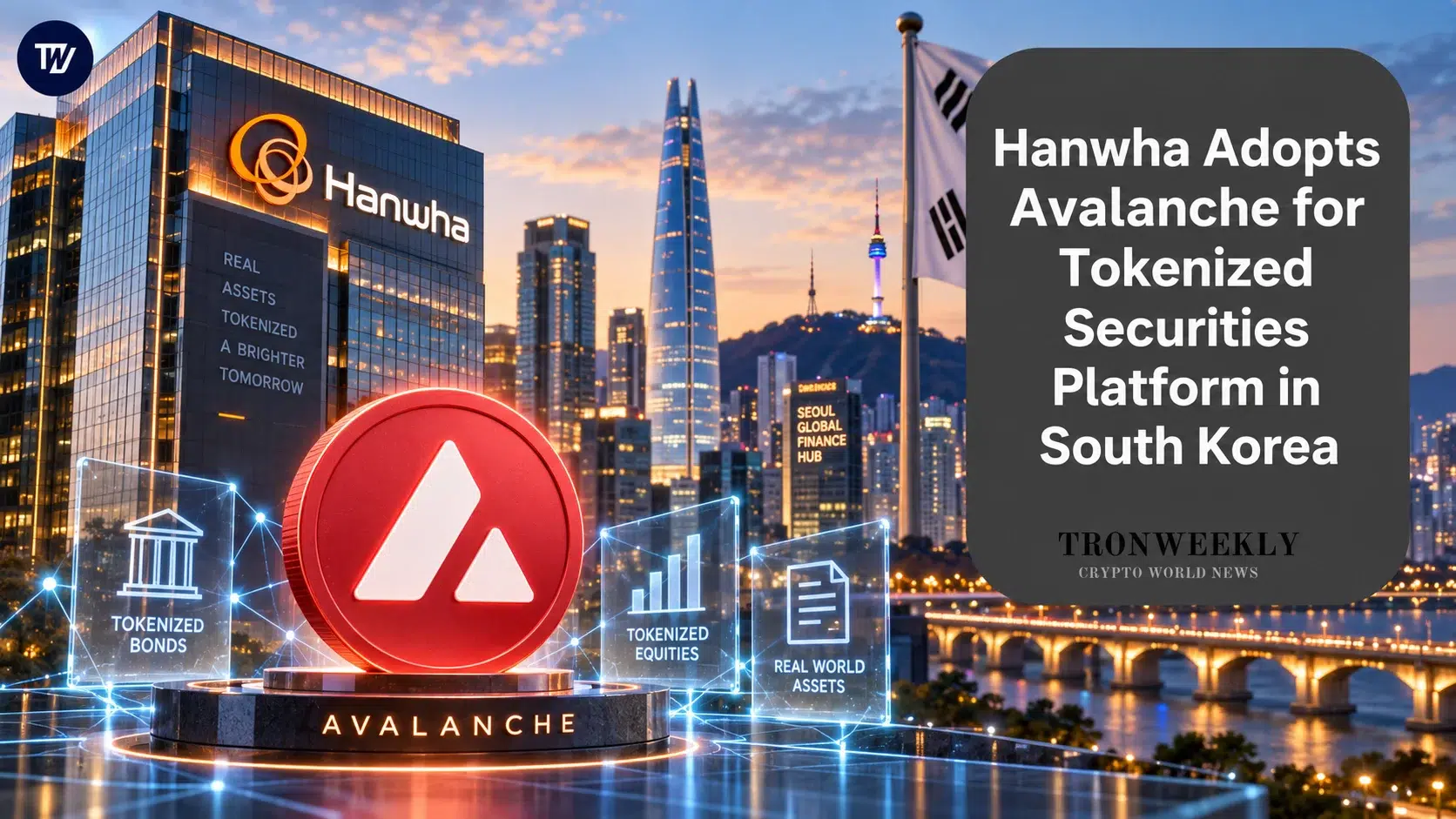
Hanwha Investment & Securities has reportedly completed a tokenized securities platform that supports Avalanche and other blockchain networks, according to Seoul Economic Daily. The build-out comes ahead of South Korea's launch of a regulated market for tokenized securities in February 2027, positioning the brokerage to operate in one of the first fully regulated tokenized securities markets among major economies. The South Korean brokerage began the project in 2025 with technology company FairSquare Lab, and the system also supports Hyperledger Besu, an enterprise Ethereum client.
South Korea's Preparations for Tokenized Securities
The launch framework takes effect on Feb. 4, 2027. Amendments to the Electronic Securities Act and Capital Markets Act will recognize distributed ledgers as securities registers, bringing tokenized securities into South Korea's existing capital markets system. That approach—registering existing securities on blockchain rather than creating a new asset class—parallels regulatory directions taken in other jurisdictions that have addressed security tokens under existing securities law.
The Financial Services Commission (FSC) unveiled its implementation roadmap on Sept. 4, outlining three stages for introducing eligible products and expanding the market. The plan also covers future payment infrastructure linked to stablecoins.
🚨 LATEST: Hanwha Investment & Securities has built a tokenized securities platform using Avalanche, as South Korea prepares to introduce its three-phase tokenization roadmap. The first phase is set to begin in February 2027, with later stages expected to expand tokenization and… pic.twitter.com/UpBtom7AJ8 — TheNewsCrypto (@The_NewsCrypto) September 7, 2026
The Korea Securities Depository (KSD) is preparing infrastructure to connect with different blockchains, with published requirements covering Avalanche, Hyperledger Besu, and Hyperledger Fabric. Securities firms will therefore have several network options when building systems under the incoming framework.
Access to connected distributed ledgers will be limited to approved institutions, including securities companies and the depository. The KSD would join the networks directly to oversee total issuance and electronic registration information.
Financial companies helped shape the decision to include Avalanche, according to Seoul Economic Daily. A KSD official said several firms had requested support for the network through industry consultations and existing projects.
Networks Behind Hanwha's Tokenized Securities Platform
FairSquare Lab built Hanwha's system to work across multiple distributed ledgers. Other South Korean financial firms have already used enterprise networks such as Hyperledger Besu, which is compatible with Ethereum and designed for enterprise deployments, for securities infrastructure. Hanwha's platform extends that approach by adding support for Avalanche, which lets institutions establish dedicated networks with controls over participants and validators.
The reported development comes as South Korea finalizes its operating structure for tokenized securities. The initial phase of the roadmap covers privately pooled money market funds, bonds exclusive to institutional investors, and unlisted stocks held in the form of trusts. Fractional securities offered publicly will also be considered during the first phase.
In the second phase, tokenization would extend to all publicly issued securities. No definite deadline has been set for this expansion, as it depends on the outcome of the first phase's implementation.
The third phase involves on-chain payments using stablecoins. On-chain payment of tokenized securities will use blockchain technology, and the timing of this part of the settlement system depends on South Korean legislation on stablecoins, making that legislative progress a key factor to watch for the framework's later stages.
What South Korea Will Test Before Expanding Tokenization
The National Assembly approved the legal amendments in January, providing a foundation for distributed ledgers as securities registration mechanisms. Instruments recorded on such platforms will still be considered securities under existing financial law and will not constitute a new category of assets.
The FSC had outlined its plans to create these rules in May, when the agency was examining how stocks, bonds, and money market funds could be introduced to the ecosystem. According to the commission, the entire electronic securities market would not move onto blockchain immediately; instead, the market would be tested in stages across securities rights, trading, clearing and settlement, and on-chain payment operations. This staged approach preceded the September roadmap, which specified initial product eligibility and conditions for later expansion.
Avalanche is also used in Japan for tokenized securities infrastructure. In July, Progmat switched its platform from Corda 5 to Avalanche Layer 1, moving all active security token projects—whose underlying asset value and securities totaled more than 452 billion yen—to the new layer. The two countries' adoption of the same network technology points to a broader regional pattern of financial institutions in Asia building tokenized securities infrastructure on Avalanche.
Progmat, Japan's largest STO platform, is now live on @avax "All ST projects (over 452 billion yen) are now EVM-compatible, achieving both financial institution-level requirements and the utilization of public chains. Rights transfers are accelerated 3-5 times faster than… — Justin Kim (@justinkim415) July 13, 2026
How Hanwha Became Securitize's Largest Shareholder
Hanwha has also positioned itself among companies building capabilities in tokenization and blockchain infrastructure. A US regulatory filing revealed an aggregate stake of 9.6% in Securitize held through three Hanwha affiliates, making the conglomerate the company's largest shareholder.
According to figures reported in July, the three affiliates held 15.69 million Securitize shares—more than the stakes held by Blockchain Capital and Securitize co-founder and CEO Carlos Domingo. A private equity firm managed by Hanwha Asset Management holds 5.9%, H Foundation, a subsidiary of Hanwha Systems, owns 3.1%, and Hanwha Investment & Securities holds 0.6%.
The company described the purchase as a financial investment during pre-IPO financing, while leaving room for possible use of the investment in its digital asset operations and real asset tokenization business.
Financial Institutions Using Securitize's Infrastructure
Securitize provides infrastructure for tokenized securities and tokenized assets. Its institutional clients include BlackRock, Apollo, BNY, Hamilton Lane, KKR, and VanEck. This year, its platform was handling over $4 billion worth of on-chain assets across more than 650 tokenized funds.
Securitize held its IPO on the New York Stock Exchange in July, listing under the ticker SECZ. At the time, it offered blockchain versions of its common shares, available on both Solana and Avalanche. These tokens represent the same shares listed on the NYSE and do not constitute a new class of securities.
Beyond Securitize, Hanwha Investment & Securities also invested this year in blockchain research and data firm Xangle and in Web3 infrastructure company Kresus, alongside its broader investments in tokenized securities and blockchain firms. In July, the brokerage invested 30 billion won (roughly $22.3 million) in Digital Asset, the operator of Canton Network, an institution-focused network. Together with the completed platform, these moves show the brokerage building relationships across several competing tokenization networks ahead of the 2027 launch, when the first phase's rollout and the pace of South Korea's stablecoin legislation will shape how quickly the market expands.
