HANMI (042700) Is Listed on edgeX: HBM Equipment, Packaging Bottlenecks, and the HANMI Trading Thesis
Key Takeaways
- •Hanmi Semiconductor is listed on Korea’s KOSPI market under ticker 042700 and is closely linked to advanced memory packaging.
- •Its TC bonder tools are central to HBM production, which supports AI server memory needs.
- •Recent reporting on record profitability and strong margins has increased attention on the stock as a packaging-scarcity trade.
- •The main risk is that packaging capacity expands faster than expected, reducing customer urgency and weakening the premium valuation.
Quick Answer
HANMI refers to Hanmi Semiconductor, one of the key Korean equipment names tied to HBM production and advanced packaging. The HANMI/USDC perpetual on edgeX lets traders position around the AI-memory equipment cycle rather than around memory prices alone. The stock matters now because investors are trying to decide whether packaging demand is a lasting bottleneck or a peak-cycle surge.
https://x.com/edgeX_exchange/status/2088223391904092299
HANMI Arrives on edgeX as the AI Memory Buildout Moves Upstream
Hanmi Semiconductor has become one of the most interesting Korean AI names because it sits upstream of the memory story. The market does not buy the stock only as an equipment company. It buys it as a way to trade whether HBM capacity, packaging difficulty and customer urgency remain tight enough to keep tool spending elevated.
That is why the HANMI/USDC perpetual matters on edgeX. The setup is not just "more AI means more semiconductors." It is a more specific test of whether the bottleneck in advanced memory packaging remains valuable long enough for a tool supplier to earn a premium cycle multiple.
What Hanmi Semiconductor Actually Sells
Hanmi Semiconductor is best known for tools used in semiconductor packaging and assembly, including the TC bonder line that has become central to HBM production. That positioning matters because the AI server buildout does not depend only on chip design. It also depends on the physical ability to package, stack and connect memory at the required performance level.
Advanced packaging is where the shortage becomes visible
The memory market can look healthy at the product level while still running into a packaging problem at the equipment level. If customers need more HBM but cannot expand packaging capacity quickly enough, the companies selling critical tools can gain pricing power and investor attention. That is the exact logic behind HANMI's popularity with AI-focused equity traders.
The opposite is also true. If customers rush to add capacity and the bottleneck eases faster than expected, the tool story can de-rate quickly. Equipment names often trade on the rate of change in spending, not just the level of demand.
| Driver | Bullish signal | Risk signal |
|---|---|---|
| HBM demand | Customers keep ordering advanced memory at scale | AI-server demand cools or pauses |
| Tool cycle | TC bonder orders remain tight and visible | New capacity erodes urgency |
| Margins | High profitability holds through mix and pricing | Orders normalize and margins fall |
| Technology | Hybrid and next-gen bonding efforts gain traction | Customer qualification slips or rivals catch up |
| Stock setup | Equipment leverage plus 24/7 edgeX access | Peak-cycle fears overwhelm fundamentals |
The Latest Signals Explain Why the Stock Got More Crowded
Recent reporting around record profitability and strong margins helped turn HANMI into a cleaner market symbol for packaging scarcity. Traders are not only reading revenue numbers. They are reading what those numbers imply about capacity pressure in the AI memory chain.
That distinction matters. A memory maker can benefit from strong chip pricing, but an equipment supplier benefits when customers believe they must keep spending to avoid losing time in the cycle. If the market believes that urgency remains real, HANMI can keep trading like a leverage instrument on AI-memory expansion.
The real question is how durable the bottleneck is
The best version of the thesis is that advanced packaging stays difficult enough, and customer roadmaps stay aggressive enough, that tool demand remains visible even after the first rush. In that setup, Hanmi Semiconductor is not just a one-quarter winner. It becomes part of the enabling infrastructure for the next leg of HBM expansion.
The weaker version is that customers pull forward too much spending too quickly. If the bottleneck begins to clear or if rivals offer enough substitute capacity, the market can move from excitement to caution with very little warning.
What the Market Is Really Pricing In
The market is pricing whether HBM tool demand remains structurally strong or whether it is already peaking. That is a much more useful framing than a generic "AI is bullish" narrative. HANMI can justify a richer multiple if investors believe customer spending is tied to roadmaps that still need more tools, more packaging quality and more cycle speed.
If the market decides the spend is front-loaded, the same stock can de-rate even while company numbers remain respectable. Equipment names are often hardest to value when the current quarter looks excellent but the next one depends on customer behavior that can change quickly.
A premium tool story must keep proving scarcity
For HANMI to keep its premium, the company has to show that its relevance is not temporary. That means customers still see its tools as critical, switching remains hard, and the next generation of packaging work keeps the company's roadmap tied to the industry's roadmap. When those conditions hold, tool suppliers can behave like bottleneck owners.
When they do not, the stock can trade more like a normal cycle name with all the compression that comes with that shift.
A Scenario Framework for HANMI
In a bullish scenario, HBM demand remains urgent enough that customers keep spending on packaging equipment even after the first wave of expansion. That would allow Hanmi Semiconductor to keep benefiting from scarcity, high urgency and a customer base that still values speed over short-term cost minimization. In that setup, the stock can keep behaving like a leverage instrument on AI infrastructure buildout rather than like a late-cycle equipment name.
In a base scenario, demand remains healthy but more selective. Customers still buy tools, but they scrutinize timing and return more carefully, and the market starts focusing on order quality rather than only on order size. The stock could still work in that environment, but it would likely become more sensitive to backlog visibility, customer concentration and the mix between current products and next-generation bonding tools.
In a bearish scenario, the bottleneck narrative fades faster than expected. Capacity comes online, customer urgency falls and tool demand begins to look pulled forward. That would not require AI demand to disappear. It would only require the market to conclude that the fastest spending phase has already passed, which can be enough to compress equipment multiples quickly.
Why Equipment Cycles Can Break Faster Than Chip Cycles
The market sometimes treats upstream equipment names as if they have the same staying power as the chip or memory makers they serve. That is usually a mistake. Tool suppliers often experience more violent swings because customers can keep producing with installed capacity even after they slow new orders. That means a strong current quarter does not automatically imply a strong next quarter.
For HANMI, that risk is unusually important because the stock has become such a clean symbol for packaging scarcity. If scarcity remains real, the multiple can stay rich. If the market starts to think scarcity is easing, the de-rating can happen before the operating numbers fully reflect it. That is why traders should care not only about company execution but about how fast the industry's spending psychology changes.
What the Next HANMI Readout Has to Confirm
The next useful HANMI evidence will be simple on paper and difficult in practice: customers still need the tools, they still need them urgently, and the company's technology still matters enough that pricing and margin quality remain firm. Traders should pay attention to whether the story is broadening into a more durable roadmap narrative or narrowing into a single-cycle excitement trade.
That distinction will decide whether HANMI keeps its premium. The market can forgive some volatility when it believes the bottleneck is structural. It becomes much less forgiving when it decides the cycle is starting to normalize. That is why a stock like this should be read through customer urgency and spending psychology as much as through headline revenue.
What Traders Should Watch Between Here and the Next Quarter
For HANMI, the next few months should be read through customer behavior rather than through abstract AI enthusiasm. Traders should watch whether memory makers continue talking about capacity urgency, whether the conversation shifts toward next-generation packaging and whether equipment commentary still sounds like a race against time rather than a plan for orderly catch-up. Those distinctions matter because a bottleneck story weakens long before a shipment line fully rolls over.
That is also why the stock can remain volatile even when the long-term AI narrative still looks strong. A stock like HANMI does not need a collapse in end demand to underperform. It only needs the market to believe that the fastest phase of customer spending is cooling. When that possibility enters the tape, valuation often reacts first and operating data follows later.
Why Hanmi's Customer Base Matters More Than the Logo List
Not every customer is equally helpful for a tool supplier. A famous customer can validate the technology, but the more important question is whether the demand is broad enough and recurring enough to last beyond one equipment cycle. For HANMI, that means traders should care about the depth of customer commitment, the spread of demand across major memory makers and the durability of advanced packaging needs.
The stock can look great when spending is concentrated and urgent. The harder part is what happens after that first rush. If the customer base continues to need the same tools at high urgency, HANMI can stay expensive for a reason. If demand broadens but urgency falls, the valuation can compress even if the company remains fundamentally strong.
What Traders Should Watch in the Next Quarter
The most useful HANMI evidence ahead is not just a better revenue line. It is whether the company keeps sounding central to the packaging roadmap. Traders should watch for signs that next-generation memory and packaging transitions still require meaningful tool spending. If the company remains tied to a real industry bottleneck, the stock can keep acting like a leverage play on AI infrastructure.
That is why HANMI tends to punish complacency. The market will happily price a bottleneck when it feels active, but it quickly reprices the name when the bottleneck starts to look manageable. Traders should therefore watch industry tone as closely as corporate results, because the market often moves before the numbers fully confirm the change.
edgeX Korean Stock Perpetual Trading Party
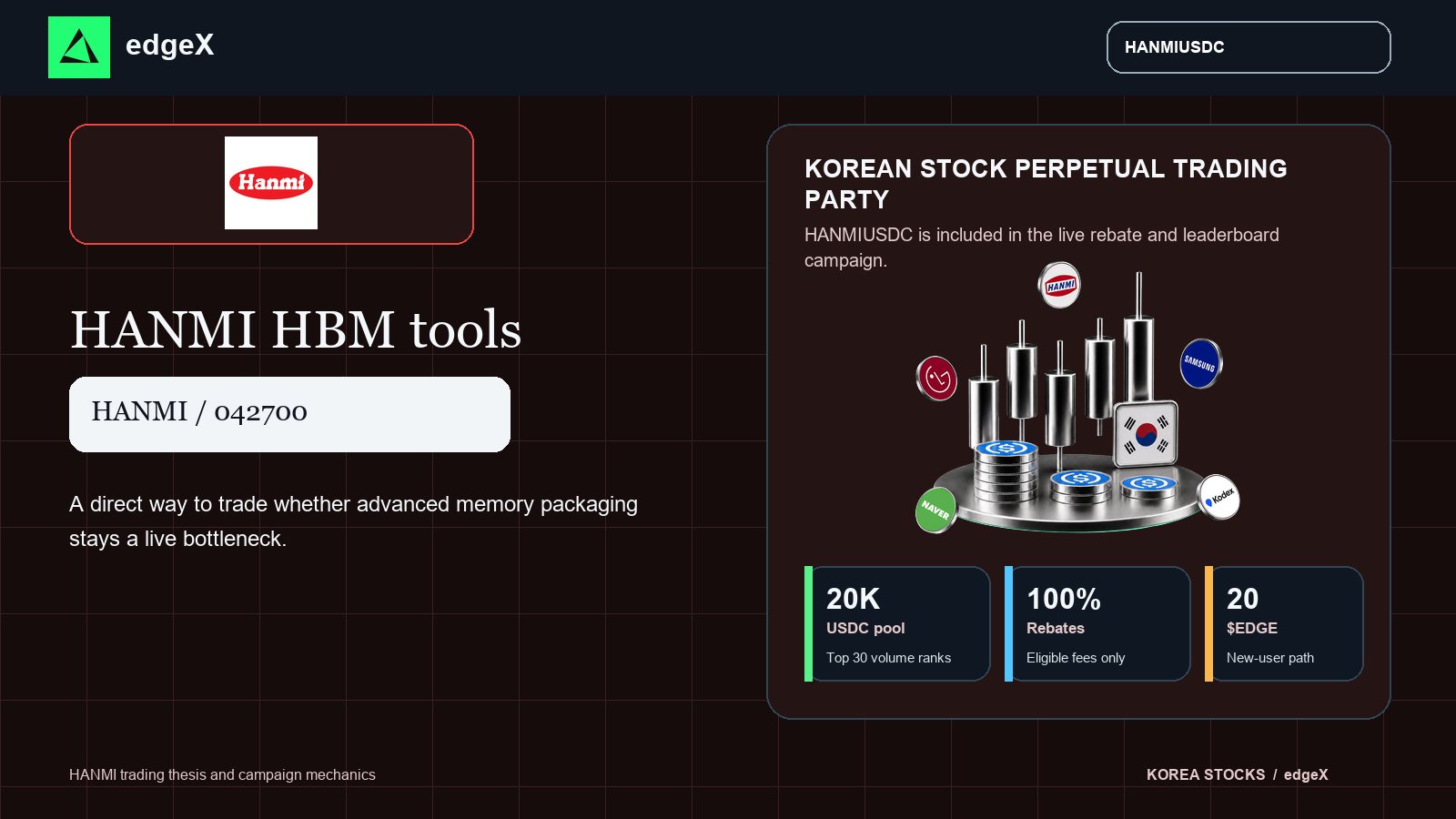
The edgeX Korean Stock Perpetual Trading Party fits HANMI especially well because equipment names can react sharply to supply-chain news, memory sentiment and broker commentary. HANMIUSDC is one of the selected pairs, which means traders can pursue fee rebates, compete for the tiered prize pool up to 20,000 USDC, and still use a market that stays open outside the ordinary Korean session.
Why this campaign fits an event-driven equipment trade
HANMI can move on news that does not wait for a tidy session boundary. If traders are reacting to a memory-spending headline, a packaging bottleneck story or a sector rotation inside Korea tech, the value of 24/7 access can be practical rather than theoretical. The campaign sweetens that access by lowering costs through rebates and by rewarding valid trading volume.
For a high-beta equipment name, the campaign is not the thesis. The thesis is still whether advanced packaging remains scarce. But the campaign changes how efficiently traders can act when that view strengthens or weakens.
What Could Strengthen or Weaken the HANMI Thesis
The bullish case strengthens if customer tool demand remains firm, next-generation packaging work stays visible and the company continues converting scarcity into high margins. That would suggest the cycle is more durable than a typical semiconductor-equipment burst.
The thesis weakens if the market starts to believe customers over-ordered, if packaging capacity catches up faster than expected, or if technology transitions become less favorable. HANMI can remain a good company and still become a weaker stock if the bottleneck story fades.
Trade HANMI Perpetuals on edgeX
TradFi access no longer has to stop when traditional exchanges close. edgeX gives traders around-the-clock access to selected stock perpetuals through a self-custodial venue. Users retain control of their assets while the platform is built for fast execution and transparent on-chain settlement.
The HANMI/USDC perpetual lets eligible traders express a long or short view without waiting for the next Korean session open. A perpetual is a derivative, not ownership of Hanmi Semiconductor shares, so traders should verify current leverage, funding, fees, liquidity, index methodology, contract specifications and regional availability before acting.
Frequently Asked Questions
What does Hanmi Semiconductor sell?
Hanmi Semiconductor sells semiconductor packaging and assembly equipment and is widely associated with TC bonders used in advanced memory production.
Why is HANMI linked to the AI trade?
Because AI server demand has increased the importance of HBM, and HBM expansion depends on packaging tools as well as chip demand.
Is the edgeX perpetual the same as owning Hanmi Semiconductor stock?
No. It is a derivative contract and does not provide shareholder rights, dividends or voting power.
What is the biggest risk for HANMI traders?
The biggest risk is that the packaging bottleneck eases faster than expected, turning a premium scarcity story into a more ordinary equipment cycle.

