Hammersmith Bridge Stands as a Test of Burnham's Place-Based Growth Agenda
Key Takeaways
- •Hammersmith Bridge has been closed to motor traffic since April 2019 and to all users since August 2020, with pedestrian and cyclist access restored in July 2021.
- •Around 22,000 vehicles used the bridge each day before it closed, and that traffic has been diverted onto surrounding routes in Putney, Barnes, Richmond and Hammersmith.
- •More than 70% of local businesses have reported that the closure has affected their staff, suppliers or customers.
- •The article says Hammersmith and Fulham Council cannot cover the roughly £300 million reopening cost alone, while essential works to keep the bridge open to pedestrians and cyclists are estimated at £128 million.
- •The Department for Transport has a £1 billion Structures Fund, which the article says could support a long-term repair that restores the bridge’s full transport role.
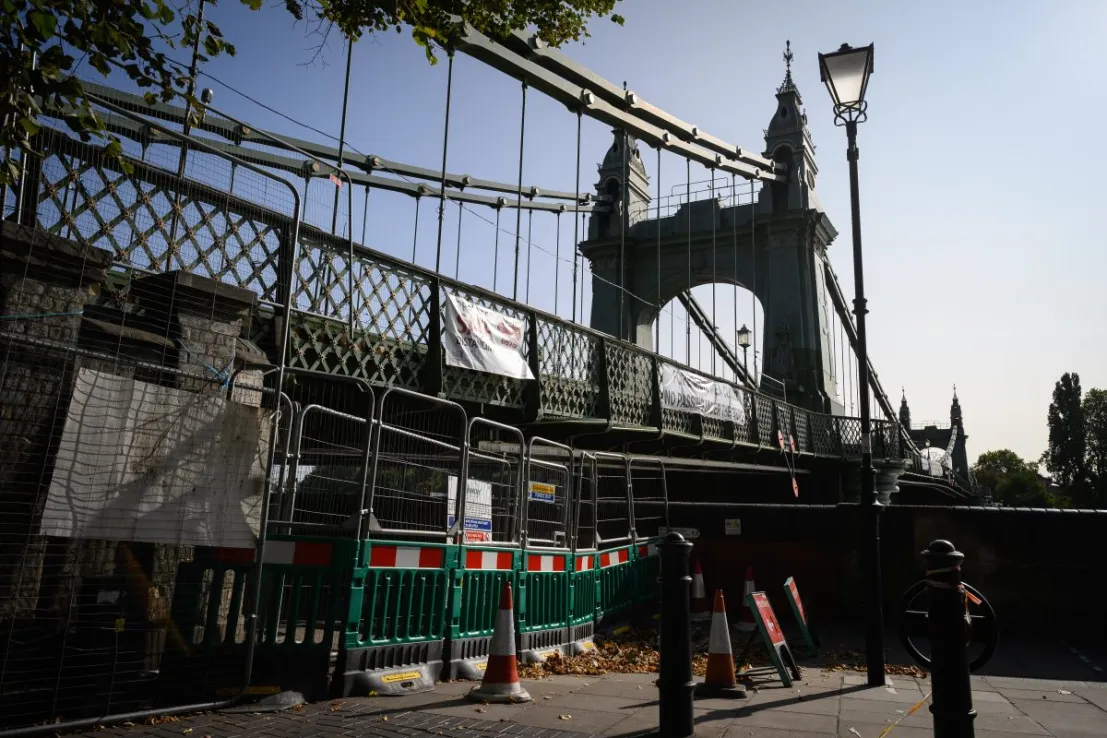
Funding the reopening of Hammersmith Bridge is not special pleading for the capital — it is common sense, writes Tolga Inanc.
Andy Burnham, the Mayor of Greater Manchester since 2017, has promised to reshape Britain's economy around greater devolution, local investment and growth 'in every postcode'. At the heart of that agenda sits a compelling idea: government should identify the barriers holding places back and give them the investment and powers needed to grow.
Hammersmith Bridge should be an obvious candidate for action.
Seven years of closure
For seven years, one of south-west London's most important transport arteries has been closed to vehicles and emergency services. The Grade II* listed suspension bridge, designed by Sir Joseph Bazalgette and opened in 1887, was shut to motor traffic in April 2019 after cracks were discovered in its cast-iron pedestals, closed to all users in August 2020, and reopened only to pedestrians and cyclists in July 2021. There is still no funded route to reopen it to all modes of transport, despite the economic consequences being felt across Putney, Barnes, Richmond and beyond.
Cities depend on connectivity. People need to reach jobs, businesses need customers and suppliers, and emergency services need reliable routes. When infrastructure stops functioning as intended, the economic activity that depended upon it does not simply disappear. It becomes slower, more expensive and less productive.
Before its closure, around 22,000 vehicles crossed Hammersmith Bridge every day. Those journeys have not vanished. They have instead been displaced onto other routes through Putney, Barnes, Richmond and Hammersmith, adding congestion, extending journey times and placing greater pressure on surrounding roads.
Inanc is not currently a car driver and cycles around Wandsworth, and strongly supports walking, cycling and public transport. But hundreds of thousands of Londoners still rely on cars, and Hammersmith Bridge remains a vital road artery. That traffic does not vanish simply because the bridge is closed to it.
Nor is there any longer a convincing argument that political fragmentation makes the problem intractable. The bridge is owned by Hammersmith & Fulham Council, but its southern end sits in Barnes, in the neighbouring borough of Richmond upon Thames — a boundary that has fed years of argument over who should pay for its upkeep. In 2019, Fleur Anderson MP campaigned in Putney on a platform that central government — then Conservative-run — should foot the bill for repairing Hammersmith Bridge. Seven years on, Labour runs every level of government: Hammersmith & Fulham Council, City Hall and No 10. If Labour wanted to reopen the bridge, it could.
Hammersmith & Fulham Council cannot reasonably absorb the roughly £300m cost of reopening the bridge alone. Yet in July, plans for a full repair were scrapped, while the estimated cost of essential works simply to keep it open for pedestrians and cyclists rose to £128m.
That should prompt a basic value-for-money question. If taxpayers are being asked to spend such a substantial sum maintaining a bridge at a fraction of its intended capacity, while the Department for Transport has a £1bn Structures Fund, why not invest in a long-term solution that restores its economic function?
The cost of doing nothing
The consequences of inaction extend well beyond motorists.
Congestion means slower bus journeys. Longer and less predictable journeys make it harder for businesses to move staff and goods. Traffic displaced onto surrounding roads affects air quality and local communities. More than 70 per cent of local businesses have reported that the closure has affected their staff, suppliers or customers.
Individually, these may look like relatively small inefficiencies. Across seven years and millions of journeys, they accumulate into the sort of drag on productivity that a government supposedly obsessed with place-based growth should want to remove.
London remains Britain's largest economic engine, generating around 40p of every pound of tax collected by government. Making it more productive is not special pleading for the capital; London's growth helps finance investment across Britain.
That is also why 'Manchesterism' faces an intellectual test.
If it means empowering places and investing in productive infrastructure wherever growth is being constrained, it is a serious economic philosophy. If it means investment for some parts of the country while productive infrastructure is neglected because spending money in the capital is politically unfashionable, it risks becoming regional favouritism dressed up as economic strategy.
Growth should not be a zero-sum contest between London and Manchester, or north and south. A bridge that delivers a credible economic return should be repaired wherever it crosses.
If place-based growth means anything, it should mean fixing infrastructure that demonstrably connects people, businesses and communities and allows an important part of Britain's most productive city to function properly.
Reopening Hammersmith Bridge to all modes of transport would be a relatively simple way for Burnham to demonstrate that his growth agenda applies to every part of Britain.
After seven years, the question is no longer who is responsible. It is whether the government has the political will to get it done.
Tolga Inanc is an approved parliamentary candidate for the Conservative Party.
