GTA 6 Could Create a New Crypto Payments Market for Sponsored Content
Key Takeaways
- •Grand Theft Auto VI is scheduled for release on November 19, 2026, and its launch is expected to generate a large secondary market of creator content and sponsorship demand beyond software sales.
- •CreatorFi said in early September 2026 that it secured up to $45 million in financing commitments, advancing capital against projected creator earnings from platforms including YouTube, TikTok, Spotify and Roblox.
- •In April 2026, Meta began offering USDC payouts to select creators in Colombia and the Philippines through Stripe, with supported wallets on Solana and Polygon.
- •Diameter Pay raised $10 million in September after reporting it processed more than $10 billion in payment volume during 2026, serving financial institutions with dollar accounts, payments and stablecoin on- and off-ramps.
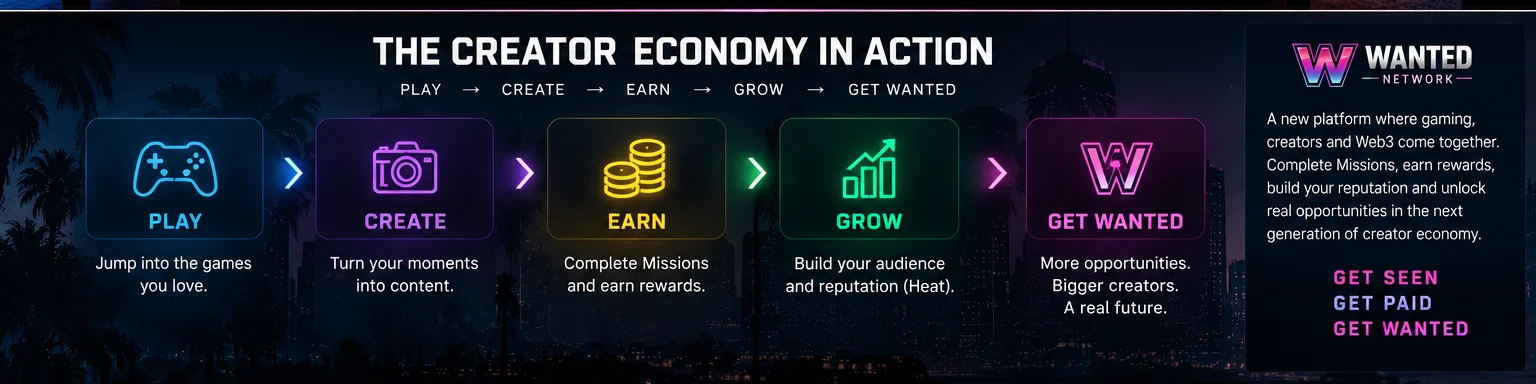
- •Wanted Network, an independent creator campaign network not affiliated with Rockstar Games or Take-Two Interactive, uses structured Missions and a reputation score called Heat, with WNTD planned as a Solana SPL utility token for rewards and ecosystem participation.
For years, crypto sought to make games more financial. The next opportunity may be the reverse: making the creator economy built around major games more efficient.
Grand Theft Auto VI is scheduled for November 19, 2026, and its release is already expected to be one of gaming’s largest attention events. However, the economic impact will extend beyond software sales. A blockbuster game can generate a second market around itself, including livestreams, reaction videos, guides, edits, memes, roleplay, commentary, Discord communities, sponsorships and thousands of independent creators competing for attention.
That matters to crypto because the creator economy increasingly resembles a financial market rather than a social-media side hustle. Creators are becoming small media companies, brands are purchasing distribution from them, platforms are underwriting future earnings, and payment providers are competing to move creator revenue across borders.
The central question is no longer whether creators can earn money online. It is who will build the infrastructure connecting attention with money.
GTA 6 is arriving as influencer marketing becomes more sophisticated
Influencer marketing was once easy to describe: a brand paid a creator for a post. That model still exists, but the systems supporting it have become more complex. Campaigns now include creator discovery, briefs, approval workflows, disclosure requirements, audience-quality assessments, performance tracking, usage rights, payment terms and repeat relationships.
The creator is no longer merely a distribution endpoint. The creator is an operating business.
The change is also visible in finance. In early September 2026, CreatorFi said it had secured up to $45 million in financing commitments for creator-led businesses. Its model advances capital against projected earnings from platforms including YouTube, TikTok, Spotify and Roblox. The broader implication is that creator cash flow is increasingly being treated as measurable and financeable.
A launch such as GTA 6 could intensify that trend. The game may generate substantial demand for sponsored content without Rockstar having any involvement in those sponsorships. Hardware brands, gaming-accessory companies, streaming tools, communities, crypto projects and consumer-product businesses may all seek access to audiences forming around the release.
The challenge will be converting that demand into an organized market.
Coordination and payment are the main bottlenecks
There is unlikely to be a shortage of GTA 6 content. The more difficult problem will be finding reliable systems that answer basic commercial questions: Which creators fit a campaign? What should they produce? How will the work be reviewed? How can a sponsor determine whether the content is authentic? Who gets paid, how quickly and in what currency?
These questions may be less exciting than game trailers or token launches, but they are where durable businesses are built.
Traditional influencer-marketing platforms address some coordination needs, while payments remain fragmented. Creators may earn income from platforms, sponsors, affiliate programs, subscriptions and communities, each with different payout schedules, currencies and intermediaries.
Crypto payments become more relevant when they operate in the background.
In April 2026, Meta began offering USDC payouts to select creators in Colombia and the Philippines through Stripe, with supported wallets on Solana and Polygon. Meta did not need to launch a new social token. The underlying content business remained unchanged; only the payment rail changed.
That represents a more mature crypto proposition.
Stablecoins address the routine payment problem
Stablecoin payments have become one of crypto’s strongest real-world use cases because their value proposition is straightforward. A dollar-denominated asset can move across blockchain networks without waiting for conventional international settlement. Depending on available services and local rules, a creator or business can receive funds in a compatible wallet, hold them, transfer them or convert them.
Users do not necessarily need to care about “Web3.” They care that the money arrived.
This is why stablecoin payment infrastructure continues to attract investment. Diameter Pay raised $10 million in September after saying it had processed more than $10 billion in payment volume during 2026. The company serves financial institutions with dollar accounts, payments and stablecoin on- and off-ramps.
The implication for the creator economy is straightforward: crypto becomes more useful when it functions as infrastructure rather than as the pitch itself.
A gaming creator should not need to become a token analyst to complete a campaign. A sponsor should not need to design a blockchain economy to pay creators. The technology earns its place when it reduces friction in a workflow that users already understand.
A functioning sponsored-content market needs more than wallets
Payments alone do not create a functioning creator marketplace. A wallet cannot tell a brand which creator is trustworthy. A stablecoin cannot determine whether a submission followed a campaign brief. Fast settlement does not resolve fake engagement, campaign eligibility or quality-control problems.
The market also needs a coordination layer that includes structured campaign briefs, creator reputation, submission review, eligibility rules, reward pools and a persistent record of participation.
That combination can be more important than any individual payment method because it creates a repeatable path from advertiser intent to creator output. The game supplies attention. Creators turn that attention into media. Brands purchase access to the media. A network coordinates the transaction.
Crypto can support rewards, payments, access or economic participation beneath that system without claiming to be part of GTA 6 itself.
Wanted Network is targeting the coordination gap
Wanted Network is one example of a platform designed around this model. It is an independent creator campaign network starting with gaming and is not affiliated with Rockstar Games or Take-Two Interactive.
Its current Missions use structured creator briefs, submission requirements and review to onboard creators and test participation. Approved activity can contribute to Heat, the platform’s creator-reputation score, while rules specific to each Mission determine eligibility and rewards.
This current layer is separate from the planned commercial layer. Wanted Network’s whitepaper describes Sponsored Missions as externally funded creator campaigns in which advertisers fund structured briefs for the network. The campaigns are intended to connect advertiser demand with eligible creator work rather than automatically paying every person who submits content.
The project also separates reputation from token utility. Heat is intended to support ranking, reputation and eligibility. WNTD is the planned Solana SPL utility token for creator rewards, access, platform tools and broader ecosystem participation as those functions become available.
The platform does not need WNTD to exist inside GTA 6. Instead, it is attempting to build an economic layer around creators and campaigns that emerge during major gaming attention cycles.
More information is available through Wanted Network’s official channels:
- Website:
- Whitepaper:
- X: https://x.com/Wanted_Network
Creator marketplaces could become financial infrastructure
The first era of the creator economy focused on distribution. The next may focus on infrastructure.
Creators already know how to produce content, and brands already know they want attention. The missing layer increasingly consists of everything between those points: discovery, trust, campaign execution, reputation, payment and repeat commercial relationships.
GTA 6 could make that gap particularly visible because the attention wave may be enormous and the creator supply global.
If that happens, the companies that benefit may not be those trying to force crypto into the game. They may instead be the companies that make it easier for creators to turn cultural attention into structured commercial opportunities while making the payment layer nearly invisible.
That would be a quieter crypto transformation than the industry is accustomed to. It may also be a more useful one.

