Elon Musk's Grok AI Predicts the Best Privacy Coin: Monero (XMR) vs. Zcash (ZEC)
Key Takeaways
- •Monero enforces privacy on every transaction by default through ring signatures, stealth addresses, and RingCT, making it the stronger pure-privacy technology in Grok's assessment.
- •Zcash relies on optional shielded pools built on zk-SNARKs, but much of its historical activity has remained transparent, shrinking its effective anonymity set.
- •Monero trades near the mid-$600s with roughly a $12 billion market cap and has used a fixed tail emission since 2022, whereas Zcash's supply is capped at 21 million coins.
- •Grok projects Monero could climb toward $900–$1,200 and Zcash toward $1,800–$2,500 from Q4 2026 into 2027, but only if broader market conditions stay constructive.
- •Privacy coins face regulatory scrutiny and have been delisted by several major exchanges in certain jurisdictions, narrowing where XMR and ZEC can be traded.
Grok, the AI chatbot developed by Elon Musk's xAI, was asked to break down the two premier privacy-focused cryptocurrencies, Zcash (ZEC) and Monero (XMR), and to assess which token is best from both an investment and a technical perspective. The central questions: which of the two has the higher price upside in 2026, and which offers the best privacy technology?
The comparison was produced by 99Bitcoins, which posed the questions to the AI model. According to the findings, Monero (XMR) is recognized as the superior pure-privacy technology, while Zcash (ZEC) appears better positioned for significant percentage gains through the rest of 2026. For context, xAI rolled out Grok in late 2023, and outputs like this are AI-generated interpretations rather than independent analyst research.
Privacy Technology: Monero's Always-On Anonymity vs. Zcash's Optional Shielding
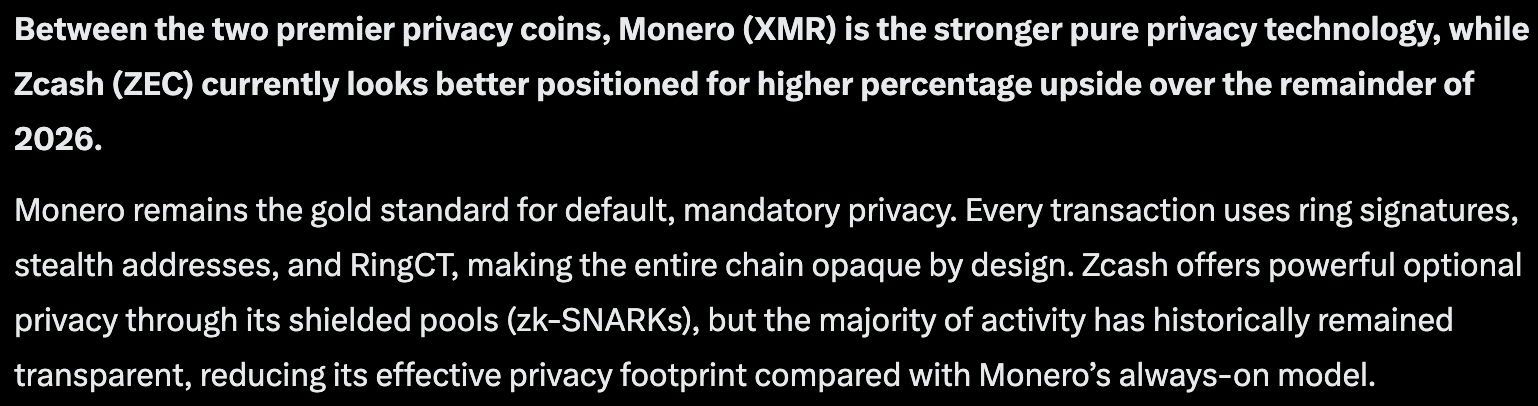
Monero is considered the gold standard for privacy because it enforces mandatory privacy features by default. Every transaction utilizes ring signatures, stealth addresses, and Ring Confidential Transactions (RingCT), which intentionally make the entire blockchain opaque.
Zcash, which launched in 2016 — two years after Monero's 2014 debut — provides strong optional privacy through its shielded pools, which rely on zero-knowledge proofs known as zk-SNARKs (zero-knowledge succinct non-interactive arguments of knowledge). However, much of Zcash's activity has historically remained transparent, which has reduced its effective privacy footprint compared with Monero's always-on approach. (Source: X.com)
Technical Snapshot: How XMR and ZEC Are Trading
Monero is trading near the mid-$600s with a market capitalization of roughly $12 billion. It has shown relative resilience, holding higher lows in recent weeks and maintaining steadier trading volume than many mid-cap assets. Key resistance sits overhead near recent local highs, while support has formed in the mid-to-high $500s. Its monetary design also diverges from Bitcoin's: since 2022, Monero has run a fixed tail emission that keeps new issuance steady rather than letting it fall to zero, while Zcash, like Bitcoin, is capped at 21 million coins.
Zcash has been more volatile, recently trading in a wide range with stronger short-term momentum swings and a 24-hour volume that is significantly higher relative to its size. Its market cap sits higher, near the low $20 billion range in recent prints. The price has been oscillating between deeper pullback zones and sharp relief rallies, reflecting its higher beta and sensitivity to narrative shifts.
Pure Privacy Comparison: Which Token Functions Best?
From a pure privacy and fungibility standpoint, Monero is superior. Its default-on privacy makes chain analysis considerably harder and preserves fungibility more effectively. The analysis frames this as the difference between privacy by design and privacy by choice. Zcash's optional shielding is cryptographically strong when used, but optional privacy creates a smaller anonymity set and leaves more of the chain transparent.
On pure technical privacy grounds, XMR wins. On market structure and potential percentage upside from current levels, however, ZEC's higher volatility and lower relative maturity in this cycle give it a larger swing range if privacy narratives regain force.
Price Outlook for Monero and Zcash Through Q4 and Into 2027
(Source: TradingView)
In a constructive broader market, the analysis suggests Monero could grind higher toward $900–$1,200, with a stretch into the mid-$1,000s if privacy demand strengthens. Zcash, with its higher beta, has room for a sharper move and could retest the $1,800–$2,500 zone, with an aggressive stretch toward prior-cycle extremes if shielded adoption and narrative momentum accelerate. Both projections cover the fourth quarter of 2026 and extend into 2027.
Market access is a background variable for those targets: privacy coins have drawn regulatory scrutiny in recent years, and several major exchanges have delisted them in certain jurisdictions, narrowing where each token can be traded. The projections are also explicitly conditional, resting on the constructive broader market the analysis itself assumes — making overall market conditions, Zcash's shielded adoption, and the support and resistance zones already mapped the practical markers to track through the fourth quarter and into 2027.
Bottom Line: Grok's Verdict
Elon Musk's Grok AI predicts that, while Monero is the better privacy coin, Zcash currently offers the larger upside asymmetry if risk appetite returns to the privacy sector.
Source: 99Bitcoins

