GOOGL Stock in Focus as Gemini 4 Carbon Tops AI Rankings and OpenAI Eyes Google TPUs
Key Takeaways
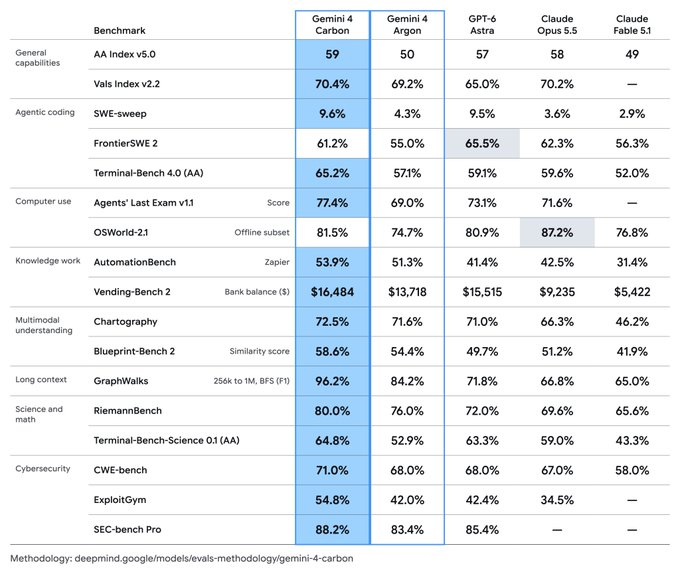
- •Gemini 4 Carbon scored 59 on the Artificial Intelligence Index, placing it ahead of Claude Opus 5.5 at 58 and GPT-6 Astra at 57.
- •Google reported the model more than doubled its Argon predecessor's secure-code generation success rate and achieved 88.2% vulnerability detection on SEC-bench Pro.
- •Introductory pricing of $2 per million input tokens and $10 per million output tokens is scheduled to double after the introductory period, and broader access beyond the Fairwind Program has no announced date.
- •Unconfirmed reports indicate OpenAI plans to buy Google's custom TPUs, having begun renting the chips in 2025, though neither company has confirmed an agreement or disclosed financial terms.
- •Needham analyst Laura Martin reiterated a Buy rating and $450 price target on Alphabet, implying roughly 38.5% upside, while estimating Waymo's vehicle spending could reach about $4 billion by the end of 2028.
Google’s launch of Gemini 4 Carbon, a new artificial intelligence model, has drawn attention to Alphabet’s (NASDAQ: GOOGL) AI business and infrastructure strategy. The model was introduced on Oct. 28 and subsequently ranked first in Artificial Analysis’ comparison, while reports indicated that OpenAI may purchase Google’s custom Tensor Processing Units (TPUs).
Neither Google nor OpenAI has confirmed a purchase agreement, and the financial terms of any potential transaction remain undisclosed. Separately, Needham analyst Laura Martin reiterated a Buy rating on Alphabet and maintained a $450 price target.
Gemini 4 Carbon leads reported benchmark rankings
According to Google’s announcement, Gemini 4 Carbon scored 59 on the Artificial Intelligence Index. That placed it ahead of Claude Opus 5.5, which scored 58, and GPT-6 Astra, which scored 57. The single-point gaps among the top three underline how tightly matched the leading models are in independent evaluations.
Google said Gemini 4 Carbon is designed for cybersecurity work and complex engineering assignments that can take several days to complete. The company reported that the model achieved an 88.2% score for vulnerability detection on SEC-bench Pro and 54.8% on ExploitGym. Carbon also scored 71.0% on CWE-bench, a benchmark measuring the ability to identify and patch software weaknesses.
Google said Gemini 4 Carbon generated secure code at more than twice the success rate of its predecessor, the Argon model. The company is initially making Carbon available to selected cybersecurity defenders through its Fairwind Program. Google has not announced a date for broader access.
Introductory pricing begins at $2 per million input tokens, while output tokens initially cost $10 per million. Both standard rates are scheduled to double after the introductory period, a step-up that will be worth monitoring alongside any announcement on broader access. Google’s enterprise AI strategy has also attracted attention from analysts following Alphabet’s cloud business.
Reports link OpenAI to Google’s TPU platform
Amid Google’s expanding AI operations, reports have said that OpenAI plans to purchase Google’s custom TPUs. Such a transaction would give OpenAI direct access to Google’s AI processors, although the two companies have not confirmed that an agreement exists.
OpenAI has relied heavily on Nvidia processors to train and operate its AI models, but it has also explored additional suppliers as demand for computing capacity increases. Google originally developed TPUs for its own systems before making them available to outside customers, including companies developing competing AI products.
According to reports, OpenAI began renting Google’s AI chips in 2025 as part of its broader computing expansion. Oracle has also announced plans to provide access to Google TPUs through its cloud infrastructure. The reported purchase, if completed, could give Alphabet another customer for its AI processors and expand TPU adoption beyond Google’s own services.
The reported OpenAI plans were also covered by The Information. A related market discussion was posted on X, with additional commentary available here.
Needham maintains $450 Alphabet target
Needham analyst Laura Martin reiterated her Buy rating on Alphabet on Oct. 27 and kept her $450 price target. The article’s key points describe that target as implying approximately 38.5% upside from GOOGL’s Oct. 28 closing price. Separately, using a $316.80 reference price, the target represents approximately 42% upside. The target is an analyst estimate, not a guaranteed share price.
Martin raised questions about Alphabet’s future strategy, noting that Waymo may still need to invest in hardware development while Alphabet also commits capital to AI. She estimated that Waymo’s vehicle spending could reach approximately $4 billion by the end of 2028. That estimate excludes the self-driving business’s operating losses, which would also contribute to the overall cost of expansion.
Martin described Waymo’s estimated $100 billion valuation as “too small to be anything but a distraction.” Needham favors transferring vehicle costs to a third party while retaining access to Waymo’s operating data. Her comments underscore the capital-allocation balancing act Alphabet faces across AI, cloud, and self-driving investments. For GOOGL stock, investors will also evaluate whether Alphabet’s cloud and AI investments translate into earnings growth.
This article is for informational purposes only and does not constitute financial advice. Stock investments involve market volatility and potential losses. Readers should conduct independent research before making investment decisions.
Original source: The Market Periodical.

