Google DeepMind Launches Gemini Robotics ER 2 for Real-Time Spatial Reasoning and Multi-Robot Collaboration
Key Takeaways
- •Google DeepMind's newly launched Gemini Robotics ER 2 operates as a high-level reasoning brain that delegates physical execution to specialized vision-language-action models.
- •The system integrates with the Gemini Live API to achieve sub-second response times, enabling fluid and safe robotic operations.
- •Developers can access the platform via the Gemini API and Google AI Studio to build interactive physical AI agents.
- •The model introduces multi-robot collaboration capabilities, allowing diverse machines to communicate through shared semantic understanding.
- •Google considers this their safest robotics model to date, featuring advanced spatial awareness that safely halts robots when humans are nearby.
Google DeepMind Launches Gemini Robotics ER 2 for Real-Time Spatial Reasoning and Multi-Robot Collaboration
Google DeepMind has launched Gemini Robotics ER 2, the company's most capable "embodied reasoning" model designed to serve as a high-level brain for robots. The model enables real-time spatial reasoning, multi-step task planning, and collaboration between different robots, representing a significant upgrade over its predecessor, Gemini Robotics ER 1.6. The release intensifies competition in the emerging market for general-purpose robotics foundation models, where players including NVIDIA with Project GR00T, Figure AI, Physical Intelligence, and Tesla's Optimus program are all racing to build AI systems that can control physical machines across diverse tasks.
Gemini Robotics ER 2 is now publicly available to developers via the Gemini API, Google AI Studio, and in private preview on the Gemini Enterprise Agent Platform. Developers can use it to build physical AI agents that chat with humans, understand the physical world, and plan multi-step tasks before handing off motor execution to lower-level vision-language-action (VLA) models. This layered architecture — where a reasoning model orchestrates high-level decisions and delegates physical control to specialized execution models — reflects a design philosophy shared by several robotics AI efforts, as an alternative to single end-to-end models that attempt to handle everything from perception to motor control in one system.
The model can natively call tools such as Google Search or any user-defined function. Its architecture allows a robot to "think" about the next step while simultaneously performing current actions, enabling more fluid operation.
Advancing Physical Agentic Capabilities
Most physical-world tasks require multiple steps. Gemini Robotics ER 2 functions as a physical agent that orchestrates steps, enables self-correction, and generalizes to novel situations. Developers can declare low-level control interfaces — including VLA models or navigation APIs — as tools and stream multimodal video, audio, or text directly into the model.
Google reports that Gemini Robotics ER 2 consistently outperforms ER 1.6 for tool orchestration across three control modes: real VLA, simulated VLA, and human tele-operation.
High-level reasoning in robotics depends heavily on execution speed. Gemini Robotics ER 2 integrates with the Gemini Live API, using a bidirectional streaming endpoint optimized for latency-sensitive tasks. The result is fluid orchestration in which the model commands action models and robotics APIs to complete multi-step tasks without the disruptive "stop-and-think" pauses typical of earlier systems. Sub-second response times have long been a prerequisite for safe, closed-loop robot control; achieving them in a large language model–based system narrows the gap between cognitive planning and physical reaction that has historically limited real-world deployment.
To demonstrate these capabilities, Google built a demo using Spot from Boston Dynamics. Gemini Robotics ER 2 orchestrates Spot APIs — such as navigation and manipulator movement — to create an interactive robot that fetches objects on natural language command. The code is available on GitHub alongside other examples.
Temporal Intelligence for Task Completion
Determining when a task is fully complete remains one of robotics' most persistent challenges. Gemini Robotics ER 2 introduces step-change improvements in video understanding and progress tracking, enabling robots to verify that complex tasks — such as tightening a light bulb or tying a trash bag — meet specifications before proceeding.
Continuous Progress Classification
Progress classification refers to a robot's ability to track task completion in real time. In Google's evaluations, each frame in a video feed is assigned to one of five progress levels (0–20%, 20–40%, 40–60%, 60–80%, 80–100%). By quantifying task progress, the model gives robots situational awareness, allowing them to adjust actions on the fly or retry failed steps without restarting an entire workflow.
Gemini Robotics ER 2 achieves 57.4% accuracy on progress classification tasks, outperforming previous-generation models and competing frontier models.
Precision Moment-Finding
Moment-finding measures a model's ability to identify the exact video frame where a critical event occurs — for example, when to stop pouring coffee into a cup. For moment-finding tasks, Gemini Robotics ER 2 achieves 91.3% accuracy with a 0.96-second mean absolute distance. According to Google, this performance competes closely with much larger model categories while delivering precision at a fraction of the compute cost and four times the execution speed — the sub-second latency required to safely operate physical robots in real-world environments.
Multi-Robot Collaboration
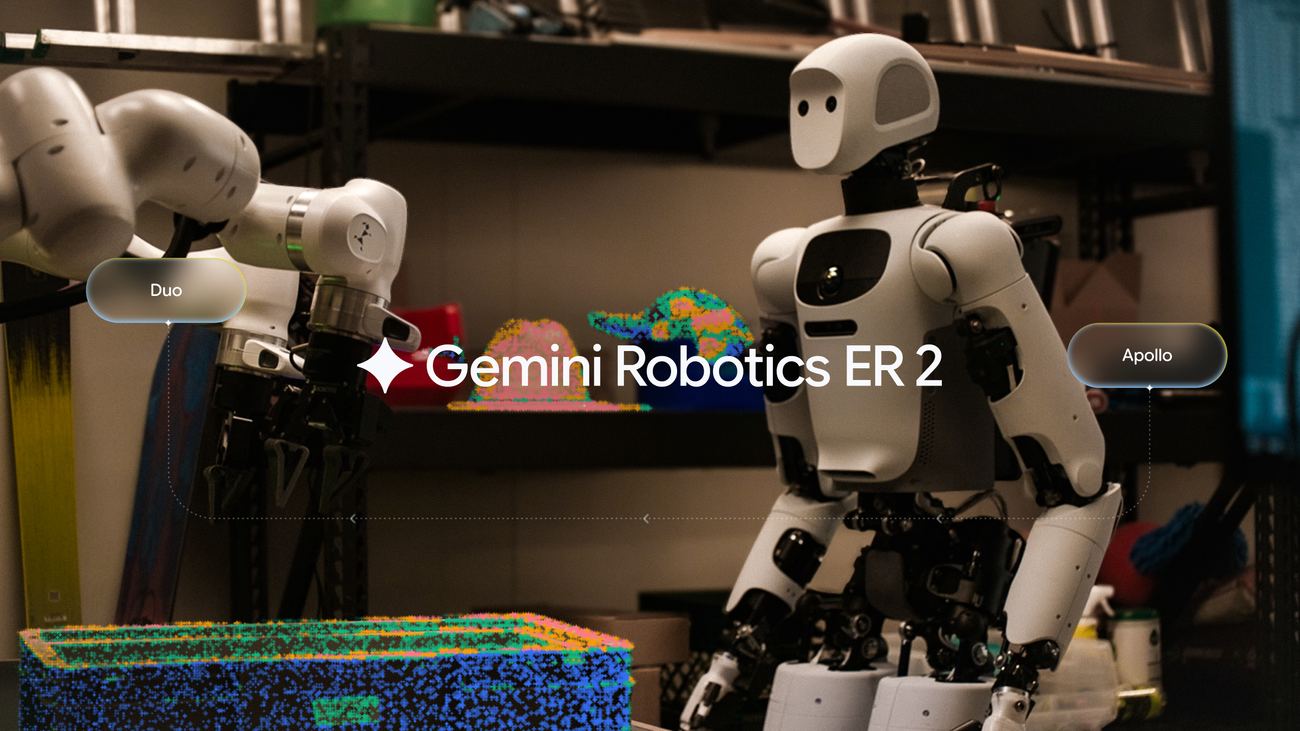
No single robot suits every task: a wheeled rover excels indoors, while a humanoid robot may perform better on uneven terrain. Gemini Robotics ER 2 introduces multi-robot collaboration, allowing diverse machines to communicate via shared semantic understanding to hand off and complete complex tasks. Google has demonstrated this capability with Apptronik's Apollo 2 and the Franka F3 Duo working together. This positions Google alongside Amazon, which has deployed heterogeneous robot fleets in fulfillment centers, though those systems rely on centralized warehouse-management coordination rather than real-time semantic communication between robots of different makes.
Improved Spatial Intelligence
Gemini Robotics ER 2 advances core spatial reasoning capabilities across three benchmarks:
- Success/failure detection: Now operates on raw video feeds rather than static snapshots, enabling the model to catch mid-execution failures such as spills, slips, or misalignments.
- General instrument reading: Extends beyond circular dials and sight glasses to include digital displays, linear scales, rulers, and liquid thermometers. Google tested the capability across 10 different instrument types.
- Enhanced spatial VQA: Improves Visual Question Answering through Gemini's advancements in multi-modal understanding.
The model consistently achieves the highest accuracy across all core capabilities, including success detection (image and video), Question Answering (ERQA), and generalized instrument reading.
Safety Advancements
Google describes Gemini Robotics ER 2 as its safest robotics model to date, with significant gains on Safety Instruction Following and Human Proximity benchmarks — evaluations that test how well a model adheres to physical constraints during reasoning tasks and its spatial awareness for detecting nearby humans. These benchmarks carry practical weight as industrial robotics shifts from traditional caged deployments toward collaborative environments where humans and robots share workspaces.
In testing, Gemini Robotics ER 2 successfully halted a humanoid robot when a person entered its vicinity and autonomously resumed work only once the area was clear.
Google is also introducing a new benchmark that evaluates a foundation model's capacity to act as a safe VLA orchestrator. The benchmark tests a model's ability to enforce safety constraints, monitor the environment, assess physical feasibility, and seek human clarification. Full details are available in the safety technical report.
Gemini Robotics ER 2 outperforms ER 1.6 and other frontier models on both the Safety Instruction Following and Human Proximity benchmarks.
Looking Ahead
Google stated that it plans to push the model toward even more complex tasks to accelerate the development of helpful robots and support the broader robotics community. Developers can find configuration and prompting examples on GitHub and review the model card for additional details.

