Gold SWOT: Evolution Mining Expands Copper Growth Pipeline
Key Takeaways
- •Platinum was the strongest-performing precious metal of the week with a 3.49% gain, whereas silver posted the largest decline at 1.60%.
- •Senior gold producers have returned $10.9 billion to shareholders year-to-date through dividends and buybacks, already surpassing last year's record of $8.6 billion.
- •Evolution Mining agreed to acquire Carnaby Resources for A$213 million at a 60% premium, broadening its copper growth pipeline alongside industry diversification into electrification metals.
- •Nornickel's palladium production dropped 14% and platinum output fell 16% in the first half of 2026 compared with the prior year, reflecting weaker supply from the world's largest palladium producer.
- •Alamos Gold raised all-in sustaining cost guidance to $1,775–$1,875 per ounce and cut production targets at its Mulatos mine due to longer-than-expected leach cycles.
Gold SWOT: Evolution Mining Expands Copper Growth Pipeline
By Frank Holmes
Strengths
Platinum was the best-performing precious metal of the week, gaining 3.49%. BMO estimates that China has accumulated roughly 30,000 tonnes of above-ground gold—well above official figures—and now represents approximately one-third of global gold demand. The firm believes China's long-term strategy to bolster the renminbi's credibility encompasses continued overseas mine acquisitions (approximately $18 billion to date) alongside sustained central bank gold purchases. At its current pace, the People's Bank of China could continue acquiring gold for another five years before its reserves reach levels comparable to U.S. Treasury holdings. This trend aligns with broader dedollarization efforts among emerging-market central banks diversifying reserves away from U.S. dollar-denominated assets.
Senior gold producers continued to deliver record shareholder returns. Annualized dividends and share buybacks reached $10.9 billion so far this year, already exceeding last year's record of $8.6 billion. From 2024 through 2026, senior producers are projected to return more capital to shareholders than during the previous 13 years combined. With two quarters remaining and several buyback programs still in progress, Canaccord expects total capital returns to climb further if precious metal prices hold near current levels. The strong capital return environment reflects the sector's improved balance sheets following years of disciplined capital allocation since the last commodity downturn.
Valterra continued its focus on shareholder returns. The company's platinum business reported first-half 2026 EBITDA that was 9% above consensus expectations, while its dividend surpassed consensus estimates by 20%. The results extend Valterra's track record of returning excess cash to shareholders, reinforcing management's commitment to capital discipline.
Weaknesses
Silver was the worst-performing precious metal of the week, declining 1.60%. Impala Platinum temporarily halted mining operations at its Rustenburg complex in South Africa from July 24–28 to conduct a comprehensive safety reset following an uptick in serious workplace incidents. According to Bloomberg, the operation employs approximately 51,500 workers and accounts for nearly half of Implats' total platinum production, underscoring the scale of the temporary shutdown. South Africa's deep-level platinum and gold mines are among the world's deepest, and safety stoppages remain a recurring operational challenge for producers in the Bushveld Complex.
Nornickel reported lower platinum and palladium output in the first half of 2026. According to Interfax, palladium production fell 10% year-over-year to 590,000 ounces in the second quarter, while platinum output declined 6.5% to 145,000 ounces. For the first half of 2026, palladium and platinum production were down 14% and 16%, respectively, compared with the same period a year earlier—reflecting weaker supply from one of the world's largest producers. As the world's largest palladium producer, Nornickel's output declines are particularly notable for a market where autocatalyst demand remains the primary consumption driver.
Petra Diamonds reported weaker-than-expected fourth quarter results. Production and sales fell below BMO's estimates, primarily due to the suspension of operations at the Finsch mine during the quarter, while the Cullinan mine remained operationally stable. Revenue was also pressured by continued softness in demand for smaller-sized diamonds. The rough diamond market has faced headwinds from growing lab-grown diamond penetration and cautious consumer spending in key Asian markets.
Opportunities
Evolution Mining is broadening its copper growth pipeline. The company agreed to acquire 100% of Carnaby Resources for A$213 million, offering 0.0682 Evolution shares per Carnaby share and valuing the transaction at A$0.77 per share. According to RBC, the offer represents a 60% premium to Carnaby's last closing price and a 31% premium to its 30-day volume-weighted average price (VWAP), highlighting Evolution's commitment to expanding its resource base. The acquisition follows a broader industry trend of gold producers diversifying into copper, a metal essential to electrification, electric vehicle manufacturing, and renewable energy infrastructure—demand drivers that are structurally distinct from traditional precious metal markets.
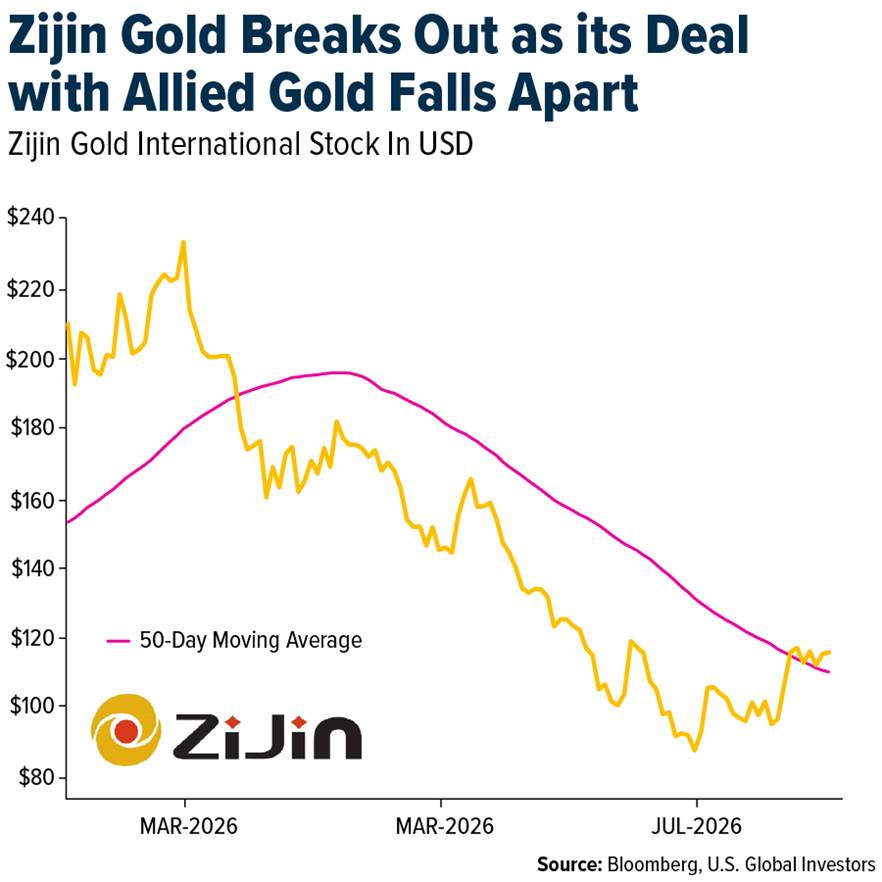
Allied strengthened its financial position ahead of Kurmuk's startup. Although the company terminated its arrangement agreement with Zijin Gold, it secured a $295 million strategic investment that preserves the relationship while substantially improving liquidity ahead of the Kurmuk project's expected August startup. According to CIBC, management also reaffirmed a strong production outlook for 2027–2028, reinforcing confidence in the company's long-term growth strategy. The Kurmuk project, located in Ethiopia, represents one of several new gold developments coming online across East Africa's emerging mining belt.
Gold mining valuations remain broadly in line with historical averages. At current spot gold prices, RBC's royalty coverage trades at 1.69x P/NAV, slightly below its 1-year and 3-year averages of 1.73x and 1.79x, respectively. Its senior producer coverage trades at 1.10x P/NAV, also modestly below historical averages of 1.11x and 1.13x. At spot gold prices, senior producers are generating forward 12-month free cash flow-to-enterprise value (FCF/EV) yields of 7.0%, reflecting continued cash generation despite elevated gold prices. The valuation stability suggests the market has not fully repriced the sector despite gold trading near record levels, a divergence that has persisted through multiple rate cycles.
Threats
The Solomon Islands is proposing higher export duties on gold producers. The country's Minister of Finance and Treasury announced a 15% export duty on alluvial gold and gold concentrates. According to UBS, the measure has not yet been applied to Wanguo, and discussions with the government are ongoing. As a result, the company's current effective export tax rate remains at 1.5%, limiting the immediate financial impact while regulatory uncertainty persists. Resource nationalism—where governments seek a larger share of mining revenues through higher royalties, taxes, or state ownership stakes—has been an increasing trend across multiple mining jurisdictions in recent years.
Bellevue Gold reduced its production growth expectations. According to UBS, the company had previously targeted annual production exceeding 200,000 ounces before revising its FY27 goal to 175,000–195,000 ounces. Its latest FY27 guidance of 160,000 ounces constitutes a meaningful downgrade, particularly as management now emphasizes a target of consistently producing 40,000 ounces per quarter, signaling a more conservative production outlook. Bellevue's operation in Western Australia had been positioned as one of the region's newer high-grade gold mines, making the guidance reduction notable for investors tracking the tier of mid-tier Australian producers.
Alamos Gold raised cost guidance and cut production expectations at Mulatos. According to RBC, the company lowered production targets for its Mulatos mine due to a longer-than-expected leach cycle. Consequently, all-in sustaining cost (AISC) guidance increased to $1,775–$1,875 per ounce, while capital expenditure guidance was also raised modestly to $945–$1,035 million. The Mulatos mine, located in Mexico, has been transitioning to its La Yaqui Grande pit, and leach cycle variability is a common operational factor in heap-leach gold recovery operations.
About the Author
Frank Holmes is the CEO and chief investment officer of U.S. Global Investors. He purchased a controlling interest in the firm in 1989 and became its chief investment officer in 1999. In 2006, Mining Journal selected him as mining fund manager of the year, and in 2011, Brendan Wood International named him a U.S. Metals and Mining "TopGun." In 2016, he and portfolio manager Ralph Aldis received the award for Best Americas Based Fund Manager from Mining Journal. He is co-author of The Goldwatcher: Demystifying Gold Investing. More than 30,000 subscribers follow his weekly commentary in the award-winning Investor Alert newsletter, read in over 180 countries.
Under his leadership, the company's mutual funds have earned recognition from Lipper and Morningstar. In 2015, he led the company into the ETF business with the launch of the U.S. Global Jets ETF, focused on the global airline sector. In 2017, U.S. Global Investors made a strategic investment in HIVE Blockchain Technologies, listed in Toronto, and Mr. Holmes was appointed non-executive Chairman of the Board.
Mr. Holmes was awarded the Huron Medal of Distinction from Huron University College in 2013, his alma mater (class of 1978). A native of Toronto, he is a graduate of the University of Western Ontario with a bachelor's degree in economics and a former president and chairman of the Toronto Society of the Investment Dealers Association.
A sought-after keynote speaker, Mr. Holmes has addressed the Investing in African Mining Indaba, the Denver Gold Group's European Gold Forum, and numerous Money Show events. He is a regular commentator on CNBC, Bloomberg, BNN, and Fox Business, and has been profiled by Fortune and the Financial Times. His weekly gold commentary appears on Gold Game Film in collaboration with Kitco News and TheStreet.com. He is a regular contributor to Forbes, Business Insider, Seeking Alpha, and the Wall Street Journal's Experts Corner.
Frank Holmes serves as non-executive chairman of the Board of Directors of HIVE Blockchain Technologies. Both Mr. Holmes and U.S. Global Investors own shares of HIVE, directly and indirectly. This article should not be considered a solicitation or offering of any investment product.

