Gold Jumps Above $4,300 as Weak U.S. Jobs Data Dampens Fed Rate Hike Bets
Key Takeaways
- •U.S. nonfarm payrolls declined by 23,000 in July, sharply missing economists' forecasts for an 80,000 increase and marking the first monthly drop in five months.
- •Previous months' data was also revised lower, with combined payroll gains for May and June reduced by 103,000 jobs.
- •Markets cut the probability of a September Federal Reserve rate hike to 43.9% from 57% following the weak employment report.
- •Gold posted its strongest weekly performance since January with a gain exceeding 7%, as a weaker dollar and lower Treasury yields boosted demand for the metal.
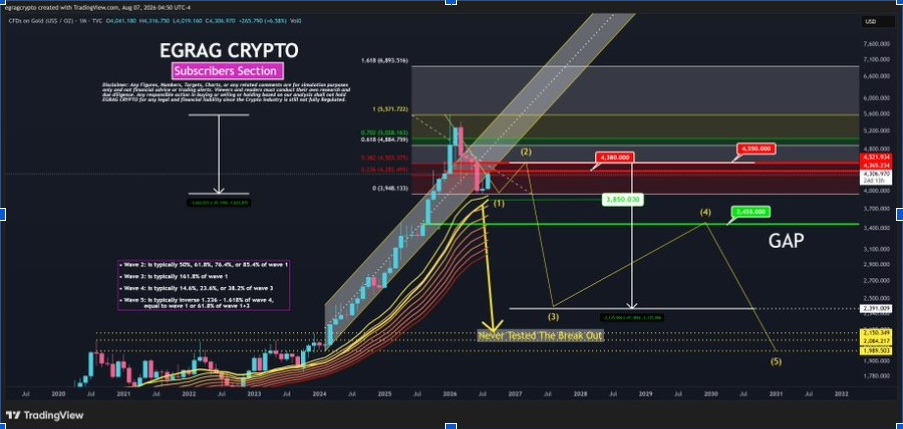
- •EGRAG CRYPTO's technical analysis identifies a recovery zone between $4,380 and $4,550, with a decisive monthly close above $4,550 needed to invalidate the bearish outlook.
Gold prices surged on Friday after July U.S. payroll data pointed to an unexpected contraction in the labor market and sharply reduced expectations for a Federal Reserve rate hike in September.
Spot gold traded around $4,336 late Friday after rising more than 3% intraday. Bullion gained more than 7% for the week, marking its strongest weekly performance since January. Gold had already moved above $4,300 before the labor data was released, but softer jobs figures pushed Treasury yields and the U.S. dollar lower, adding support to the rally.
Weak Payrolls Push Gold Higher
U.S. nonfarm payrolls fell by 23,000 in July, according to Bureau of Labor Statistics data reported by Reuters. Economists surveyed by Reuters had expected payrolls to increase by 80,000.
June employment growth was also revised down to 20,000. Combined payroll gains for May and June were cut by 103,000 jobs.
The unemployment rate eased to 4.1%, although that decline partly reflected a smaller labor force. Labor-force participation fell to 61.4%, its lowest level in nearly five-and-a-half years.
July marked the first monthly decline in nonfarm payrolls in five months. The payroll miss was large enough to shift the market narrative around the Fed's policy path, given that the central bank operates under a dual mandate that includes maximum employment alongside price stability. A contracting labor market complicates the case for maintaining a restrictive policy stance, even if inflation remains above the Fed's 2% target.
Gold reacted quickly to the report. Spot bullion rose 2.3% to $4,336.02 by late Friday trading after gaining more than 3% earlier in the session. U.S. gold futures settled 2.3% higher at $4,399.70.
The dollar weakened and Treasury yields fell as markets scaled back expectations for another Federal Reserve rate increase.
Resistance Levels in Focus
EGRAG CRYPTO's monthly gold price outlook maps a recovery zone between $4,380 and $4,550. In that framework, the area is treated as a possible Wave 2 top within a broader Elliott Wave structure.
Gold is now trading close enough to the lower boundary that $4,380 may serve as the first nearby test. The analysis places greater attention on $4,550, which sits above the current resistance band. A decisive monthly close above $4,550 would invalidate the bearish setup and open the way for a larger upward structure.
Fed Expectations Shift Lower
Interest-rate markets reduced the probability of a September Fed hike after the payroll report. The odds of a September increase fell to 43.9% from 57% before the data, while the probability of no change rose as traders reassessed the labor market and the Fed's next move.
Lower rate expectations often support gold because the metal does not pay interest, making it relatively more attractive when yields on interest-bearing assets decline. The dollar index also fell after the jobs report, while Treasury yields moved lower, easing pressure on bullion after markets had recently priced a stronger chance of another rate increase. Gold is priced in dollars, so a weaker currency makes the metal cheaper for holders of other currencies.
Gold also drew support from lower oil prices and softer near-term energy inflation expectations. Crude prices headed for a weekly decline as U.S.-Iran discussions raised expectations for progress around the Strait of Hormuz. Lower energy prices can reduce inflation pressure and limit expectations for tighter monetary policy.
Silver and platinum also advanced during Friday trading as precious metals rose across the session. Silver traded above $63, while platinum traded near $1,746. Gold, however, posted the larger macro move as the payroll report shifted rate expectations and weakened the dollar.
In the same chart framework, $3,850 is identified as the first major downside level if gold fails near the $4,380 to $4,550 zone. The chart also marks $3,455 as another support area, with the moving average near $3,400. A larger gap on the chart sits around that region and forms part of the analyst's bearish path. The longer-term roadmap extends toward $2,500 to $2,000 if the projected correction fully develops.

