Gnosis Rises 8.49% as GnosisDAO Considers Ethereum Integration Proposal
Key Takeaways
- •GNO gained 8.49% over the past 24 hours to $112.80, though it remains well below its November 2021 peak above $1,000.
- •GnosisDAO is considering GIP-153, which would move Gnosis Chain from a standalone Layer 1 to an Ethereum-settled rollup in an Ethereum Economic Zone framework.
- •The proposal is intended to improve access to Ethereum liquidity, applications, oracles, and on-ramps through synchronous composability.
- •The vote on GIP-153 is open through August 19, and converting the network would still require substantial engineering work even if approved.
- •LiquidChain is building a Layer 3 designed to pool liquidity across Bitcoin, Ethereum, and Solana, with tokens priced at $0.0148 and presale funding at $940,000.
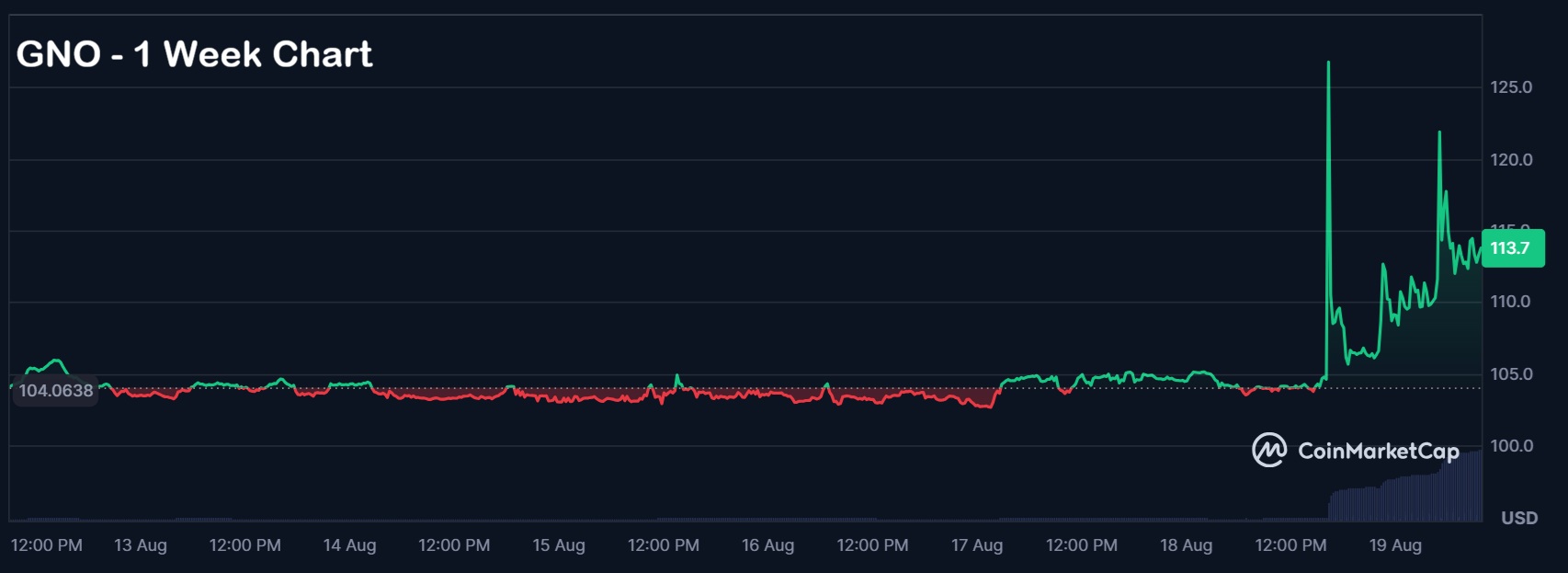
Gnosis is back among crypto’s stronger performers, with GNO rising 8.49% over the past 24 hours to $112.80 — still far below the token’s November 2021 all-time high, which topped $1,000.
The move comes as GnosisDAO considers a substantial change to the network itself. The GIP-153 proposal — GIP stands for Gnosis Improvement Proposal — asks whether Gnosis Chain should transition from a standalone Layer 1 into the Ethereum Economic Zone, a proposed rollup framework designed to give Gnosis much closer access to Ethereum’s liquidity and applications.
The proposal says the main benefit would be synchronous composability with Ethereum, making assets and liquidity on mainnet much easier for Gnosis applications to reach.
The debate provides a notable backdrop for investors searching for the best crypto to buy, as it underscores a wider shift in blockchain thinking: instead of asking which chain will win outright, the question increasingly becomes how multiple successful ecosystems can work together.
It also highlights LiquidChain (LIQUID), which is building a shared liquidity pool around Bitcoin, Ethereum, and Solana. LIQUID is priced at $0.0148, has raised $940,000 in its presale, and offers 1,202% APY through staking.
Gnosis Looks to Ethereum for Deeper Liquidity
Gnosis Chain currently operates as an EVM-compatible Layer 1 with its own validator network. Its history already runs close to Ethereum: the chain began as xDAI Chain, a sidechain where gas is paid in xDAI, a bridged form of the DAI stablecoin, and it was merged into Gnosis and rebranded in 2021, placing it under GnosisDAO’s governance. Under GIP-153, it would instead become an Ethereum-settled rollup — a chain that executes its own transactions but settles to Ethereum — while retaining GNO economics and xDAI for gas.
The rationale is primarily economic. GIP-153 argues that operating as an independent chain has left Gnosis separated from much of Ethereum’s liquidity and asset ecosystem. The proposed EEZ structure is intended to make Ethereum liquidity, oracles, on-ramps, and applications more directly accessible.
The timing also matches Ethereum’s own trajectory. Ethereum’s roadmap has been explicitly rollup-centric since 2020, and a large share of DeFi activity now runs on Ethereum-settled rollups such as Arbitrum and Optimism, which rank among the largest chains by total value locked. GIP-153 effectively asks whether an established standalone chain should join that pattern rather than keep competing with it.
The vote is live through August 19, so the change remains only a proposal, and even a passed vote would still leave the engineering work of converting a live network into a rollup ahead of it. Even so, GNO’s 8% rally illustrates how important liquidity remains in a market where blockchain boundaries can still keep capital fragmented.
LiquidChain Builds Around a Market With Several Winners
LiquidChain starts from a similar observation, but applies it on a broader scale.
Bitcoin, Ethereum, and Solana have all developed substantial economies without becoming interchangeable. Bitcoin holds large pools of capital, Ethereum has deep decentralized finance markets, and Solana has built a fast, active execution environment. Many users now have reasons to interact with more than one of these ecosystems.
The challenge is that capital does not automatically move across chains.
LiquidChain is developing a Layer 3 intended to bring activity from those three ecosystems into a shared liquidity pool. Its architecture is designed to verify Bitcoin transactions, Ethereum state, and Solana accounts in real time, while unified liquidity pools allow applications to access capital wherever it originates. The project says it does this without wrapping or bridging assets.
L1 laid the foundation. L2 scaled it. Now L3 rises above them all. ⟁ pic.twitter.com/X96p0CjhzH — LiquidChain (@getliquidchain) August 19, 2026
In practical terms, users would be able to access liquidity across BTC, ETH, and SOL without needing to focus as much on where their money is sitting. Developers, meanwhile, could build products that tap capital across those ecosystems without maintaining three separate codebases.
That makes an interesting comparison with Gnosis. Gnosis is considering tighter integration with Ethereum because Ethereum contains the liquidity its ecosystem wants. LiquidChain, by contrast, assumes that several major blockchain economies will continue to grow and builds infrastructure around using their liquidity together.
LIQUID Targets the Cost of Fragmented Capital
Fragmentation is often treated as a minor inconvenience, but it is a significant and growing problem. Economically, it can mean thinner markets, more swaps, bridge transactions, and capital held somewhere other than where a user or application needs it.
Bridges in particular have been a recurring security weak point: the Ronin Network and Wormhole exploits in 2022 each caused losses in the hundreds of millions of dollars. That history is part of why designs that avoid bridging and wrapped assets, like the one LiquidChain describes, have become a common pitch.
The Gnosis proposal is an unusually direct acknowledgment of the fragmentation issue. Its authors argue that being a technically capable standalone blockchain is no longer enough when applications need access to larger pools of capital.
LiquidChain’s case rests on the same pressure becoming more widespread.
Rather than asking users to choose among Bitcoin, Ethereum, and Solana, the project argues that infrastructure can make those distinctions less intrusive. An application could benefit from Bitcoin-originating capital, Ethereum liquidity, and Solana-style execution without forcing users to hop chains every few minutes.
LIQUID remains at an early stage. The presale has raised $940,000 so far, with tokens priced at $0.0148. Staking currently offers a 1,202% APY, though the rate is expected to fall as more holders stake. SpyWolf and CertiK have reviewed the project contracts, a common step for early-stage launches that reduces but does not remove technical risk.
The key question is whether developers and users will see value in treating capital across several chains as a shared resource. If they do, LiquidChain is addressing a problem that grows as blockchain ecosystems become more successful, not smaller.
Best Crypto to Buy? LIQUID Bets the Multichain Era Will Last
Gnosis, by considering a fundamental redesign to get closer to Ethereum, points to an important change in blockchain competition.
Being faster or cheaper on its own is no longer necessarily enough. GIP-153 suggests that the real prize is access to liquidity and applications that already exist elsewhere.
LiquidChain extends that logic into a market where there may never be a single center. It is built on the assumption that Bitcoin, Ethereum, and Solana will all remain important, while users become less interested in switching chains all the time.
Crypto already has plenty of capital. LIQUID aims to reduce the friction between different pools by making them function more like one.

