GMX Review 2026: Hands-On Walkthrough of Perp Trading, Liquidity Pools and Referrals
Key Takeaways
- •GMX executes perpetual-futures trades against user-funded liquidity pools at oracle prices rather than matching orders through a traditional order book.
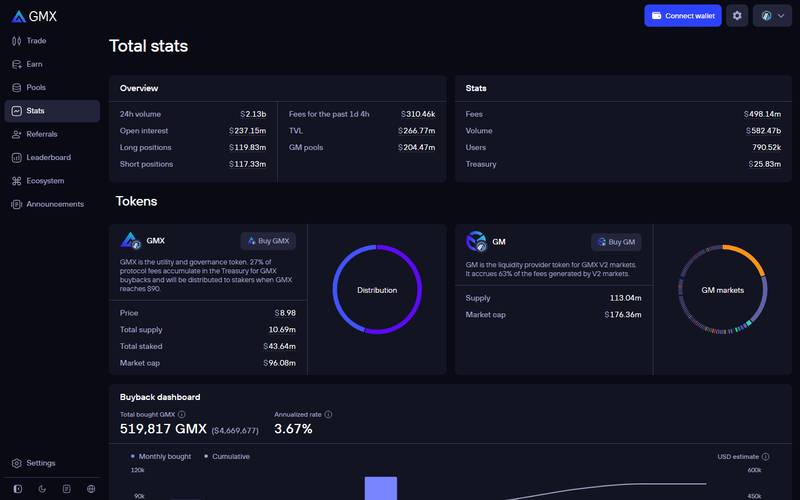
- •Interface data captured on November 5, 2026 showed 791K traders, $238M in open interest, $582B in cumulative volume, and roughly $176.3M in TVL across Arbitrum pools.
- •The live Earn page indicates that 27% of protocol fees accumulate in the treasury for GMX buybacks, with the stakers' share distributed only when GMX reaches $90, well above its roughly $8.98 price on the capture date.
- •Leverage on GMX reaches 100x, but the review cautioned that a move of about 1% against a position can approach liquidation at that level and suggested beginners stay between 2x and 5x.
- •The reviewers rated GMX 7.5 out of 10, citing strengths such as oracle pricing and commodity markets, while acknowledging a learning curve for DeFi newcomers.
A hands-on review published by AiCryptoCore on November 5, 2026 walked through the GMX decentralized exchange interface screen by screen on three devices, capturing live figures from app.gmx.io and gmx.io on the review date. It targets two audiences: readers who have heard of “perps” (perpetual futures) and want to understand how GMX works before committing funds, and traders on centralized exchanges who want to try a decentralized venue where they keep their own keys.
The review states its limits plainly. Every observation was captured live from app.gmx.io and gmx.io — desktop at 1440 x 900, tablet at 1024 x 1366 (iPad size) and phone at 430 x 932 (iPhone 16 Pro Max size). The reviewers did not connect a wallet or place a real trade. Button labels, tabs, figures and on-screen explanations are recorded as observed; claims documented in the GMX docs are referenced there. Wallet actions and any resulting execution, withdrawals, payouts and staking outcomes were not tested. The review’s own caution applies throughout: never trade money you cannot afford to lose.
What Is GMX? (Plain English)
On a conventional exchange such as Binance, a perpetual future lets a trader bet on a price rising (a long) or falling (a short), usually with leverage — borrowed buying power. The trader never owns the coin; they hold a contract that tracks its price and has no expiry date.
GMX offers the same instrument directly from a user’s crypto wallet, with no account and no ID upload. Two structural differences set it apart from most exchanges:
- No order book. On a normal exchange, traders are matched against others waiting in a queue. On GMX, trades execute against a liquidity pool at a price taken from an oracle (a price feed), so the fill does not depend on a thin order book.
- Liquidity providers take the other side. Regular users deposit tokens into pools and earn a share of the fees. When traders lose, the pool gains — and the reverse is also true.
In plain terms: GMX is a perpetual-futures exchange with no order book, where the counterparty is a pool of tokens funded by ordinary users who earn fees from it.
Live Numbers and the Stats Page
On November 5, 2026, the review captured a snapshot of GMX’s “Total stats” page, which consolidates volume, open interest, TVL, fees, user counts and treasury data on one screen, with a buyback dashboard at the bottom. Because the numbers move every few seconds, they should be read as a snapshot. Figures displayed on GMX’s own pages at capture time included 791K traders, $238M in open interest and $582B in total volume. The review advises consulting the stats page before depositing to see whether volume and open interest are healthy.
How GMX Looks on Each Device
Desktop (1440px wide). The navigation menu (Trade, Earn, Pools, Stats, Referrals, Leaderboard, Ecosystem, Announcements) sits on the left; the centre shows a TradingView chart for the selected market with Price, Depth and Net rate tabs; the order box is on the right. The top bar displays 24h volume, open interest, available liquidity and the hourly net rate. This is the layout for serious trading, with chart, order box, positions and fee preview visible at once.
Tablet (1024px wide). The chart shrinks into a narrow column beside the Positions panel, and the Long/Short/Swap buttons move to a bar at the bottom of the screen, from which the order box opens. Price, 24h volume, open interest, available liquidity and net rate stay in a strip at the top that scrolls sideways. This suits monitoring positions and adjusting stop-losses away from a desk; the chart is cramped at this width, so the review recommends desktop for technical analysis.
Phone (430px wide). The page becomes a single column — market selector and price on top, then the chart, then positions — with the Long/Short/Swap buttons pinned to the bottom within thumb’s reach. The Pools page also works on a phone, though long tables need sideways scrolling.
Bottom line on devices: no app is required. GMX is a website that adapts to the screen. Desktop is the most comfortable for trading; a phone is fine for checking positions.
The Landing Page (gmx.io)
The marketing site at gmx.io headlines “Trade 100+ crypto tokens from your wallet” and displays 791K traders, $238M open interest and $582B total volume. “Open app” and “Trade now” buttons lead to app.gmx.io. The review urges readers to check the address bar before connecting a wallet, because fake GMX sites exist. Feature cards further down advertise up to 100x leverage with on-chain liquidity, support for many assets as collateral, the slogans “No deposits required / Trade from your wallet / No loss of fund ownership,” sub-second Chainlink price feeds used against liquidations, and One-Click and Express Trading.
Core Features
1. Trade (Perpetual Futures)
The main screen. The user picks a market, chooses Long or Short, enters a margin (the money put up) and a size (the total position), then sends the order. Order types appear as tabs under Long/Short: Market (execute now), Limit (execute when price reaches the chosen level) and More (additional order types such as trigger orders). A Take-Profit/Stop-Loss switch lets exit levels be attached when the position is opened.
2. Markets: Crypto Plus Gold, Oil and More
Clicking the market name at the top left opens the market list, which on November 5, 2026 showed price, 24h change, volume, open interest and available liquidity per market, each with a maximum-leverage badge. Tabs divide the list into All, Crypto and TradFi, and a “Swap” mode at the top shows spot swap pairs. The TradFi tab groups the commodity and index markets — placing gold and oil alongside BTC in a wallet-based exchange is one of GMX’s most unusual features.
The list carries a leverage warning: at 100x, a move of roughly 1% against a position can bring it close to liquidation, depending on maintenance margin, fees and market conditions. Beginners, the review suggests, should stay at 2x to 5x.
3. Earn: GMX, GLV and GM
The Earn page has four tabs: Portfolio, Discover, Additional opportunities and Distributions. The Discover tab lists three products — GMX (the governance token), GLV (a passive liquidity vault) and GM (a single-market liquidity pool) — while a side FAQ explains where staking rewards come from, GLV versus GM, withdrawals and supported networks.
The review flags an important change from older guides: the live Earn page states that 27% of protocol fees accumulate in the Treasury for GMX buybacks, and that the stakers’ share of this pool is distributed when GMX reaches $90. Older articles describe GMX staking as paying a continuous share of fees in ETH. With GMX trading at about $8.98 on November 5, 2026, the distribution condition was not met, and the review advises checking the Earn page and the Distributions tab for the current rule before staking.
The Total stats page corroborates this with a buyback dashboard: 519,817 GMX bought for about $4.67M, shown with an annualized rate of 3.67%.
4. Pools: GLV Vaults and GM Pools
The Arbitrum pools page headlines $176,282,280 in TVL across vaults and pools over the default 90-day view, with GLV vaults at the top, GM pools below, and filters for All / Favourites / Crypto / TradFi plus a search box. The figures are GMX’s own interface numbers for that window. The reviewers did not recalculate them, and GMX does not display its formula on the page, so they should be treated as the platform’s reported numbers rather than a forecast.
The review explains how to read them: Fee APY measures income from fees alone, while annualized performance also includes changes in the value of the pool’s tokens and the pool’s profit or loss against traders. Annualized performance can be negative even when Fee APY is high — a pool of volatile assets (for example BTC-BTC) can show a large Fee APY and still lose money. A Details link on each row shows pool composition and a performance chart.
5. Referrals
The Referrals page opens on a “Trader benefits” tab stating that traders can save up to 10% on opening and closing fees with a referral code, and that affiliates can earn up to 25% commission. Tabs cover Trader benefits, Create referral code and Distributions.
6. Leaderboard
The leaderboard ranks GMX V2 traders. Its header read “Global | Concluded” at capture time, meaning the competition had ended. Tabs show Top addresses and Top positions, filtered by Last 7d, Last 30d or Total. In the Total view, which ranks wallets by profit, the top address showed about +$8.26M PnL (+111.17%) with a 405/343 win-loss record and the second about +$7.36M. Average leverage across the top 16 ranged from 1.56x to 78.77x — a spread the review cites to show results vary widely and are not a recommendation.
Supported Networks
In the interface observed at capture time, the network selector listed Arbitrum, Avalanche, Solana and MegaETH. The Pools and Referrals pages carry an “Arbitrum data” label showing which network is displayed. One practical note from the Referrals FAQ — which asks “Do I need to enter a code on each network?” — is to check the answer before assuming a code works everywhere.
Fees
Fees need no manual calculation: the order box shows Price impact / fees and an Execution details panel before confirmation. For liquidity providers, the Stats page states that GM tokens accrue 63% of the fees generated by V2 markets; fee details are documented in the GMX fee documentation.
How to Trade on GMX: Step by Step
Steps 1 through 5 were captured from the live interface without connecting a wallet; approving, signing, confirming and resulting order execution were not tested.
Step 1: Open the app. Go to app.gmx.io, or use the launch button on gmx.io. Prices, charts and market data can be browsed without a wallet; the blue “Connect wallet” button appears in the top-right corner and again inside the order box.
Step 2: Connect a wallet. Clicking Connect wallet opens a “Log in or sign up” window listing MetaMask, WalletConnect, Coinbase Wallet, Other wallets and “Log in with email or socials,” provided by Privy, with an “I have a passkey” link. For readers new to the concept, a wallet works as a digital keychain — it holds coins and signs transactions. The observed GMX modal does not ask users to create a GMX password. MetaMask or Coinbase Wallet are the most common first choices, and the email/social option is also shown. Users also need funds on the network in use (for example USDC on Arbitrum) and a small amount of the network’s gas token (ETH on Arbitrum) for transaction fees.
Step 3: Choose the market. Click the market name at the top left — the default is BTC/USD — and pick one from the list.
Step 4: Pick Long or Short and the order type. Long is for an expected price rise, Short for a fall. Below that, choose Market to trade now or Limit to wait for a price; in the Limit tab the trader sets a trigger price and the order waits. The Short tab looks otherwise identical, so the review urges double-checking the side before confirming.
Step 5: Enter margin, size and leverage. Margin is the deposited collateral (USDC by default, changeable through the Collateral selector at the top). Size is the total position value, with a slider spanning 0% to 100% of the balance. Leverage sits in a box at the top left of the order panel (default 2x); higher leverage moves the liquidation price closer. Optionally, switch on Take-Profit/Stop-Loss to set exit levels now. Before confirming, the review directs attention to three readings: the liquidation price (where the margin is lost), Price impact / fees (the total cost of entering) and Execution details (the keeper fee and other details).
Step 6: Confirm and manage the position. The observed interface provides Positions, Orders, Trades and Claims tabs. Approving, signing, execution and any resulting position management or claims were not tested.
How to Provide Liquidity (GM or GLV)
These steps follow the Earn and Pools pages; wallet actions were not captured. Open Earn and read the FAQ, or open Pools to see all vaults and pools. Choose GLV for a single token that spreads risk across several markets, or GM for one specific market. Compare Fee APY and Annualized performance rather than picking on Fee APY alone. Press Buy GLV or Buy GM, choose the deposit asset and confirm in the wallet, then track the position under the Portfolio tab of Earn.
The risks for liquidity providers, as the review lists them: pools can lose money when traders are collectively profitable; the price of the pool’s tokens can fall; and smart contract risk always exists.
How to Use or Create a Referral Code
These steps are based on the Referrals page; wallet actions were not screenshotted.
As a trader: open Referrals > Trader benefits (headlined “Trade smarter with up to 10% fee savings”), connect a wallet, enter a referral code and trade as normal. The page states the discount can reach up to 10% of opening and closing fees, depending on the referral tier.
As an affiliate: open Create referral code, register a code with a wallet and share it. The page states commission can reach up to 25%, depending on tier; the observed page includes a Distributions tab. The review adds a caution before promoting any code: tiers and percentages are set by GMX and can change, and the Referrals FAQ (“Why should I enter a referral code?” and “How do I know if a code is good?”) is worth reading first.
Security: What to Know
- Self-custody: users connect their own wallets; the observed wallet modal does not ask for a GMX password.
- Oracle risk: the landing page describes Chainlink price feeds, but oracle-price risk remains a consideration.
- Liquidation risk: with leverage, the whole margin can be lost quickly.
- Smart contract risk: any DeFi contract can contain bugs.
- Phishing: use only gmx.io and app.gmx.io, and never share a seed phrase.
GMX vs Competitors
For readers comparing venues, detailed Hyperliquid figures appear in the outlet’s dedicated Hyperliquid review.
Pros and Cons
Pros:
- No sign-up: the interface, charts and stats are browsable without a wallet.
- Oracle pricing with no order-book queue.
- Gold, silver, oil and gas markets available from a crypto wallet.
- Passive options (GLV) for people who do not want to trade.
- A clear stats page with open interest, TVL and buyback data.
Cons:
- The interface is built for DeFi users; terms like margin, price impact, keepers and GM vs GLV take time to learn.
- Fees are charged on opening and closing, so very frequent trading adds up.
- GMX staking rewards now depend on the token reaching $90 — far from the $8.98 price on the capture date.
- Attractive Fee APY on some pools can be offset by negative performance.
- Leverage up to 100x is dangerous for beginners.
Verdict
Rating: 7.5 / 10.
GMX is a mature and transparent perp DEX with an unusual product: oracle-priced futures on both crypto and commodities, funded by ordinary users’ liquidity. The interface is clean and fast across all three screen sizes tested, the stats are public and the earn options are explained on the page. The main weaknesses are the learning curve and the change in how GMX staking is rewarded.
The review’s guidance: choose GMX to trade BTC, ETH or commodities from a personal wallet at moderate leverage, or to earn fees as an LP while understanding the risks; look elsewhere for the lowest fees under very frequent trading, or for a simple app with no new concepts to learn.
Notes and Attribution
The review was updated November 5, 2026 and is explicitly not financial advice. AiCryptoCore states its QC Team checked the article before publication on November 6, 2026 for headline accuracy, original value, factual consistency, metadata, authorship claims, review evidence and risk disclosure; an AI review system screens every article before it goes live, and a duty editor monitors it after publication. AiCryptoCore discloses that it uses AI for research, drafting and review, while its editorial team remains responsible for every article and corrects or withdraws articles when needed.
Source: GMX Review 2026 — AiCryptoCore

