Will Post-FOMC Digestion, Durable Goods, and China Price Signals Hold in Week 39?
Key Takeaways
- •Week 39 is structured as a confirmation week in which markets must verify, through incoming data rather than policy statements alone, whether the messages from the Week 38 FOMC and Bank of Japan meetings can endure.
- •August PPI final demand rose 0.4% month over month and 5.4% year over year, driven by a 4.2% jump in energy costs and a 24.1% surge in diesel fuel, while CPI held at 3.4% year over year with core inflation at 2.4%.
- •The European Central Bank raised its key rates by 25 basis points on September 10, lifting the deposit facility to 2.50% and reducing the odds of a synchronized global policy easing.
- •China's September 15 activity data showed industrial production accelerating to 5.2% year over year while retail sales slowed to 0.4% and fixed-asset investment fell 7.2% year to date, leaving factory margins exposed to input-cost pressure.
- •The September 24-25 data cluster—China's means-of-production price report, U.S. Q2 international transactions, and August advance durable goods orders—will determine whether stable post-FOMC yields, resilient PMIs, and firm core capital goods orders confirm an orderly digestion phase.
Quick Answer
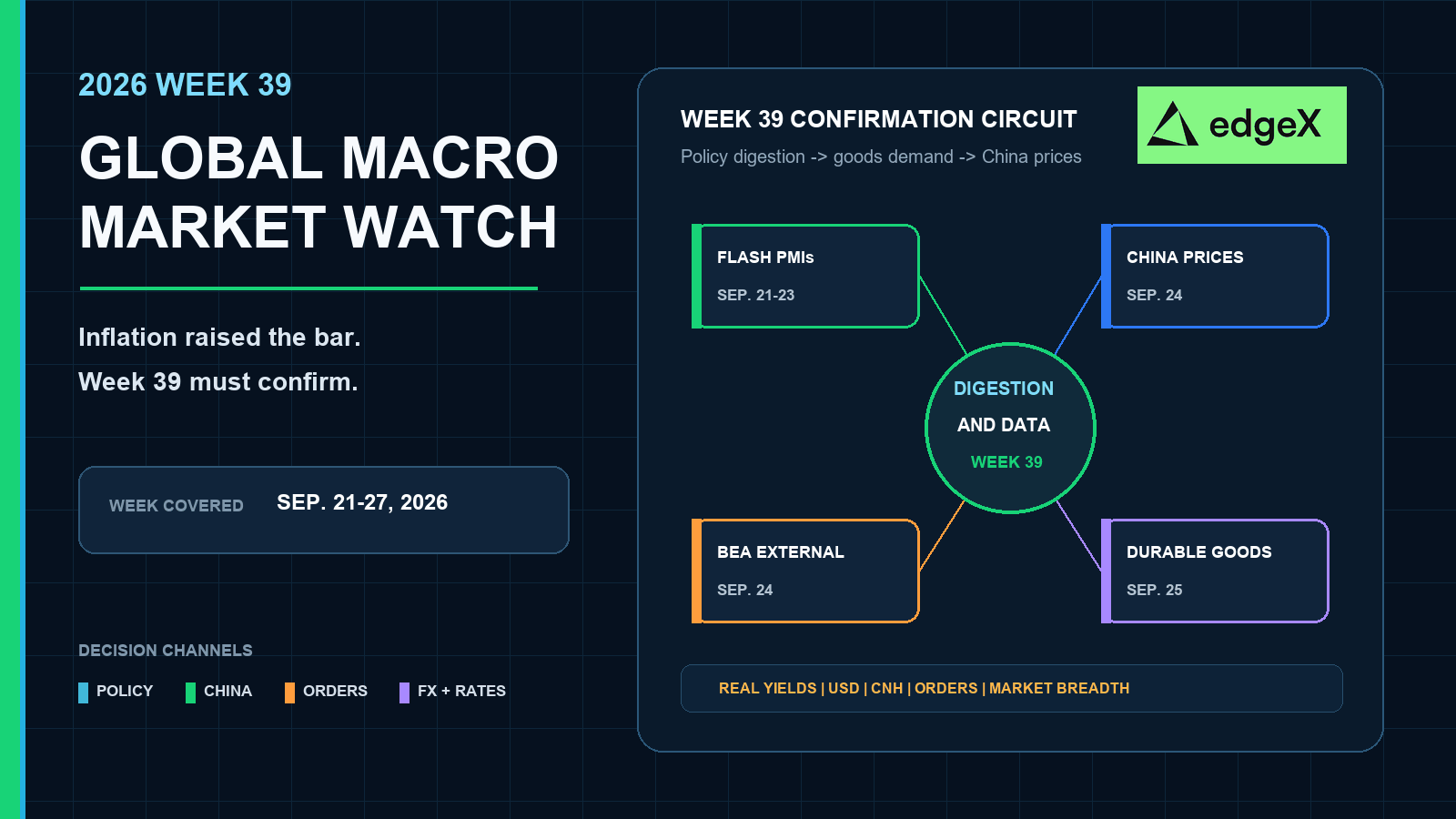
Week 39 is a confirmation week after Week 37 restored inflation pressure and Week 38 concentrated global policy risk. Stable post-FOMC yields, flash PMIs that do not collapse, durable goods that keep core capital goods from rolling over, and China input-price or industrial-margin signals that do not force a fresh commodity shock would support an orderly digestion phase. A hawkish hangover in real yields, soft U.S. goods demand, and another China print that pairs strong factories with weak domestic absorption would tighten financial conditions through a stronger dollar, narrower breadth, and weaker industrial commodities. Week 37's completed data already warned against pricing clean disinflation into the September policy window.
Why Week 39 Is a Digestion and Confirmation Test
Week 38 packed China's activity release, the projection-bearing FOMC meeting, U.S. retail sales, and the BOJ decision into one short sequence. Week 39 does not repeat that density. It asks whether the policy message survives contact with private-sector activity, trade-balance stocktaking, and China's next price and margin checkpoints.
Positioning should treat those stages separately. A policy surprise can reprice front-end rates in one afternoon. A durable macro regime needs confirmation in orders, PMI momentum, FX follow-through, and Asia demand absorption. Week 39 is built for that second stage.
The inflation baseline is no longer soft enough to ignore
The Bureau of Labor Statistics Producer Price Index showed August final demand up 0.4% after a 0.1% July rise, with the 12-month unadjusted gain at 5.4%. Goods prices jumped 1.1% as final-demand energy rose 4.2% and diesel fuel surged 24.1%. Final demand less foods, energy, and trade services still advanced 0.3% on the month and 4.7% over the year.
The Consumer Price Index then confirmed the consumer-side pass-through. August CPI-U rose 0.4% seasonally adjusted and 3.4% over 12 months. Core CPI rose 0.3% and 2.4% year over year. Gasoline increased 3.9% on the month, energy rose 2.1%, and shelter accelerated back to a 0.3% monthly gain. Food remained comparatively contained at 0.1% month over month and 2.7% year over year. The combination left Week 39 dependent on whether post-meeting markets treat energy-led inflation as a temporary pipeline shock or as a reason to keep real yields elevated.
Week 39 Global Macro Calendar
| Date | Region | Scheduled Event | Why Markets Care |
|---|---|---|---|
| September 21-23 window | Global | S&P Global flash manufacturing and services PMIs | Early read on whether private-sector output and new orders are cooling after the inflation and policy shock. |
| September 24 | China | Market prices of important means of production in circulation | Tracks industrial input costs, commodity transmission into factory margins, CNH, and metals. |
| September 24 | United States | International transactions and investment position, Q2 2026 | Updates the external balance, income flows, and financial-account backdrop after a volatile trade and energy year. |
| September 25 | United States | August advance durable goods orders | Tests capital-goods demand, transportation equipment noise, and core orders after the payroll rebound. |
| September 25 | United States | Employee benefits in the United States, March 2026 | Adds labor-cost structure detail rather than a high-frequency market mover. |
| September 28 | China | Industrial economic benefits / industrial profits package | Adjacent Week 40 open that tests whether August's factory acceleration translated into margins. |
Post-FOMC Digestion Sets the Rate Path Tone
The Federal Reserve FOMC calendar places the September meeting on September 15-16, with the decision and Summary of Economic Projections due September 16. The Bank of Japan Monetary Policy Meeting schedule still lists September 17-18 inside the incomplete Week 38 cluster at cutoff. Week 39 therefore starts from process, not from a locked policy conclusion.
What Week 39 can settle is follow-through. If the FOMC message is measured, confirmation would appear as contained real-yield spikes, selective dollar softening, and equity breadth that does not narrow into only a handful of defensives. If the message is hawkish after Week 37's inflation prints and the August payroll rebound, confirmation would show up in sticky front-end pricing, a firmer dollar, and pressure on long-duration equities and high-beta crypto. If growth concern dominates the market reading even without a dovish statement, curves can twist while cyclicals lag.
Flash PMIs arrive before the goods-order test
S&P Global PMI flash releases typically cluster in the September 21-23 window across the euro area, the United States, and other major economies. Those surveys will not rewrite the Fed dots, but they can change the digestion narrative. A soft manufacturing flash after strong PPI goods inflation would raise stagflation-style concern: prices still hot, orders fading. A resilient services flash with cooler input-price components would support the case that Week 37's energy shock is not yet a broad private-sector break.
Cross-asset traders should pair the PMI prints with the dollar and industrial metals rather than with a single equity index open. PMI confirmation is strongest when FX, rates, and cyclicals move together.
Durable Goods and the External Accounts Test U.S. Demand Quality
The U.S. Census Bureau M3 schedule sets August advance durable goods orders for September 25 at 8:30 a.m. Eastern. That release is Week 39's cleanest U.S. goods-demand checkpoint after the incomplete Week 38 retail-sales and industrial-production sequence.
Headline durable goods can be distorted by aircraft and defense. Markets will lean harder on core capital goods orders and shipments for evidence that business investment is still absorbing higher financing costs. A firm core print would support the labor-resilience story from earlier September. A drop concentrated in machinery and nondefense capital goods would reopen the growth-scare channel even if the policy message from Week 38 was not overtly dovish.
BEA international transactions reset the external backdrop
The Bureau of Economic Analysis schedules U.S. International Transactions and Investment Position for the second quarter of 2026 on September 24. The release arrives in a year already marked by energy-price shocks, trade-balance swings, and shifting income flows. It is less of a minute-to-minute catalyst than durable goods, but it can reframe USD and Treasury demand if the current-account or financial-account detail shows a larger external financing need or a sharper income deterioration.
Week 39 therefore splits U.S. evidence into two layers. Durable goods speak to near-term factory and capex momentum. International transactions speak to the stock of external adjustment that markets must fund after the inflation and policy weeks.
China Price and Margin Signals After a Split Activity Print
China's National Bureau of Statistics 2026 calendar is the anchor for the week's required China event. The calendar's ten-day means-of-production price reports are scheduled on the 4th, 14th, and 24th in principle, placing the next industrial input-price checkpoint on September 24. The same calendar places industrial economic benefits on September 28, just after Week 39 closes, and official PMI on September 30.
The September 15 activity package already set the baseline on the NBS latest releases page. Industrial production accelerated to 5.2% year over year, retail sales slowed to 0.4%, and fixed-asset investment deepened to −7.2% year to date. That mix improved factory throughput without restoring household or investment demand. Week 39's China question is whether input prices and nearby profit data keep that imbalance manageable or push it into a fresh margin squeeze.
Transmission still runs through CNH, metals, and earnings
A stable means-of-production price print after the August oil and diesel shock would ease one channel of imported cost pressure into Chinese factories and industrial metals pricing. Another leg higher in industrial input costs, especially if retail and investment stay weak, would worsen the supply-demand imbalance: factories produce, domestic demand lags, and margins compress. Cross-asset confirmation should appear in CNH, copper and related industrial commodities, Hang Seng and onshore cyclicals, and multinational earnings expectations tied to China revenue.
The adjacent September 28 industrial-profits package then becomes the first hard test of whether August's 5.2% industrial production gain converted into earnings or only into inventory and price pressure. Week 39 does not need to wait for that print to start positioning, but it should treat profits as the next confirmation node rather than as an afterthought.
Week 37 Review: Inflation Reaccelerated as the ECB Tightened
Week 37, September 7-13, was the latest completed weekly window available at the September 15 production cutoff. Its core message was that the disinflation path was no longer clean enough to dominate the September policy debate.
The week opened after Labor Day with pipeline inflation back in focus. On September 10, the BLS PPI release showed final demand up 0.4%, goods up 1.1%, and energy up 4.2%, with diesel fuel the standout driver at 24.1%. That was not a broad services breakout, but it was a clear goods-and-energy reacceleration after softer midsummer readings. The same day, the ECB raised key rates by 25 basis points and moved the deposit facility to 2.50%, confirming that European policymakers were still responding to war-linked and energy-linked upside inflation risk rather than preparing an easy pivot.
September 11 then delivered the consumer confirmation on the BLS September schedule. CPI rose 0.4% on the month and held at 3.4% year over year. Core inflation rose 0.3% and slowed only modestly to 2.4% year over year. Gasoline, shelter, airline fares, and lodging all contributed to the firmer monthly profile, while medical care and motor vehicle insurance eased. Real earnings were released alongside CPI, keeping the labor-income channel in view after August's stronger payroll report from the prior completed week.
China price data earlier in Week 37 also edged higher on commodity costs, reinforcing the global energy-transmission theme without repairing domestic demand. By the end of the week, markets were carrying three simultaneous messages into the incomplete Week 38 policy cluster: U.S. consumer inflation was sticky enough to matter, wholesale energy costs had reaccelerated, and the ECB had already chosen another tightening step.
The Week 37 implication for Week 39 is conditional. Inflation evidence raised the bar for any relief rally that depends on an uncomplicated dovish reading of the FOMC. The ECB move reduced the odds that global policy would ease in a synchronized way. Week 39 can improve market breadth only if post-FOMC yields stabilize, U.S. goods demand does not roll over, and China price or profit signals stop the supply-demand imbalance from widening further.
Cross-Asset Decision Map
| Week 39 Mix | Crypto | Stocks | Commodities | FX and Rates |
|---|---|---|---|---|
| Post-FOMC yields stabilize, PMIs hold, durable goods core stays firm | Lower rate volatility and better liquidity can support BTC and ETH if spot demand confirms. | Breadth can improve if cyclicals and Asia-linked shares participate. | Industrial metals gain from orders resilience; gold depends on real yields. | USD softens selectively; front-end volatility fades; CNH stabilizes if China prices cool. |
| Hawkish hangover after Week 37 inflation, soft U.S. goods demand | Higher real yields and tighter liquidity pressure leveraged crypto positions. | Long-duration and high-beta shares underperform; quality defensives lead. | Gold faces a yield headwind; industrial metals absorb order risk. | Real yields and USD rise; curves can bear-flatten; CNH stays vulnerable. |
| China input costs rise while retail and investment stay weak | Asia risk-off can hit high-beta crypto even if U.S. yields are mixed. | China-sensitive multinationals and industrial exporters lag. | Copper and related metals weaken on demand absorption risk; energy stays two-sided. | CNH softens; commodity currencies diverge; safe-haven USD demand can persist. |
| Growth softens into digestion while inflation stays sticky | Rate-cut hopes help only if deleveraging does not dominate. | Earnings revisions and margin risk become central; defensives outperform cyclicals. | Gold can outperform industrial commodities. | Curves can twist; policy-path uncertainty stays elevated across USD and EUR. |
What Would Confirm the Week 39 Signal?
The base case is digestion volatility rather than a clean one-way trend. Week 39 confirmation should appear in the joint behavior of real yields, the dollar, flash PMI momentum, core durable goods, CNH, and industrial metals. A policy message from Week 38 that moves only one asset class is less durable than a synchronized adjustment that survives the September 24-25 data cluster.
China requires its own checklist. The September 24 means-of-production price report needs to be read against the September 15 activity split, not in isolation. Stable or cooler industrial input prices with no fresh retail collapse would support a containment case. Another cost impulse into weak domestic demand would keep Asia as a selective risk. The September 28 industrial-profits package then tests whether factory acceleration became earnings. A durable risk-on result requires contained post-FOMC yields, non-collapsing private-sector surveys, firmer U.S. core goods demand, and China signals that stop the supply-demand imbalance from dominating global cyclicals.
Trade with an Edge
In fast-moving markets, execution matters just as much as direction. That's why more traders are turning to decentralized venues like edgeX for perpetuals and spot trading.
Unlike traditional centralized platforms, edgeX is built around self-custody, meaning you keep control of your assets and authorize fund movements yourself. For active traders, that offers a meaningful advantage: market access without handing custody to an exchange.
edgeX also combines the core benefits of DeFi with a trading experience designed for serious execution. The platform emphasizes deep liquidity, high-speed order matching, and low-slippage performance, helping traders stay responsive during volatile conditions. With support for high leverage, it gives experienced market participants more flexibility in how they express macro views and manage risk.
Beyond execution, decentralized trading infrastructure can offer structural advantages: greater transparency, on-chain verification, and reduced dependence on centralized intermediaries. For traders who want performance without giving up control, that model is increasingly compelling.
edgeX is built for that balance: bringing together a professional trading experience with the core principles of decentralized markets.
Traders looking to explore a more capital-efficient, self-custodial way to trade can take a closer look at edgeX.
Frequently Asked Questions
What is the biggest event in Global Macro Week 39?
Week 39 is a confirmation week rather than a single-catalyst week. The highest-impact cluster is the September 24-25 stretch: China means-of-production prices, BEA international transactions, and U.S. durable goods orders, read against whatever FOMC and BOJ message Week 38 leaves behind.
Why review Week 37 instead of Week 38?
Production closed on September 15, while Week 38 was still in progress. The FOMC decision, BOJ meeting, retail sales, and industrial production had not yet completed as finished weekly results. Week 37, September 7-13, was the latest completed weekly window and is labeled explicitly.
Why does China's September 24 price report matter globally?
Means-of-production prices connect industrial input costs to factory margins, CNH, industrial commodities, and multinational earnings. After August industrial production accelerated while retail sales and investment weakened, the next price checkpoint tests whether the supply-demand imbalance is stabilizing or worsening.
How can durable goods change the post-FOMC narrative?
Core capital-goods orders show whether business demand is absorbing higher financing costs after the payroll rebound and the inflation reacceleration. A soft core print can revive growth-scare pricing even if the policy statement itself was not dovish.
What did Week 37 change for the Week 39 outlook?
Week 37 restored an energy-led inflation impulse, held CPI at 3.4% year over year, and delivered another ECB hike to a 2.50% deposit rate. That mix raised the bar for uncomplicated policy relief and made Week 39 confirmation dependent on yields, goods demand, and China absorption rather than on hope alone.
What is the constructive Week 39 scenario?
The constructive combination is contained post-FOMC real-yield volatility, flash PMIs that hold above a clear contraction break, firm core durable goods, cooler or stable China industrial input prices, and no fresh collapse in Asia demand absorption. Confirmation should appear in selective dollar softening, wider equity breadth, and steadier industrial commodities.

