Supply Fears Drive Sharp Rise in Coffee Prices, ICO Reports
Key Takeaways
- •The ICO Composite Indicator Price averaged 287.26 US cents per pound in July 2026, up 15.4 per cent from June, the largest monthly rise since 2021.
- •Certified Arabica stocks in the United States fell 30 per cent to 290,000 bags, the lowest level since January 2024.
- •Brazil's 2026/27 harvest was only 64 per cent complete by mid-July, behind the five-year average of 70 per cent, due to unusually wet conditions.
- •El Niño was estimated at a 97 per cent probability of continuing into early 2027, with an 81 per cent chance of strengthening into a major event.
- •Green bean exports rose 0.8 per cent year-on-year in June to 10.48 million bags, supported by stronger Brazilian Naturals shipments.
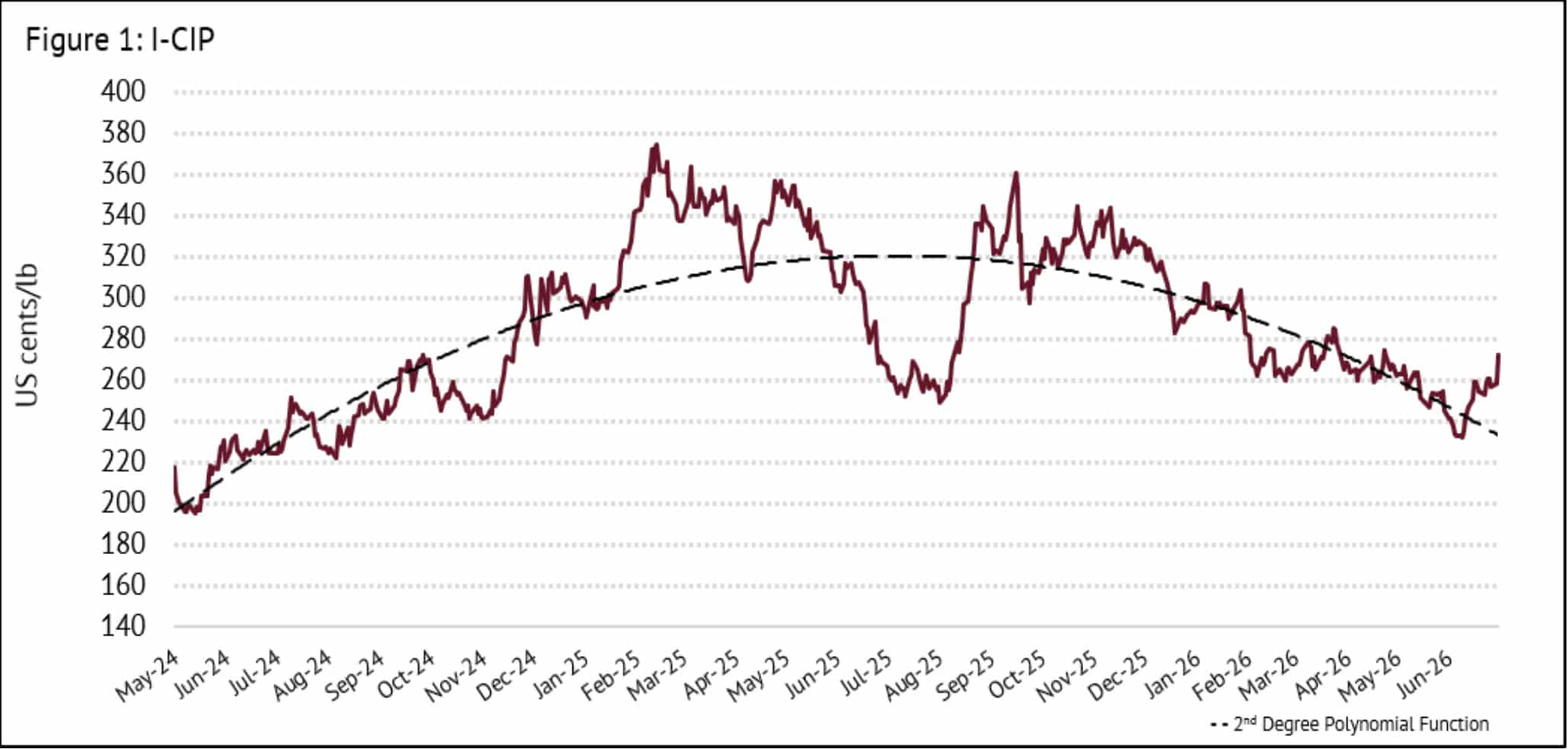
Global coffee prices surged in July, as mounting concerns over supply availability, adverse weather in Brazil, and shrinking Arabica inventories fuelled one of the strongest rallies the market has seen in recent years.
According to the International Coffee Organization's (ICO) July 2026 Coffee Market Report, the ICO Composite Indicator Price (I-CIP) averaged 287.26 US cents per pound during the month — up 15.4 per cent from June and representing the largest monthly increase since 2021.
The rally was broad-based across the Arabica segment. Colombian Milds rose 18.1 per cent month-to-month to 383.39 US cents per pound, while Brazilian Naturals increased 17.9 per cent to 320.69 US cents per pound. Other Milds climbed 16.5 per cent to 358.65 US cents per pound. By comparison, Robusta's gains were far more modest, rising 9.1 per cent to 184.78 US cents per pound. The divergence reflects the structure of the two main commercial species: Arabica, which dominates higher-value blends and trades on the New York market, has been the focus of inventory tightness, while Robusta, used widely in instant coffee and espresso blends and traded in London, faces separate supply dynamics centred on producers such as Vietnam.
Concerns over available coffee supplies are seen as a key driver of the across-the-board increases. Certified Arabica stocks in the United States fell 30 per cent to 290,000 bags, the lowest level since January 2024. Certified stocks — inventories held against exchange-traded contracts — are a closely watched gauge of immediately deliverable supply, so a drawdown of this size tends to sharpen market sensitivity to any further signs of shortage. Brazil is the world's largest coffee producer and exporter, which is why its harvest conditions carry outsized weight for global prices.
Weather developments in Brazil and the possibility of a significant El Niño event also weighed on prices. Brazil's 2026/27 harvest was only 64 per cent complete by mid-July, well behind the five-year average of 70 per cent, with unusually wet conditions slowing harvesting activity. Beyond the immediate delay, prolonged wetness during harvest raises quality risks for Arabica, as cherries left on trees or drying on patios can be more prone to defects. The probability of El Niño continuing into early 2027 was estimated at 97 per cent, with an 81 per cent chance that conditions could strengthen into a major event. El Niño episodes have historically disrupted rainfall patterns across key coffee-growing regions in Brazil and Southeast Asia.
Despite rising prices and persistent supply concerns, overall trade remained strong. Green bean exports increased 0.8 per cent year-on-year in June to 10.48 million bags, with stronger shipments of Brazilian Naturals laying the foundation for the increase. For roasters, retailers, and consumers, sustained price pressure at the commodity level has in past cycles fed through into higher retail coffee costs, and the coming months of harvest data and certified-stock movements will be the main indicators of whether supply tightness eases or deepens.
