Germany's Recession Chronologies Compared: Why 2025-26 Was Not a Recession
Key Takeaways
- •A new Econbrowser analysis finds that Germany's decline in employment and hours worked during 2025-26 does not amount to a recession because GDP has been rising strongly.
- •The study compares four business-cycle dating chronologies for Germany: those maintained by ECRI, the German Council of Economic Experts, economist Laurent Ferrara, and an employment-based chronology built by the author.
- •Recession assessments can diverge because employment and hours worked may decline even while output expands, depending on which indicators a dating method emphasizes.
- •The latest ifo nowcast, released Nov. 6, estimates German GDP growth of 0.62% quarter on quarter for the fourth quarter.
- •The analysis indexes real GDP, employment, hours worked, and industrial production to 2024Q2 to highlight the recent split between rising output and shrinking labor input.
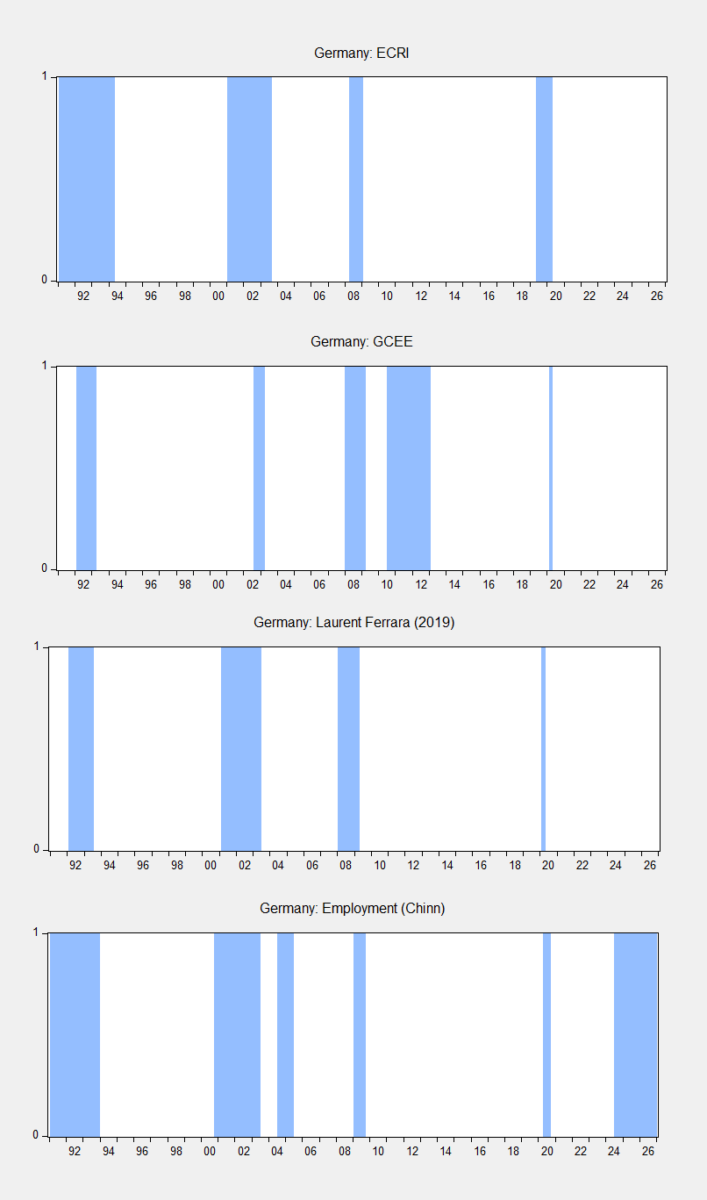
A stretch of declining employment and hours worked in Germany during 2025-26 does not amount to a recession, according to a new analysis on Econbrowser, because gross domestic product has been rising strongly. The verdict turns on how a recession is defined and measured: dates are not read off a single statistic, and Germany has more than one established way of drawing the line.
The analysis, titled The Recession Chronologies of Germany, compares three established business-cycle dating approaches for Europe's largest economy: the chronology maintained by the Economic Cycle Research Institute (ECRI), that of the German Council of Economic Experts (GCEE), and a chronology developed by economist Laurent Ferrara (2019). A fourth, employment-based chronology constructed by the author is included as well. Because each approach weighs output and labor-market data differently, the side-by-side comparison shows where the datings agree and where they diverge.
Four chronologies compared
Figure 1 presents German peak-to-trough recession dates in four panels: the top panel shows the ECRI dating with recession periods shaded light blue; the second panel uses the GCEE chronology; the third panel applies Ferrara's dates; and the bottom panel relies on employment data alone. Sources: ECRI, GCEE, Ferrara (2019), and the author's calculations.
The GCEE methodology is provided here, with further documentation in a working paper. Ferrara's 2019 study, published as a guest contribution on Econbrowser, dates business-cycle peaks using GDP and industrial production processed through the Bry-Boschan algorithm. Because Ferrara's chronology predates the pandemic, the author assumed in the chart that ECRI's dates matched Ferrara's for 2020.
The bottom-panel chronology rests solely on employment, drawn primarily from the national accounts with some reliance on the household survey. Even under that employment-centric lens, the author writes, it would be hard to argue that Germany is in a recession given that GDP is rising strongly. The exercise also illustrates why recession calls can diverge: employment and hours worked can decline even while output expands, so the indicators a dating procedure emphasizes help determine its verdict.
Broader indicator picture
Figure 2 tracks German real GDP (blue), employment from the national accounts (red), hours worked (purple), and industrial production (green), all expressed in logarithms indexed to 2024Q2=0. Sources: OECD via FRED, the ECB, and the author's calculations. Indexing the series to a common quarter makes the recent split between rising output and declining labor input easy to read directly off the chart.
Separately, the latest ifo nowcast, published Nov. 6, puts fourth-quarter German GDP growth at 0.62% quarter on quarter, per the ifoCAST release. Successive releases of national accounts, labor-market data, and nowcasts of this kind will show whether the gap between expanding output and shrinking employment narrows or persists.
Background
ECRI, the Economic Cycle Research Institute, is a private research organization that produces independent business-cycle chronologies. The German Council of Economic Experts (Sachverständigenrat zur Begutachtung der gesamtwirtschaftlichen Entwicklung) is an official advisory body to the German government, created by statute in 1963, and maintains its own dating of German business cycles. The Bry-Boschan algorithm, developed at the U.S. National Bureau of Economic Research in 1971, is a widely used statistical procedure for identifying business-cycle peaks and troughs; the NBER's Business Cycle Dating Committee remains the reference point for U.S. recession dating. The ifo Institute, based in Munich, publishes regular nowcasts of German economic activity alongside its closely watched business climate index.

