Georgia Advances 41-Mile Toll-Free Truck-Only Lanes on I-75
Key Takeaways
- •The commercial vehicle lanes will run 41 miles northbound on I-75 from the I-75/I-475 interchange in Monroe County to near SR 20 in Henry County.
- •GDOT estimates the project will cost about $3.5 billion and affect roughly 173 parcels through eminent domain filings.
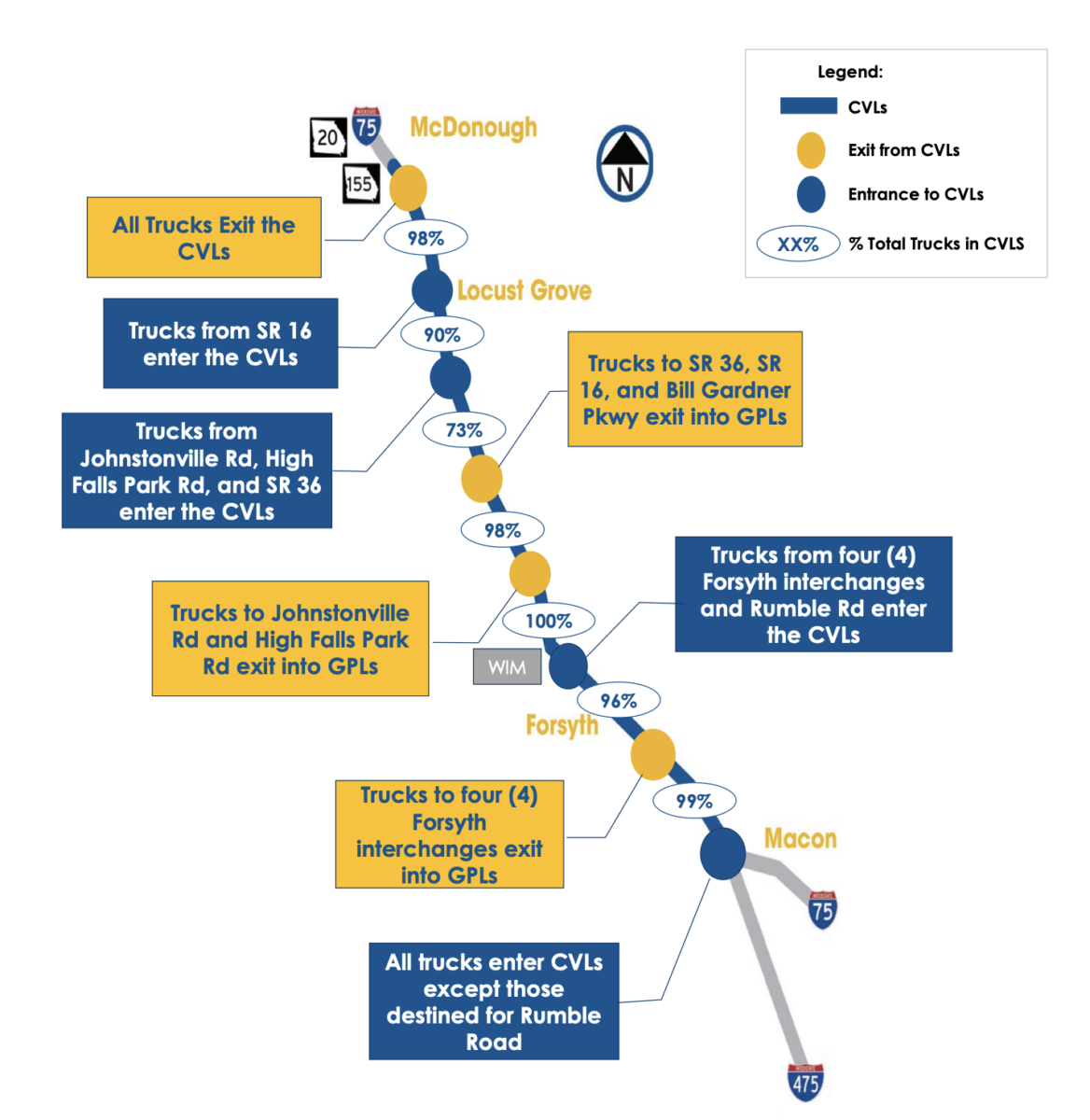
- •The department projects that 73% to 100% of trucks in the project limits will use the dedicated lanes, depending on destination.
- •Public comments were mixed but leaned supportive, with 57 in favor, 35 conditionally supportive, 19 opposed and 21 uncommitted.
- •GDOT has also planned a separate $2 million truck parking expansion at Rest Area 22 that would add 36 spaces.
Georgia is moving ahead with an idea that most of the country has only discussed: a stretch of interstate where trucks have their own roadway.
The Georgia Department of Transportation has released a construction timeline for its I-75 Commercial Vehicle Lanes project. Design work is scheduled to be finalized and construction is set to begin in 2027, with completion expected by the end of 2032. When finished, northbound I-75 will include two barrier-separated lanes reserved exclusively for commercial vehicles, extending 41 miles from the I-75/I-475 interchange in Monroe County to near the State Route 20 interchange in Henry County, and passing through Monroe, Lamar, Butts, Spalding and Henry counties.
There is no toll. GDOT refers to the lanes as the CVL, and they will be free for trucks to use.
For a project of this scale, the details matter, as does the context. This is not a minor widening. It is a roughly $3.5 billion investment in a specific approach to moving freight through one of the most congested corridors in the country, and if it works, Georgia will not be the last state to try it.
What Is Being Built
The core concept is straightforward, even if the engineering is not. GDOT is adding two new lanes on the northbound side of I-75, separating them from the general-purpose lanes with a barrier and restricting them to commercial vehicles. Under the current proposal, all trucks with more than six wheels must use the CVL unless they are headed to a local exit within the project limits.
The 41-mile corridor runs from the point where I-75 splits from I-475 in Monroe County near Macon to near the SR 20 interchange in Henry County, in the McDonough area south of Atlanta. It passes through five counties and the communities along that stretch, including Forsyth, Locust Grove and McDonough.
The project carries GDOT project number 0014203 and an estimated cost of about $3.5 billion. The state’s eminent domain filings estimate roughly 173 affected parcels of property and tens of millions of dollars in right-of-way acquisition. Because the work involves major reconstruction and widening of the northbound right-of-way, the timeline extends to 2032.
The schedule has changed before. Earlier versions of the plan had aimed for substantial completion around 2027, and the timetable has been revised more than once as GDOT restructured how the project would be bid and built. The dates announced now, with construction beginning in 2027 and ending in 2032, are the current official projection.
Why This Corridor Matters
GDOT did not choose this stretch at random. It selected one of the worst freight chokepoints in the United States.
In the American Transportation Research Institute’s 2026 Top Truck Bottleneck List, I-75 at McDonough ranks as the 10th-worst truck bottleneck in the country. That location sits at the northern end of the corridor the new lanes are meant to relieve. Georgia placed nine locations on ATRI’s 2026 top 100 list, second only to Texas, and three Georgia bottlenecks landed in the national top 10. The McDonough chokepoint on I-75 is the one this project is intended to address.
Truck volume on the corridor helps explain the urgency. GDOT officials have said truck traffic through this stretch of I-75 is approaching 30% of average daily traffic, an unusually high share, and the department expects that number to keep rising as economic development and port activity in Georgia continue to grow. When close to a third of the vehicles on a road are heavy trucks and the road is already failing during peak hours, separating truck traffic from everything else becomes a serious infrastructure proposal rather than a novelty.
The national backdrop underscores the challenge. ATRI found that average rush-hour truck speeds at the country’s bottlenecks fell to 33.2 miles per hour in its 2026 analysis, and among the 10 worst locations, average peak truck speed fell to 29.6 miles per hour. ATRI also said the delays imposed on truckers are equivalent to 436,000 drivers sitting idle for an entire year. For an owner-operator paid by the mile, time lost crawling through McDonough is time that cannot be recovered.
GDOT’s Traffic Projection
The figure drawing the most attention is GDOT’s estimate of how many trucks will actually use the new lanes. The department projects that between 73% and 100% of trucks traveling within the project limits will move out of the general-purpose lanes and into the commercial vehicle lanes, depending on their destination.
That upper end, essentially every truck, is what makes the project notable. It reflects the design intent: with a rule requiring trucks over six wheels to use the CVL unless they are exiting locally, and with the lanes running through the most congested part of the corridor, GDOT expects near-total use by through traffic.
GDOT also provided a more specific figure showing how traffic would sort itself out. About 27% of trucks entering the CVL near Macon are expected to exit before reaching McDonough, meaning a little more than a quarter of the trucks that enter will peel off for local destinations along the way, while the rest continue toward the Atlanta metro area. That split matters for lane design and for the placement of entry and exit points.
Public Response and GDOT’s Reply
The project went through a public comment process, and the response was mixed but leaned supportive. Of the 132 comments GDOT received, 57 supported the project, 35 offered conditional support, 19 opposed it and 21 were uncommitted. In other words, 92 comments fell into the support or conditional-support categories, compared with 19 in opposition.
Two issues came up repeatedly, and both go directly to the drivers who will use the lanes.
First, commenters asked GDOT to include professional truck drivers in the planning process. That concern is familiar in freight infrastructure: decisions about truck movement are often made by people who do not drive trucks. GDOT said coordination with transportation organizations will be important throughout the life of the project. That is an acknowledgment, though not a specific commitment to give drivers a formal seat at the table.
Second, commenters raised concerns about merging traffic at the northern end of the CVL, where the truck-only lanes will eventually have to reconnect with general traffic. Merge points often determine whether separated-lane designs succeed or fail, so the concern is understandable. GDOT said its safety analysis shows the proposed merge area up to SR 155 is expected to experience fewer crashes than the current no-build scenario, attributing the improvement to more channelized traffic flow and less weaving. The department also said an auxiliary lane between SR 155 and SR 20 will improve operations at the merge point.
Whether that holds up in practice will not be known until the lanes open, and it is the kind of question professional drivers will be best positioned to judge.
The Truck Parking Project Alongside It
The CVL project is the headline, but GDOT has also paired the corridor work with truck parking investment, which addresses a quieter but important part of freight mobility.
Alongside the CVL planning, GDOT has advanced a project to expand truck parking at Rest Area 22 along the corridor. The project is budgeted at $2 million and would add 36 truck parking spaces. Construction is scheduled to begin in summer 2027 and is expected to take about 12 months.
That is a modest addition compared with the national parking shortage, but it reflects a broader understanding that moving trucks faster through a corridor and giving drivers a legal place to stop are connected problems. A driver who clears McDonough more quickly still has to park legally at the end of the day.
What It Means for Drivers and Small Fleets
For owner-operators and small fleets running through the Southeast, the I-75 corridor between Macon and Atlanta is familiar territory and often a difficult one. The practical promise of this project is clear: a barrier-separated, toll-free lane through one of the 10 worst truck bottlenecks in the country would directly return time and fuel to the drivers who use it, and time is the one input a per-mile operation cannot replace.
There are reasons to keep expectations measured. Construction will run from 2027 to 2032, which means years of work zones on an already difficult corridor before any relief arrives. Work zones bring their own congestion and safety risks. The merge design at the northern end has not yet been proven in real-world operation. And because the schedule has already moved more than once, a 2032 completion remains a projection, not a guarantee.
Even so, the larger significance is difficult to ignore. Dedicated truck lanes at this scale are rare in the United States, and a successful 41-mile segment on I-75 would become a proof of concept that other states can point to. Georgia has nine of the nation’s worst bottlenecks, leaving it with no shortage of places to apply the model if this one works. For drivers, the project is worth watching not only for what it may do to one corridor, but for what it could signal about how freight is moved over the next decade.
For now, the timeline is set, the corridor has been chosen and the work is coming. According to GDOT’s projection, the trucks running northbound I-75 through McDonough are about to get a road of their own.