Gen Z’s lonely weekends reflect the cost of going out
Key Takeaways
- •The Harris Poll found that 51% of Gen Z adults report weekend loneliness, the highest share among generations surveyed.
- •Ogilvy found that more than 60% of Gen Z want to reduce screen time and 52% want more in-person social time, but only 6% are satisfied with their current in-person experience.
- •Sixty-eight percent of Gen Z say going out is not worth the cost, and 62% avoid making weekend plans to prevent financial regret.
- •About one in three Gen Z adults still live at home, and 71% would save an unexpected $100 or use it to pay bills rather than spend it on a weekend outing.
- •Despite the strain, 85% of Gen Z say they have already adopted lower-cost ways to socialize, including hosting friends at home and using free or discounted activities.
In 1993, Blur closed “For Tomorrow” with a spoken aside describing modern life as “rubbish.” Three decades later, that sentiment has taken on new meaning for Gen Z, according to a pair of recent reports from The Harris Poll and Ogilvy.
The reports suggest that many young adults are not rejecting social life. Instead, they are facing an economic reality that makes going out increasingly difficult. As Ogilvy puts it in its new Gen Z Pulse report: “Gen Z isn’t contradictory. Modern life is.”
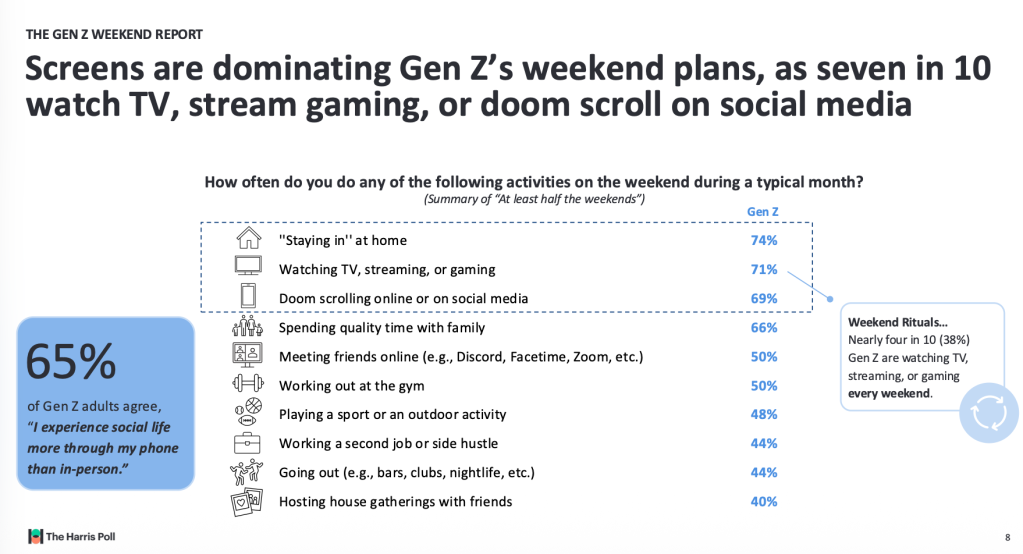
The Harris Poll, in a separate survey of 4,100 American adults conducted in late May and early June, found that half of Gen Z report feeling lonely every weekend, with the strain tied in part to the cost of socializing. Nearly three-quarters spend their weekend time at home, and the pollster says the pattern reflects a “spending hangover.”
“We call it placing financial regret over FOMO,” Libby Rodney, Chief Strategy Officer at The Harris Poll, said in an interview with Fortune about the firm’s new Gen Z Weekend Report. “It isn’t the physical connection of things [that Gen Z is trying to avoid], it’s just financial.”
Reid Litman, the director who authored Ogilvy Consulting’s Gen Z Pulse report, made a similar argument. “Contrary to how they’re viewed in most media coverage, Gen Zers are not hypocritical or incompetent,” he writes. “They’re navigating new contradictions created by modern life.”
Gen Z, Litman argues, is the first generation to grow up entirely inside a “new reality,” as systems that once supported adulthood have increasingly shifted onto individuals. “Identity, relationships, and work increasingly blur together,” he writes, leaving the youngest generation to figure out more on their own.
A generation raised indoors
Rodney said Gen Z’s loneliness also has a physical dimension, echoing Litman’s point that many of the structures older generations relied on have been weakened or removed. She described a childhood shaped by screens and limited access to unsupervised public space, often under the supervision of Gen X parents.
She cited data showing that 75% of 8-to-12-year-olds are allowed to play on Roblox, while only 25% of the same age group are allowed to play unsupervised in their own front yards. That pattern, she said, continued into adolescence, with cafes that withhold Wi-Fi, malls that treat teenagers as a theft risk, and public areas increasingly designed to discourage unmonetized gathering.
“They’re really having a hard time connecting in places that aren’t capitalized or monetized around them,” Rodney said. She added that the global pandemic, which hit during Gen Z’s formative years, reinforced a default pattern of staying in.
Ogilvy’s data complicates the idea that young people simply prefer screens. More than 60% of Gen Z say they are trying to reduce their screen time, and 52% say they want more in-person social time, more than they want additional travel, entertainment, or fitness experiences. Yet only 6% say they are satisfied with their current level of in-person experience, and majorities across all three markets surveyed — 58% in the U.S., 63% in the U.K., and 55% in Australia — say digital connection helps, but in-person time remains essential.
The screens, the report suggests, are not the goal. They are what remains when the budget does not stretch further.
51%: The loneliness number
The Harris Poll surveyed 603 Gen Z adults as part of its nationally representative sample of 4,100 U.S. adults and found that 51% report weekend loneliness, the highest share of any generation and 37 percentage points above Boomers at 14%.
Rodney said that figure should not be read as only a mental-health statistic.
“When you read it, you understand they are under a lot of financial pressure, but also just the social implications of that is really sad,” she said. “When a generation is under a lot of financial distress, their social connection can also be under massive pressure as well.”
Ogilvy’s report, based on 2,100 respondents across the U.S., U.K., and Australia, found that only 17% of young Americans feel deeply connected to even one community, and fewer than 20% say belonging comes naturally to them. Seventy-five percent describe belonging as something that requires constant, intentional effort.
68%: The cost of going out
Sixty-eight percent of Gen Z say going out “isn’t worth the damage it does to my wallet,” and 62% avoid making weekend plans altogether to sidestep the financial regret that follows a night out.
At $15 to $25 a drink, Rodney said, “it just becomes impossible to have a weekend that is affordable.” She pointed out that roughly one in three Gen Z adults still live at home, often to save enough money to move out.
Rodney said that is strong evidence the retreat is economic, not social. Gen Z is not skipping plans because it dislikes people, she said, but because “the spend will hit harder than anything else.”
The clearest example, she said, comes from a survey question asking what Gen Z would do with an unexpected $100 to spend on a weekend. Seventy-one percent said they would save it or put it toward bills, more than double the 46% of Boomers who said the same.
“That is not something that you would see in generations before,” Rodney said. “That is quintessentially, I think, what the research points to.”
That caution reflects a wider financial shift identified by Ogilvy. Half of Gen Z now say they feel financially insecure, up from less than a third 12 months earlier, according to Deloitte data cited in the Pulse report.
Why the math is so unforgiving
Rodney linked the pressure on Gen Z to a decade of overlapping shocks that arrived all at once rather than one after another. “They are the first ones to get laid off and the least likely to be hired after graduating college,” she said, pointing to inflation and housing costs on top of a difficult entry into the labor market.
“Everything is kind of hitting them simultaneously at the same time,” she said. “They are feeling like they have to be fiscally responsible. And so they’re trading their kind of social connection and their social health for financial health.”
She used the term “polycrisis,” popularized by Columbia historian Adam Tooze, to describe the stacked crises running from the pandemic through inflation and into current labor-market disruptions.
That framing echoes research from Dartmouth economist David Blanchflower, whose 2025 working paper described Gen Z as turning the midlife crisis into a “quarter-life crisis,” as previously covered in Fortune. Rodney said she planned to visit Dartmouth soon, citing the university’s research on Gen Z, along with NYU psychologist Jonathan Haidt’s work.
Ogilvy’s respondents describe the pressure in similar terms, often rejecting the idea that their caution reflects laziness rather than economics. When asked about the biggest misconceptions attached to their generation, one 20-year-old woman said: “Lazy because the affordability of past generations is unattainable to us.” Another said: “Not socially smart or financially smart.”
The report frames this as a generation being judged against “a version of adulthood that barely exists anymore,” echoing the complaints Gen X once had about the systems that shaped them.
The burden is also uneven. Forty-two percent of Gen Z renters say they cannot afford to spend money on “fun,” compared with 25% of homeowners, and renters cite saving money as their top reason for staying home at a rate of 58%, versus 41% for homeowners.
The gap is sharper for women. Roughly 41% of Gen Z women say they cannot afford to have fun, compared with a notably lower share of men, a divide Rodney called a “fun tax” on young women.
“There’s also this pressure on young women maybe to be more responsible and have less fun, which kind of stinks,” she said, linking that pressure to broader labor-market disadvantages, including recent research showing young women are disproportionately concentrated in AI-exposed entry-level jobs.
Even viral restaurant lines, which can make Gen Z appear performative, fit the same pattern. Social media has turned dining out into a status ritual, with survey data suggesting as many as 84% of Gen Z are actively trying food trends they first see online. Restaurant marketers say younger diners are heavily influenced by what feels current and trustworthy on their feeds.
For a generation that largely tells pollsters that eating out is a “treat” rather than an everyday habit, those outings may be the night out itself — a rare, carefully curated event they can document and post — rather than evidence that the rest of their weekends are not shaped by difficult wallet math.
Constraint as catalyst, not just retreat
Despite the strain, Litman and Rodney both pointed to signs of adaptation.
“It’s so easy to always paint Gen Z in this distressed kind of picture. But they are really thinking about: how do we get out of this?” Rodney said.
Eighty-five percent of Gen Z say they have already built lower-cost ways to socialize over the past year, including hosting friends at home, chasing happy-hour deals, and using free fitness-class trials as social outings. Seventy-three percent say they want more social settings where alcohol is not the centerpiece.
Rodney described that shift as a demand for better value, not less connection.
“They want more spaces that ask for less, meaning ask for less money from them and give them more back,” she said, citing hikes and wellness-oriented hangouts as examples where Gen Z leaves “feeling better and not with a hangover, either.”
Ogilvy says that redirected demand is already finding outlets. Forty-two percent of Gen Z now find consistent belonging through hobby groups, interest communities, and fandoms, a share comparable to family at 48% and friends at 44% as a source of connection.
Run clubs are a clear example. Strava said the number of run clubs on its platform nearly quadrupled in 2025, with organized events up 50% year over year, largely used not to track performance but to find other active people. That pattern matches the Harris Poll finding that 65% of Gen Z feel more socially connected in wellness-focused settings than in traditional nightlife.
Rodney called Gen Z a “high intent, low budget” generation, saying its limited spending power should not obscure its cultural influence.
“It would be a mistake to just ignore them because they have low budgets, because they’re high influencers of culture, as youth always have been,” she said, adding that bars and nightlife venues may eventually need to adapt.
Ogilvy’s researchers reached a similar conclusion from another angle, saying Gen Z is projected to lead all generations in spending growth, adding an estimated $9 trillion by 2034. That means the same generation now priced out of a Friday night may eventually reshape what socializing looks like.
Rodney connected that back to drink prices: at $15 to $25 a drink, she said, “it just becomes impossible to kind of have a weekend that is not affordable.”
The loneliness number, in other words, is not the end of the story. Only 6% of Gen Z say they are satisfied with their current social life, but the generation is already building the outline of a less expensive and more sustainable model.
The clue may have been in Blur’s lyrics all along. The narrator does not end by saying life is rubbish. They say they are “holding on for tomorrow.”
This story was originally featured on Fortune.com

