AI Capex and AI-Related Imports Both Revised Up, Contributing Roughly Equally to US GDP Growth
Key Takeaways
- •Updated BEA estimates for third-quarter 2026 GDP raised the measured contributions of both AI-related capital expenditures and AI-linked imports, leaving the two roughly equal on an accounting basis.
- •The offsetting pattern reflects national accounting rules, as GDP measures domestic output, so foreign AI hardware is recorded as investment and simultaneously subtracted as imports of computers, peripherals, and semiconductors.
- •The near-term macroeconomic effect depends on Keynesian multipliers, which may be small for imports because spending flows to foreign producers, and similarly constrained for capital expenditures.
- •Data center and power station construction, performed by domestic firms and crews, is a potential exception with stronger domestic circulation, but it is not separately broken out in the published decomposition.
- •The Bureau of Economic Analysis will publish a third estimate later in the release cycle, providing the next checkpoint at which these measured contributions may change.
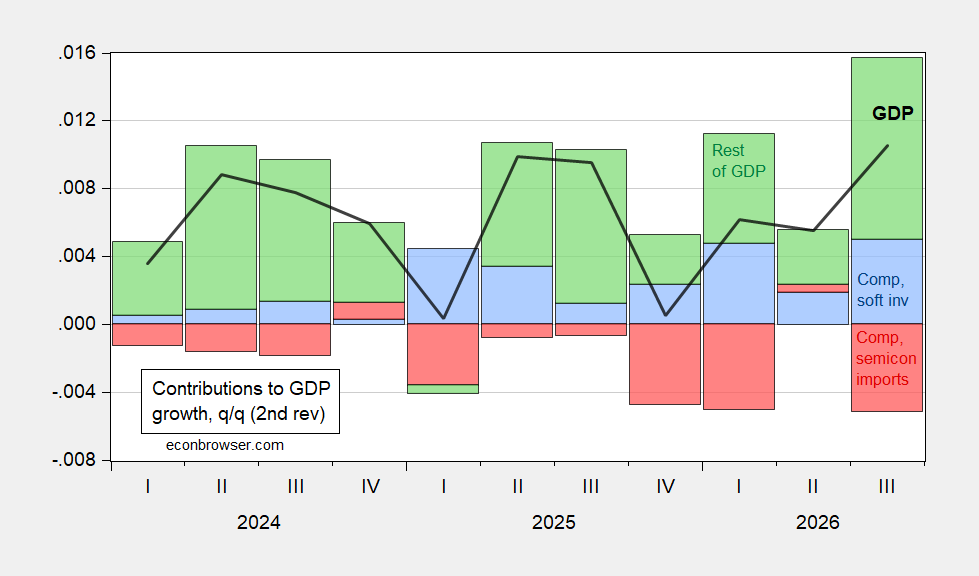
Revisions to U.S. gross domestic product (GDP) data have lifted the measured contribution of artificial intelligence (AI)-related capital expenditures, but imports tied to AI have been revised upward as well. On an accounting basis, the two show about equal contributions to GDP growth. The symmetry follows from how the accounts are constructed: GDP is meant to capture output produced domestically, so purchases of foreign-made AI hardware appear twice — once as investment in computers and software, and once as a subtraction for the imports of computers, peripherals, and semiconductors.
Figure 1: Quarter-on-quarter GDP growth (black line), with contributions to quarter-on-quarter GDP growth from computer and software investment (blue bar), from imports of computers, peripherals, and semiconductors (red bar), and the rest of GDP (green bar), all not annualized. Source: BEA 2026Q3 2nd release, author's calculations.
The short-run macroeconomic impact depends on the Keynesian multipliers for capital expenditures versus imports. A multiplier measures how much total activity each dollar of initial spending ultimately generates. For imports, the multiplier may be small because there are few domestic substitutes for the imported goods, since the spending flows to foreign producers rather than circulating through domestic payrolls and suppliers. For capital expenditures, the same may be true, with the exception of data center and power station construction — work performed by domestic construction firms and crews, and a category that is not broken out in the decomposition above (see this related Econbrowser post).
The analysis appears in the Econbrowser post "Accounting for AI Expenditures, Revised," published on November 27, 2026, drawing on the Bureau of Economic Analysis' second release of third-quarter 2026 GDP data. The BEA issues each quarter's GDP in successive estimates — advance, second, and third — with later releases incorporating more complete source data, so the third estimate, due later in the release cycle, is the next checkpoint at which these measured contributions can move again.

