Game On
Key Takeaways
- •The author says a stimulative Treasury bond operation and Trump’s beef-price plans show political maneuvering ahead of the midterms.
- •He compares the current policy backdrop to the 2003-2008 period, when easier credit and weaker regulation helped inflate asset prices before the financial crisis.
- •He argues that bond market manipulation and banking deregulation may support markets in the near term but increase long-term risk.
- •The author says his portfolio is at fresh highs and that his process focuses on managing market rotations rather than predicting permanent decline.
- •He identifies gold stock exposure and sector selection as part of his current strategy while warning that broader systemic risk remains ahead.
Game On
Gary Tanashian
Excerpted from the August 23 edition of Notes From the Rabbit Hole
Before getting to the segment, I just found out that during the same week Bessent announced a stimulative bond market operation, Trump announced plans to manipulate beef prices, angering many of his former staunchest supporters. I have changed the title to Game On, since it is now obvious that we are in the run-up to the midterms.
Shenanigan season is underway, with both announcements scheduled to run through November 4. I will give them credit for not even trying to hide their intentions.
NFTRH 929 Excerpt: Impressions of Last Week
As you know, I was 95% out of the markets on Thursday and Friday because of my travel schedule. It was an eventful week, and I am forced to do a little catch-up this Saturday morning. So, my impressions of what happened:
The Wizard rolled over and exposed himself as the intelligent yet typical Treasury Secretary that he is. Of course they are going to play politics and rig the thing into the midterms.
[pointed and critical opinion omitted for this excerpt]
Subscribers who have been here for a while will recall that I chronicled the Biden administration’s stimulus activities into the 2024 presidential election — the old “Powell with a little Yellen in his ear” routine. It is the same thing now, with very different players and somewhat altered methods. Warsh, with a little Bessent on his shoulder whispering sweet nothings in his ear.
To boot, they are deregulating the banking industry, and I will continue to speculate that this is the primary engine they are setting up. Maybe not in time for the midterms, but for the 2028 presidential election.
Longer term, it continues to look like the 2003-2008 game plan with respect to financial markets. In that period, far less regulated banks and financial institutions drove markets to inflationary heights through the credit bubble of the time and then into the deflationary crash known as the Great Recession. For readers who lived through it, the relevance is not just historical: easier credit and looser oversight tend to reshape risk-taking long before the consequences become visible in the broader economy.
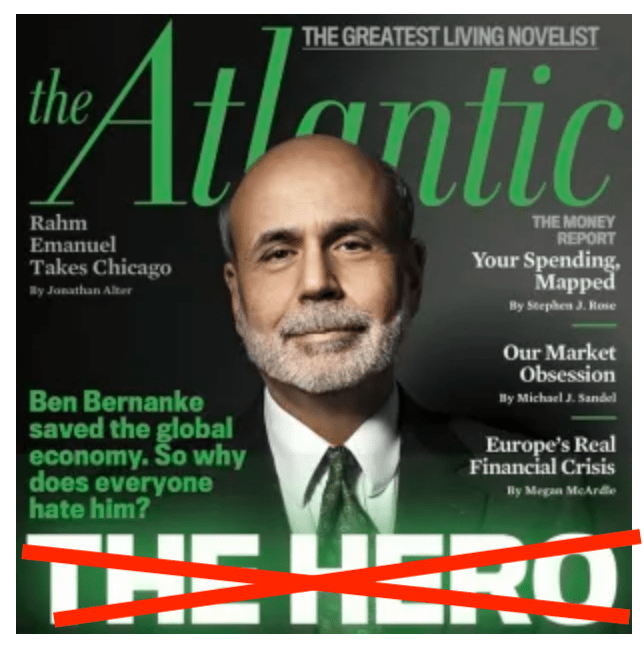
The Hero; Where Wonderland Really Came to the Fore
“Great Recession” my ass. That was a deflationary liquidation hell bent on ending the debt-leveraged system.
It was also the trigger that launched Bernanke into the most excessive — or innovative, if you want to paint a positive picture, which I do not — systemic blight ever: seven years of ZIRP, bond market manipulation through QE at will, and, yes, a little Operation Twist thrown in to “sanitize” inflation signals, to use the Fed’s word rather than mine.
That came with a little help from Treasury Secretary Tim Geithner in Bernanke’s ear during the critical years of 2009-2013.
The Hero took us off the charts and into a new realm of monetary adventurism and risk. To this day, that risk has not been realized, so the beat goes on until the music stops.
While households have rightly been deleveraging since 2010, their government has been moving like the pig that it is, leveraging the national debt — the people’s debt — for every GDP point since the Reagan miracle began in 1980.
[O/T interlude omitted]
So, Bessent rolled over. That is a position we knew he would assume when the time was right. It is a two-pronged approach: the here and now, through long-term Treasury bond manipulation, also known as QE, and the future, through commercial banking freed from restrictive laws.
My view continues to be that this is some representation of the 2003-2008 phase, where we may make a lot of money — funny munny — before a terrible liquidation somewhere on the horizon. And with debt at $40 trillion and rising, and with the former Continuum broken in secular fashion, it really is an ongoing long-term game of musical chairs. The point where the music stops is unknown, but the value of gold, err, is known.
Do you know what is, in my view, the scariest aspect of the chart above? The state of monthly RSI, and even more so MACD. They are coiled and ready for more upside. Is it any wonder why Bessent sprang into action so quickly? No.
This daily version of the chart shows the clear breakout to new highs that prompted our hero to buy bonds.
Understand that I am no perma-bear. My portfolio is literally at fresh highs, and that is not just because of gold stock positions. I am very negative on the big-picture macro backdrop and especially on the last quarter century of debt-leveraged policymaking. But a game of musical chairs can be rewarding until the music stops.
The job of NFTRH is to manage the game while it is on rather than call perma-doom year after year. The job also includes seeing risk ahead when appropriate. That risk is certainly ahead, but its realization is not yet on the near horizon. What is on the near horizon is a continued regimen of discrete sector selection and a likely oncoming global trade reminiscent of the 2003-2008 phase.
It is still Game On, as we updated the gold stock sector and discussed others of current interest. NFTRH 929 also introduced some caution points about the current situation. On that note, we had a little tin foil hat commentary about near-term monetary policy crosscurrents and risks to gold bugs.
Hint: “Evil does what it has to do. Just ask Bernanke.”
And a little fun too.
That paranoia is a continuing argument for some form of portfolio balance, and for ongoing tracking of market rotations and discrete sector selection. I plan to do that into the midterms. But longer term, there are bigger fish to fry — and I do not mean Karps.
- Well, my kind of fun at least.
About the author
Gary Tanashian
For “best of breed” top-down analysis of all major markets, subscribe to NFTRH Premium, which includes an in-depth weekly market report, detailed interim market updates, and NFTRH+ dynamic updates and chart/trade setup ideas.
Follow via Twitter @NFTRHgt.
Gary Tanashian of nftrh.com successfully owned and operated a progressive medical component manufacturing company for 21 years, keeping the company’s fundamentals aligned with global economic realities through various economic cycles. The natural progression from this experience is an understanding of and appreciation for global macroeconomics as it relates to individual markets and sectors.
Biiwii.com (RIP 2019, as there were just not enough hours in the day for two websites) was created in 2004 to help communicate a message about deeply rooted problems with too much debt and leverage within the inflated financial system. Those concerns were confirmed in 2007 as the system began to purge these distortions, resulting in a climactic washout from October 2008 to March 2009.
The URL “biiwii.com” came from the old saying “but it is what it is,” and that sentiment addressed the need to remain impartial about markets despite personal beliefs. Over the long term, the world changes, and any successful market participant should be ready to accept changes or revisions to a given plan.
Geek-like interests in technical analysis and human psychology, along with various unique macro market ratio indicators, were added to the mix, resulting in a financial market report, Notes From the Rabbit Hole (NFTRH), that combines these attributes to provide a service that is engaged and successful in all market environments.
Since 2004, the work has been featured at financial websites including GoldSeek and SilverSeek.com.
