Galaxy Withdraws Its Bitcoin Bottom Call as Bear Case Stays on Hold
Key Takeaways
- •Galaxy Research withdrew its bottom call after Bitcoin closed below its 50-week moving average in November, leaving the firm without an active floor and relying on two conditional triggers instead.
- •The firm's bear scenario activates only on a daily close below $58,525, and Bitcoin traded under that level on three days between Nov. 20 and Nov. 26 but recovered it before every 00:00 UTC close.
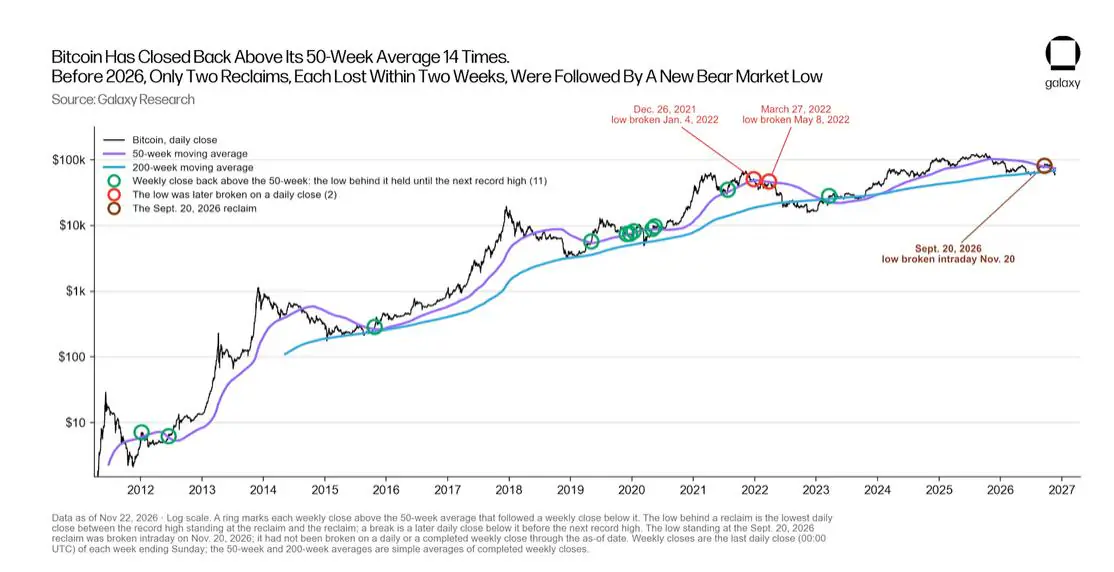
- •The withdrawn October bottom call had relied on Bitcoin's September reclaim of the 50-week average, a signal that historically held in 11 of 13 prior instances before failing this year.
- •Galaxy's review of seven earlier breaks of standing lows maps the shallowest and median further declines from $58,525 to roughly $48,500 and $28,200, figures it presents as historical reference points rather than targets.
- •Galaxy traced the Nov. 22 jump in one-year dormant supply to an exchange moving its own holdings into new addresses, which reset coin age for about 580,000 BTC rather than reflecting coins changing hands.
Galaxy Research has pulled its call that Bitcoin's bear-market bottom was already in place, after the asset lost its 50-week moving average in November. The firm's bear scenario, which triggers only on a daily close beneath $58,525, has yet to activate: Bitcoin dipped under that line on three separate days in late November and reclaimed it before each UTC close.
Alex Thorn, Galaxy's head of firmwide research, detailed both signals in a report published Nov. 25, first shared with the firm's trading and asset-management clients a day earlier. That leaves the firm without an active bottom call, with its stance now defined by two conditional triggers — one on weekly closes, one on daily closes — rather than a declared floor.
One Galaxy Signal Has Fired, the Other Hasn't
Thorn's October bottom call rested on a weekly signal. In the week ended Sept. 20, Bitcoin closed at $81,195, back above its 50-week average of $78,787 and snapping a stretch of 44 consecutive weekly closes beneath it.
That kind of reclaim has a strong record. Galaxy counts 14 of them in Bitcoin's history, and in 11 of the 13 before this year, the low in place at the time of the reclaim held until Bitcoin set its next record high. The two exceptions, in December 2021 and March 2022, lost the average within two weeks, and the lows behind them gave way on daily closes on Jan. 4 and May 8, 2022.
The September reclaim initially outlasted both failures, producing seven straight weekly closes above the average. But the week ended Nov. 8 finished at $74,968, 0.7% below the line, and the following week closed at $65,189, 4.1% under the 200-week average. That reversal is why Galaxy withdrew the June bottom call, though the firm maintained its arguments on market positioning, fundamentals and sentiment.
The bear scenario runs on a separate trigger: a daily close below $58,525, Bitcoin's lowest daily close of the bear market, recorded on June 30. Galaxy measures closes at 00:00 UTC; with Bitcoin trading around the clock, that fixed boundary is what defines a completed daily candle in the framework. A second June figure sits just above: $59,517 is the lowest weekly close, set in the week ended June 28. Galaxy treats the daily low as its breakdown line and the weekly low as a level it wants to see defended.
Three Wicks Below $58,525, No Close Below It
Bitcoin traded below $58,525 on three days between Nov. 20 and Nov. 26 on Coinbase, recovering the level before the UTC close each time. Under Galaxy's methodology, which evaluates completed daily candles, those dips do not qualify as breaks, because only a daily close beneath the level counts. The firm's own chart labels the June low as broken intraday on Nov. 20, not on a closing basis.
The widest excursion came on Nov. 21, when the price fell almost 6% below the threshold and closed 2.7% above it. The narrowest margin came a day earlier: Nov. 20 closed only $290 above the line, and on Nov. 22 the intraday low held $111 above it.
Galaxy does not name the price feed behind its closing data, so daily BTC-USD candles from the Coinbase Exchange serve as a reference here.
On Nov. 20, the first of the three days spent below the line, Galaxy CEO Mike Novogratz bought 415,000 Galaxy Class A shares for roughly $4.87 million, at weighted average prices near $11.73 and $12.32, according to an SEC Form 4 filing. Form 4 filings are the SEC's standard vehicle for disclosing insider transactions in a company's stock. The shares are held by an entity he controls through Galaxy Group Investments. The purchase came four days before the research update reached clients. Galaxy stock is not a pure Bitcoin position: the company also runs the Helios data-center business, as its third-quarter results detail.
What Seven Earlier Breaks Looked Like
Galaxy's comparison rests on what it calls "standing lows": bear-market closing lows that held for at least 60 days and were followed by a rebound of at least 20%. A break is the first daily close below one. Seven completed cases fit the criteria: three in 2014, two in 2018 and two in 2022. Raising the rebound requirement to 25% still yields seven. The current bear market's June 5 break is tracked separately.
After those breaks, the shallowest further decline to the eventual closing low was 17.1%, and the median was 51.8%. Measured from $58,525, Galaxy maps those outcomes to roughly $48,500 and $28,200. The report presents the figures as historical reference points rather than targets, stating, "We are not trying to call the low." It identifies $48,400 to $53,200 as the nearest cluster of support, and $29,100 to $46,100 as the range in which earlier bear markets ended.
Two details weaken the case for treating 17.1% as a floor. Galaxy counts record highs made within a year as one cycle, which leaves out a July 2013 break that ended only 2.8% lower; including it, seven of eight breaks ran at least 17% further lower. A close below the June 30 low now would also arrive later in the cycle than in any of the seven precedents, so their drop sizes may not carry over.
The Dormant-Supply Jump Is an Accounting Effect
On Nov. 22, the share of Bitcoin supply untouched for at least a year rose by about 2.9 percentage points in a single day. Galaxy traced the jump to a large exchange that moved its holdings into new addresses it controls on Nov. 22, 2025. Transfers between an owner's own addresses reset coin age, so roughly 580,000 BTC crossed the one-year mark together exactly one year later. The coins crossed the age threshold on schedule; the jump reflects a reset clock, not coins changing hands.
Galaxy says those coins are not the source of the recent selling. It also cautions against reading rising dormancy as a sign that selling has ended, because the metric identifies holders who are sitting still, not whether others have stopped. Coins held for one to five years have been moving more.
The Levels Galaxy Is Watching
The report sets out what would deepen the bear case and what would move the firm back toward its October view. The bear case deepens on exactly the trigger that has held so far — a daily close beneath $58,525 at 00:00 UTC — while the October stance rested on weekly closes holding the 50-week average, the signal that failed in November. Moving averages are as of Nov. 22. Bitcoin closed Nov. 26 at $60,496 on Coinbase, $979 above the June weekly low and $7,663 under the 200-week average.
Disclaimer: This article is for informational purposes only and is not financial, investment or trading advice. The price levels, historical comparisons and scenarios described are Galaxy Research's analysis, not forecasts by Coindoo. Galaxy Digital operates in digital asset markets and has a commercial interest in them. Cryptocurrencies are highly volatile, and past price behavior does not indicate future results. Readers should do their own research and consider consulting a licensed financial adviser before making investment decisions.

