G7 Cybersecurity Working Group Urges Immediate Post-Quantum Cryptography Migration, Putting Crypto on Notice
Key Takeaways
- •The G7 cybersecurity working group published a report on September 3, 2026 urging immediate transition to post-quantum cryptography to counter risks including 'harvest now, decrypt later' data collection.
- •The EU adopted a PQC roadmap in June 2025 requiring all member states to begin the transition by the end of 2026, with high-risk systems migrating no later than 2030.
- •Bitcoin is exploring the BIP-360 soft fork, which has no activation date, while Ethereum aims for core post-quantum infrastructure in 2029.
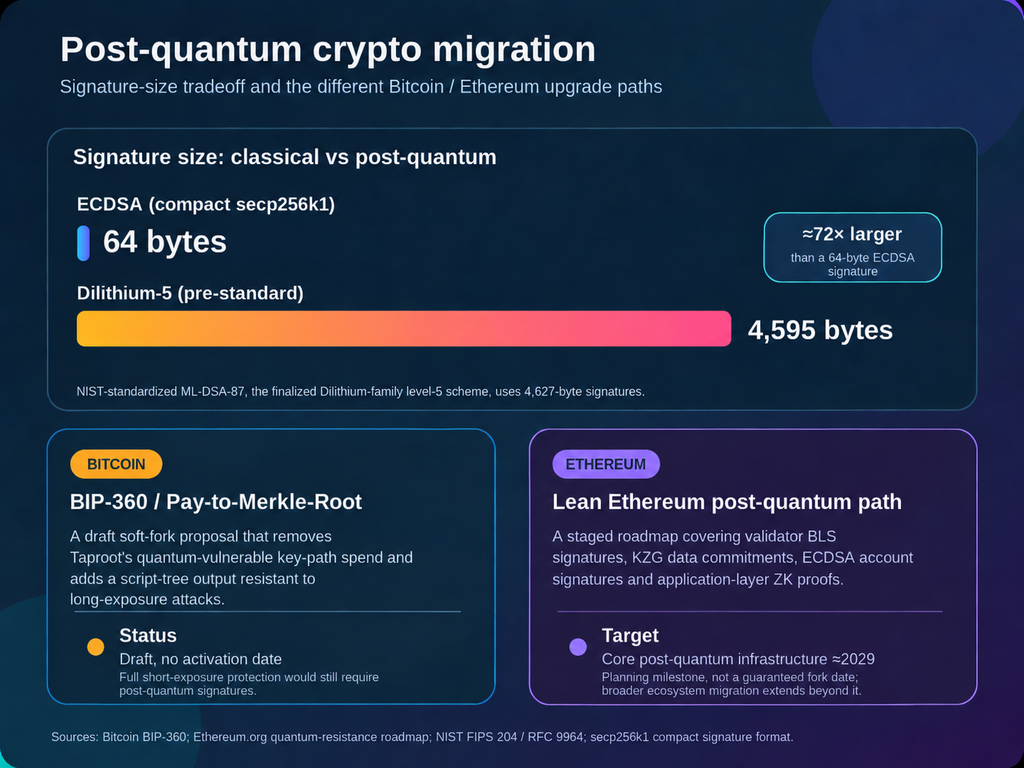
- •Quantum-resistant signatures such as ML-DSA-87 (about 4,627 bytes) are far larger than secp256k1 ECDSA signatures (roughly 64 bytes), increasing storage, bandwidth, and transaction costs.
- •Google Quantum AI argued in March 2026 that breaking 256-bit elliptic-curve cryptography requires fewer resources than previously assumed, and Google expects to finish migrating its own systems by 2029.
The G7's cybersecurity working group is calling on nations and enterprises to begin transitioning to post-quantum cryptography immediately — a warning with direct relevance to cryptocurrency networks, exchanges, and custodians, which face costly system upgrades before quantum computers become a threat to contemporary cryptography.
The working group published "Preparing for the Post-Quantum Era: A Call to Action" on September 3, 2026, framing quantum computing as a business and cybersecurity risk that organizations must prepare for before a cryptographically viable quantum machine arrives. The report is the latest in a series of government warnings: the US federal government began its own migration push with a 2022 national security memorandum directing agencies to prepare for quantum risks, and NIST has been standardizing quantum-resistant algorithms for public use since selecting the first such standards in 2024.
Why a report that never says "crypto" still hits crypto
The G7 paper makes no specific mention of cryptocurrency, yet the issue is directly tied to blockchain technology. As Decrypt notes, cryptocurrency transactions and the management of funds rely on public-key cryptography.
"Although the exact timeline is uncertain, several recent advances suggest an anticipation of the development of quantum computers able to break widely used public-key cryptography mechanisms." — G7 Cybersecurity Working Group
The concern extends beyond future attacks.
"Harvest now, decrypt later." — G7 Cybersecurity Working Group
That strategy involves collecting encrypted data today and decrypting it in the future, once quantum technology is powerful enough. Blockchains face an analogous problem: public keys and transaction history can remain visible indefinitely, leaving those keys exposed to potential compromise down the line. Bitcoin's design makes this exposure structural rather than incidental — any address that has already spent funds, including long-dormant wallets from the network's early years, has its public key recorded on-chain permanently.
The G7 recommends action across several fronts: raising awareness, developing national policies, funding research, building public-private sector collaborations, and establishing post-quantum procurement requirements.
Europe has already put dates on the calendar
Europe has gone further by setting deadlines. The EU adopted the Coordinated Implementation Roadmap for the Transition to Post-Quantum Cryptography (PQC) in June 2025.
The European Commission's PQC policy requires all member states to begin the transition by the end of 2026, while high-risk systems must migrate immediately and no later than 2030.
Quantum readiness has therefore become more than a technical matter. As post-quantum requirements become embedded in procurement and cybersecurity law, companies without adequate migration plans could face compliance and competitive difficulties. For crypto businesses operating in Europe, that regulatory timeline intersects with a sector in which major networks have not yet committed to firm migration dates of their own.
Bitcoin and Ethereum are taking different roads
Bitcoin is exploring BIP-360, Pay-to-Merkle-Root, a soft-fork proposal designed to reduce vulnerability to long-term quantum computer attacks. BIP-360 would remove the Taproot key-path spend, which is susceptible to quantum processing, although its creators acknowledge that faster attacks on mempool transactions would still depend on implementing post-quantum digital signatures. BIP-360 has no activation date, and like any Bitcoin soft fork it would require broad community consensus before taking effect.
Ethereum, meanwhile, is developing a broader post-quantum security framework. In his February 2026 roadmap, Vitalik Buterin identified four components requiring upgrades: validator BLS signatures, KZG commitments, ECDSA account signatures, and zero-knowledge proofs at the application layer. Ethereum aims to achieve core post-quantum infrastructure in 2029, though migration to the new technology may still take time.
The cost is substantial. A compact secp256k1 ECDSA signature is roughly 64 bytes, while the older Dilithium-5 parameter set used approximately 4,595 bytes. The ML-DSA standard finalized by NIST uses ML-DSA-87 signatures of about 4,627 bytes. Larger signatures translate into increased storage, bandwidth, and transaction costs — a particular constraint for blockchains, where every byte competes for limited block space and directly affects fees.
The near-term risk is the migration itself
The immediate market risk, then, is not the moment a quantum computer breaks Bitcoin. It is everything involved in preparing for that eventuality: governance disputes, protocol development, larger signatures, infrastructure changes, and old wallets whose public keys are already exposed.
A March 2026 article by Google Quantum AI argued that breaking 256-bit elliptic-curve cryptography would require far fewer resources than previously assumed. Google also announced it expects to complete the migration of its own systems by 2029.
NIST has published a draft IR 8547 recommending that 112-bit ECDSA be phased out after 2030 and that its use be prohibited after 2035.
Cryptopolitan previously reported that quantum preparedness may eventually factor into institutional custody criteria and investor due-diligence standards, making a network migration plan a competitive advantage.

