G20 Advances Digital Asset Rules, With Stablecoins in Focus
Key Takeaways
- •G20 officials backed work on regulatory and supervisory frameworks for digital financial innovation and digital assets.
- •The group did not create a single global crypto rulebook or require identical national regulations across member countries.
- •Officials are awaiting further Financial Stability Board work on global stablecoin arrangements, including cross-border use and data availability for regulators.
- •The G20 reaffirmed its roadmap for cross-border payments and called for longer operating hours for large-value payment systems.
- •The group urged stronger risk-based supervision for virtual asset activity, including efforts to combat money laundering, terrorism financing, proliferation financing, and fraud.
G20 finance officials backed clearer digital asset rules while keeping financial stability and cross-border risks in focus.
G20 officials are awaiting FSB findings on global stablecoins, including cross-border impacts and data challenges.
The G20 also reaffirmed its cross-border payments roadmap and called for longer operating hours for large-value payment systems.
Crypto regulation moved further into the G20’s financial reform agenda after finance ministers and central bank governors backed clearer pathways for digital-asset innovation.
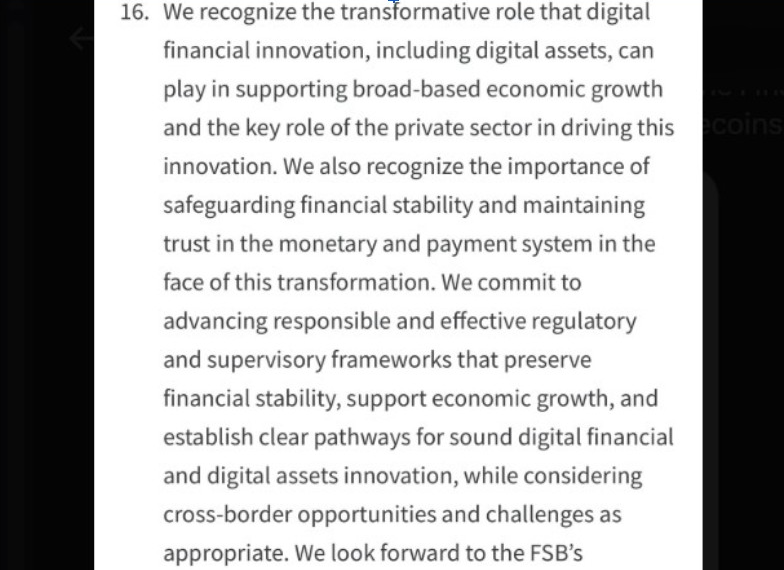
Officials meeting in Asheville, North Carolina, on Aug. 31 and Sept. 1 committed to advancing regulatory and supervisory frameworks for digital financial innovation. They said those frameworks should support economic growth while preserving financial stability and trust in monetary and payment systems.
The statement stopped short of creating a single global crypto rulebook or requiring identical regulations across member countries. Instead, the G20 emphasized coordinated principles while recognizing cross-border opportunities and risks from digital assets, a sign that international policy is still being shaped around systems that can move value and data across jurisdictions.
Crypto Regulation Moves Higher on G20 Agenda
G20 finance chiefs met in Asheville, North Carolina, on Aug. 31 and Sept. 1 as part of the 2026 Finance Track. In their Chair’s Statement, officials said member countries would work on regulatory and supervisory frameworks for digital financial innovation and digital assets.
The framework is intended to support financial innovation while protecting financial stability and maintaining confidence in monetary and payment systems. The G20 did not introduce a single global crypto regulation framework or require members to adopt identical national rules.
The group’s position leaves individual jurisdictions responsible for developing their own regulatory systems. At the same time, members will consider cross-border risks and opportunities linked to digital assets and financial technology, underscoring that any follow-up work will need to balance innovation with oversight rather than replace domestic rulemaking.
Stablecoins Remain a Key Focus
Stablecoins received specific attention during the G20 discussions. Officials said they are waiting for further FSB work on global stablecoin arrangements, including their cross-border use and the availability of data for regulators.
The FSB will also examine potential gaps in stablecoin data sources and the information available to authorities.
In the United States, the GENIUS Act created a federal framework for payment stablecoins. In the European Union, stablecoin issuers operate under the Markets in Crypto-Assets (MiCA) regulation.
Japan has also continued to update its crypto regulations. Lawmakers approved amendments that classify cryptocurrencies as financial products under the Financial Instruments and Exchange Act. Japan’s Financial Services Agency has also created a dedicated crypto division covering cryptocurrency and stablecoin supervision.
Cross-Border Payments Stay on G20 Agenda
The G20 also reaffirmed its Roadmap for Enhancing Cross-border Payments. Finance ministers and central bank governors called on countries to expand the operating hours of large-value payment systems to support international transactions.
Officials also encouraged wider adoption of the ISO 20022 messaging standard. The group called for easier cross-border transmission of financial services data while requiring jurisdictions to follow domestic laws and data security requirements.
Stablecoins have become part of discussions around international payments because they can transfer value across borders without using traditional bank transfer systems. The UK Financial Conduct Authority previously identified cross-border payments as a leading potential use case for regulated stablecoins during its Stablecoin Sprint.
G20 Calls for Stronger Oversight of Crypto Finance
Crypto regulation also featured in the G20’s approach to financial crime. Officials reaffirmed support for the Financial Action Task Force (FATF) and urged jurisdictions with substantial virtual asset activity to strengthen implementation of FATF standards.
The G20 called for risk-based supervision covering money laundering, terrorism financing and proliferation financing. Officials also addressed fraud linked to scam compounds and criminals’ use of artificial intelligence.
The G20 finance ministers and central bank governors are scheduled to meet again in Bangkok in October. The 2026 G20 Leaders’ Summit will then take place in Miami on Dec. 14 and 15, marking the final stage of the U.S. G20 presidency.
This article is for informational purposes only and does not constitute legal, financial, or investment advice.
The post Crypto Regulation: G20 Advances Digital Asset Rules With Stablecoins Under Focus appeared first on The Market Periodical.

