FutureBit Apollo Solo Miner Finds Bitcoin Block 973,262, Earning 3.154 BTC
Key Takeaways
- •A miner using FutureBit's Apollo Solo setup found Bitcoin block 973,262, earning the full 3.154 BTC block reward plus fees from 2,477 transactions.
- •Block explorers list the finder as 'FutureBit Apollo Solo,' but the public record does not identify the exact hardware model or hashrate that produced the winning hash.
- •This marks at least the fourth block attributed to FutureBit Apollo Solo, following blocks 867,760, 881,423, and 888,737.
- •Solo mining remains uncommon against a network hashrate near 1,070–1,087 EH/s, with home-scale rigs in the 10–18 TH/s range facing expected block times measured in centuries under current difficulty.
- •FutureBit users control both the node and the solo pool and retain the full reward when a block is found, with solo mining also offering privacy benefits and potential tax write-offs in some jurisdictions.
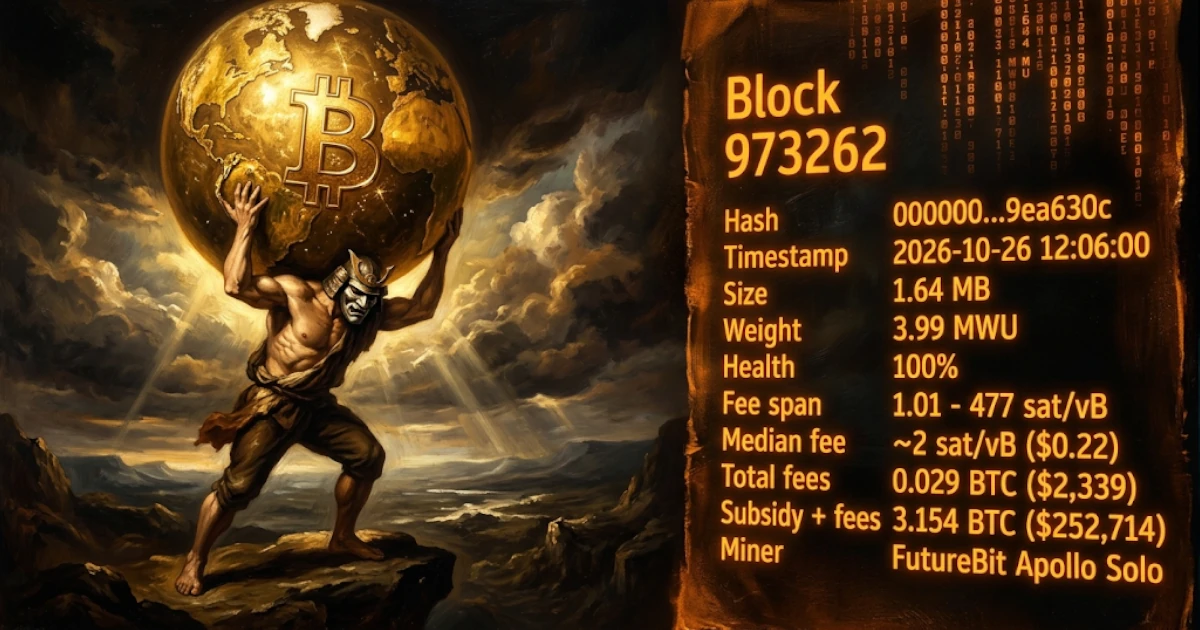
A miner operating through FutureBit's Apollo Solo setup discovered Bitcoin block 973,262 earlier this week, capturing the full block reward of 3.154 BTC plus fees from the 2,477 transactions included in the block. Multiple explorers, including mempool.space and Blockchain.com, list the finder as “FutureBit Apollo Solo,” and the coinbase transaction — the first transaction in every block, through which a miner claims the block subsidy and the attached fees — contains text referencing FutureBit and Apollo.
FutureBit announced the find on X: “Gradually, then suddenly. We (the people) hit a Bitcoin block today. Bitcoin belongs in the hands of sovereign individuals. And we're building to keep it there.”
According to the company, an Apollo device or a Solo Node running its built-in solo pool assembled the block template, served the work, and submitted the completed block to the network. The public record does not identify the exact hardware or hashrate that produced the winning hash. Per FutureBit's account of the block, it could have been an Apollo BTC, an Apollo II, an Apollo III, or other compatible machines pointed at a Solo Node.
This marks at least the fourth block attributed to FutureBit Apollo Solo, following block 867,760, block 881,423, and block 888,737.
FutureBit designs its Apollo hardware for operators who want to run a full Bitcoin node — software that independently verifies every transaction and block against the network's consensus rules — and mine independently at home rather than through large commercial pools. The company's most recent model, the Apollo III, is rated for up to 18 TH/s in turbo mode with an integrated full node. Bitcoin Magazine covered the Apollo III launch in February 2026 and previously examined FutureBit's approach to home mining in a July 2025 piece.
Solo mining, often called lottery mining because of the low odds relative to the size of the reward, remains uncommon against a network hashrate that has recently sat near 1,070–1,087 EH/s — a unit of measure one million times larger than the terahash scale at which home devices operate. A home-scale setup in the 10–18 TH/s range still faces an expected time to a block measured in centuries under current difficulty, a parameter Bitcoin automatically recalibrates roughly every two weeks to keep blocks arriving at their ten-minute target pace, yet verified solo finds continue to appear on-chain. Bitcoin Magazine examined the mathematics of these odds in an article titled Why Bitcoin Lottery Mining Has Better Odds Than The Powerball, which compared Bitcoin's continuous block attempts with the far lower frequency of major lottery draws.
Another solo block was found the following day via CKPool Solo, illustrating that individual operators can still capture full rewards even as industrial pools produce the large majority of blocks. For users running FutureBit hardware, the company notes that individual users control both the node and the solo pool, retaining the full reward when a block is found. Solo mining also carries significant privacy benefits, and hardware and energy costs can be written off against taxes in some jurisdictions.
The October 26 block is one more validation that solo mining can be viable. Satoshi Nakamoto's original Bitcoin design intended the full Bitcoin node to be able to mine blocks, not just validate and audit the blockchain. Later improvements in hardware and mining optimizations led to the creation of mining pools, which fostered a highly competitive and industrial mining sector. The secondary effects of industrial Bitcoin mining, such as reliable energy demand that can stabilize the grid, have been a boon for states like Texas.
Still, the dream of bringing mining back to homes and end users remains alive through companies like FutureBit, Bitaxe, and HeatBit, among others, that are converting heating appliances into Bitcoin miners or designing hardware of that kind for the home.
This article first appeared on Bitcoin Magazine and was written by Juan Galt.

