Bitrace Reports Fulilai Removed Merchants Amid Xinbi Crackdown
Key Takeaways
- •Bitrace is the sole cited source for the reported Fulilai merchant removals and their alleged links to money laundering.
- •The number, identity, timing, and impact of any removed merchants remain unknown, and no response from Fulilai or Xinbi was included.
- •The US Treasury designated Xinbi Guarantee on September 9, 2026, and said the network had processed more than $24 billion since around 2022.
- •The US action also involved the seizure of Xinbi infrastructure and wallets and designations of SafeW Technology and Anwen Technology.
- •Official US and UK sanctions announcements do not name Fulilai or Bitrace, so a causal link between the crackdown and the reported removals has not been established.
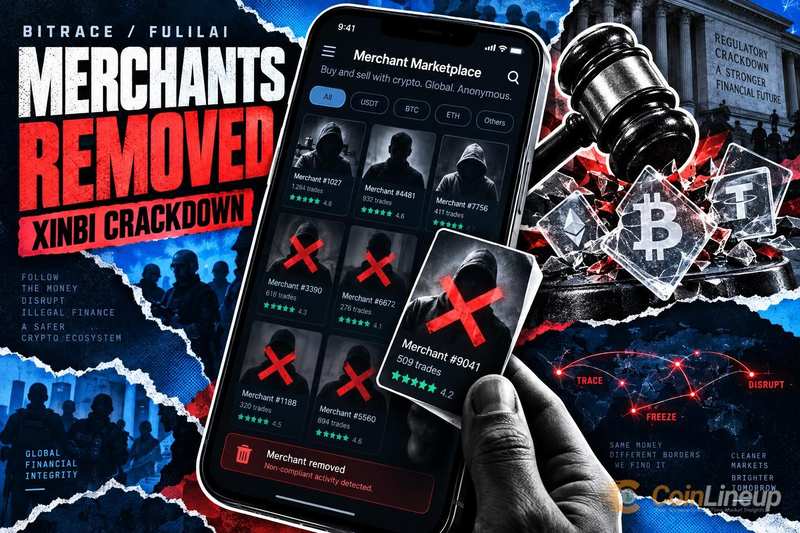
Blockchain analytics firm Bitrace reportedly said that Fulilai, an online marketplace, removed merchants it linked to money laundering after a US crackdown on the rival Xinbi network. The claim is currently attributed to a single source. The available information does not establish how many merchants were removed or whether the US action caused the removals.
Bitrace’s claim about Fulilai
According to the unconfirmed report, Bitrace said Fulilai had removed merchants associated with money laundering. Money laundering refers to concealing the origin of illegally obtained funds so they appear legitimate.
Both the removal claim and the characterization of the merchants come from Bitrace. No underlying Bitrace report was supplied, leaving key details unavailable, including the names of the merchants, the dates of the removals, the number of affected merchants, and the evidence or methodology behind the finding.
The report also does not include a response from Fulilai or Xinbi. As a result, the scale and timing of the reported removals remain unspecified.
US sanctions against Xinbi provide the backdrop
The reported Fulilai removals were framed against a US crackdown on Xinbi Guarantee. On September 9, 2026, the US Treasury’s sanctions office designated Xinbi Guarantee as a significant transnational criminal organization, according to the Treasury announcement.
The Treasury said Xinbi had processed the equivalent of more than $24 billion in digital assets and regular currency since it began operating around 2022. That figure is a cumulative estimate of processed funds. It does not represent money that was seized, nor does it refer exclusively to cryptocurrency.
Xinbi’s cumulative processing, according to the Treasury:
More than $24 billion
The Treasury said the action was coordinated with the Justice Department’s Scam Center Strike Force. On the same day, the task force seized infrastructure and digital-asset wallets used by Xinbi Guarantee. The announcement did not provide a value for the seizure.
The US also designated two entities described as supporting Xinbi: Singapore-based SafeW Technology Co., Ltd. and Cambodia-based Anwen Technology Co., Ltd. According to the Treasury, Xinbi began moving its merchant and money-laundering networks to the SafeW messaging application around June 2025. It also launched a payment application called XinbiPay, which is also known as the NewPay wallet.
The sanctions have broad reach. The Treasury said entities owned 50% or more, directly or indirectly, by blocked persons are also blocked. In general, US individuals and companies are prohibited from doing business with the designated targets. Those restrictions are the documented effect of the US action; the supplied information does not establish any separate effect on Fulilai or its merchants.
The United States was not the first government to sanction Xinbi. On March 26, 2026, the United Kingdom sanctioned the network, describing Xinbi as a Chinese-language marketplace that provided crypto-based services to scam centers in Southeast Asia, according to the UK government.
None of those official announcements names Fulilai or Bitrace. The sanctions against Xinbi provide a real backdrop for the report, but they remain separate from the unconfirmed Fulilai removals. The timing and headline alone do not establish that the US action caused Fulilai to remove the merchants.
What remains unknown
The supplied information contains no merchant count, transaction value, or additional evidence supporting Bitrace’s finding. It also does not show whether the removals disrupted money-laundering activity or merely moved it to another platform.
Assessing the claim would require access to Bitrace’s original report and supporting evidence. Until that material is available, the scale, timing, and outcome of the reported removals remain unclear. The Fulilai story should therefore be treated as an unconfirmed report rather than an established fact.
This article is for informational purposes only and does not constitute financial or investment advice. Cryptocurrency and digital-asset markets carry significant risk. Always conduct your own research before making decisions.
