Modal Shift Dampens Trucking Market as Shippers Flee to Intermodal Rail
Key Takeaways
- •Domestic intermodal rail container volumes grew 10% year-over-year while long-haul trucking tender volumes remained flat, with the divergence beginning in mid-July.
- •Truckload contract rates have risen dramatically on key lanes, including a 31% increase from Chicago to Elizabeth, New Jersey, versus just 5% for intermodal on the same route.
- •The long-haul trucking segment is the only tender category showing no annual growth even as overall tender volumes rose 6% year-over-year.
- •Atlanta has recorded domestic container volume growth exceeding 20%, outpacing both Chicago's 9% and Los Angeles's 3% increases.
- •Intermodal providers are expected to raise rates into double digits without risking significant customer losses, given the historically wide pricing gap relative to trucking.
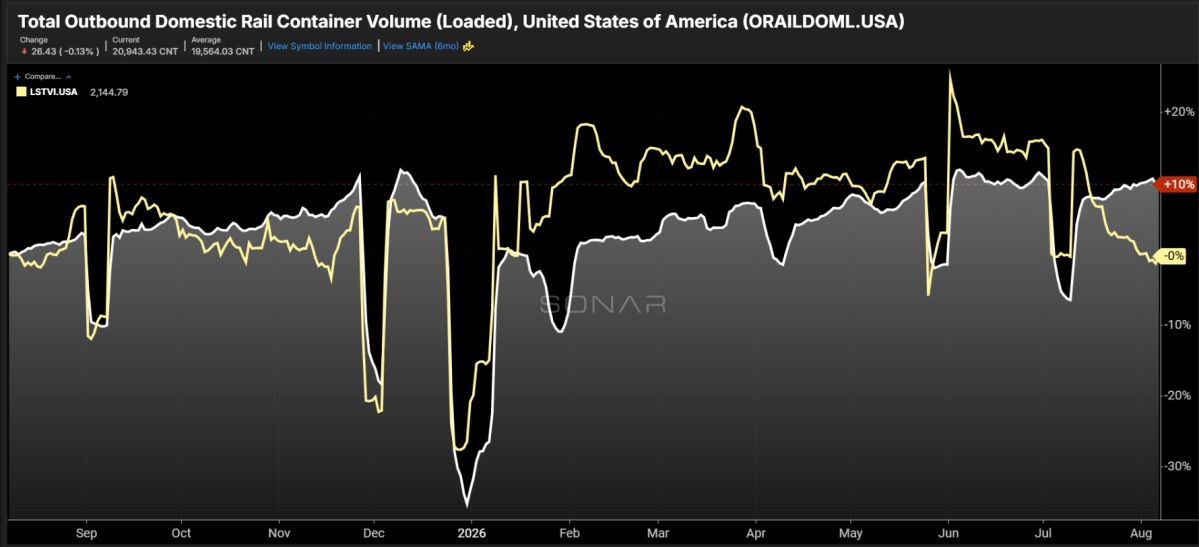
Chart of the Week: Loaded Domestic Rail Containers, SONAR Long-Haul Tender Volume Index — USA
SONAR: ORAILDOML.USA, LSTVI.USA
Intermodal rail usage for domestic-sized containers (ORAILDOML) has grown 10% compared to 2025, while long-haul trucking tender volumes (LSTVI) have remained flat. The two transportation modes have been diverging since mid-July, with truckload demand declining faster than seasonal patterns would typically indicate. The trend suggests that shippers are once again turning to rail to escape the elevated costs and operational challenges currently characterizing the trucking sector. This dynamic is consistent with historical patterns: when truckload rates rise sharply relative to rail, shippers with route and cargo flexibility routinely reallocate long-haul volumes to intermodal, which can move freight at a lower per-mile cost over distances exceeding roughly 750 miles.
Long-Haul Truckload Demand Shows Unseasonal Weakness
Long-haul tender volumes are defined as tenders for loads traveling more than 800 miles. This segment is the most substitutable with intermodal rail, and it is also where intermodal offers shippers its most significant cost advantages.
Overall tender volumes are up 6% year-over-year over the past week, but long-haul tenders are the only segment showing no annual growth. The LSTVI has fallen to its lowest point of the year — an unusual development for August, particularly given that imports into California ports have remained strong.
Long-haul trucking demand is closely linked to import volumes. Approximately 30–40% of overseas container imports clear through the port complexes of Los Angeles and Long Beach, and much of that freight is then transported across the country to major East Coast population centers.
While Los Angeles serves as the primary gateway, a substantial portion of freight remains in international containers and moves across the country before being transloaded into trucks or domestic containers. Chicago remains the largest domestic container shipping market in the U.S., posting a 9% growth rate year-over-year, compared to Los Angeles's 3% increase. Atlanta, which receives containers through both Savannah and Los Angeles, has recorded domestic container volume growth exceeding 20%.
Cost Differentials Drive the Shift
The primary catalyst for the modal shift appears to be a rapid escalation in truckload costs. Truckload contract rates from Chicago to Elizabeth, New Jersey, are up 31% (including fuel), compared to just 5% for intermodal. Rates from Atlanta to Elizabeth have surged nearly 60%, versus only 6% for intermodal. Under more typical market conditions, intermodal rates on comparable lanes run roughly 10–15% below truckload, making the current spreads — which in some cases exceed 50 percentage points of growth differential — exceptional by recent standards. For many shippers, these cost differentials are simply too large to ignore.
Growing Risks on the Horizon
While the cost savings from intermodal are undeniable — and any shipper with the capability to leverage rail must consider it — the current rate spreads are likely unsustainable, and rail infrastructure faces its own capacity limitations.
Rate increases for intermodal carriers are a near certainty. Intermodal providers could raise rates into the double digits and still not risk losing business on a cost basis, given how wide the pricing gap with trucking has become. However, the looming transcontinental rail merger may exert some downward pressure on rates until a regulatory ruling is issued.
Intermodal's peak season traditionally runs through September and October, meaning the sector has not yet reached its period of highest demand. Rail operators have managed the additional volume stress so far, but drayage capacity remains a persistent concern, with severe limitations tied to the same issues constraining longer-haul trucking.
A third factor that could alter the market dynamic is a potential return of shipping urgency. August typically carries less seasonal pressure compared to the holiday period, and back-to-school demand has largely already been fulfilled. However, inventory levels — particularly on the downstream end — are tighter than they have been in recent years, as Dr. Zac Rogers, co-author of the Logistics Managers' Index (LMI), which tracks inventory, transportation, and warehousing conditions across U.S. supply chains, discussed on the Freightonomics podcast. Tighter inventories could leave shippers more exposed to unexpected demand shocks, a scenario that favors trucking over intermodal due to trucking's greater flexibility and speed.
While the shipping community is making rational decisions in the current environment, there are clear reasons for shippers to ensure they are prepared for the risks of over-reliance on a single transportation mode. The freight market and supply chain management landscape remain highly dynamic, with no definitive path forward.
Source: FreightWaves

