Fixed Rate vs Floating Rate Crypto Swap: Which Costs Less?
Key Takeaways
- •Fixed-rate swaps lock the exchange rate at order creation, while floating-rate swaps calculate the final amount at execution.
- •Providers typically charge a fixed-rate premium of about 0.5% to 1% above the floating mid-market rate.
- •Fixed rate is usually better for larger trades, volatile markets, slower confirmations, and swaps involving XMR or congested ETH transactions.
- •Floating rate is often the better choice for small swaps, fast chains, and stablecoin-to-crypto trades when market movement is limited.
- •Swapzone displays fixed and floating quotes from more than 18 partners on the same screen and lets users filter by rate type before committing.
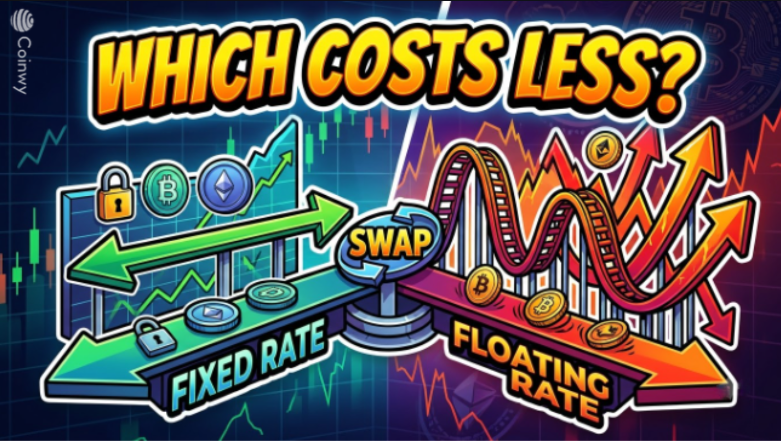
The problem with floating rates is that you send one amount and receive another, sometimes significantly less. You confirm a rate, the blockchain takes 15 minutes, and by the time the swap executes the market has moved. In that case, the “cheaper” option ends up costing more.
Fixed rate addresses that risk, but it comes with a premium. The question is whether that premium is worth paying for a given swap. The answer depends on the amount, the volatility of the pair, and how long confirmation takes. Of the costs in an instant swap, the rate type is one of the few the user chooses directly — blockchain network fees and the partner’s spread apply either way.
Quick Comparison: Fixed Rate vs Floating Rate
Floating rate is not inherently worse. For stablecoin-to-crypto swaps at small amounts, it is usually fine. For volatile pairs or larger amounts, fixed rate often produces a better real-world outcome despite the higher quoted rate. The distinction parallels a familiar split in trading: floating rate behaves like a market order, executing at whatever price prevails at settlement, while fixed rate locks the price at order creation.
Start comparing fixed and floating quotes side by side on Swapzone.
How Fixed Rate Works
When you select fixed rate, the provider locks in the exchange rate at the moment you create the order. The amount you will receive is calculated and shown before you send anything.
Once you send the funds, the provider honors that rate regardless of what happens in the market during blockchain confirmation. If BTC drops 3% while your transaction confirms, you still receive the originally quoted ETH amount. The provider absorbs the loss from that slippage.
Providers charge for this guarantee. The premium is typically 0.5% to 1% above the current floating mid-market rate. On a $1,000 swap, that equals $5 to $10. On a $10,000 swap, it equals $50 to $100.
Decentralized exchanges manage the same slippage risk differently: traders there set a slippage-tolerance percentage, and the transaction reverts if the executed price moves beyond it. Instant swap services do not revert. Under floating rate, the movement is passed to the user; under fixed rate, it is priced into the premium.
Fixed rate orders can also have slightly tighter minimum and maximum limits. Providers cap their exposure per order, so very large fixed-rate swaps, above $50,000 equivalent, may not be available through some services.
How Floating Rate Works
Floating rate calculates your receive amount at execution, not when the order is created. When you confirm the order, you see an estimated amount based on the current market rate. That estimate is not guaranteed.
Between confirmation and blockchain processing, the market can move. If it moves in your favor, you receive slightly more than quoted. If it moves against you, you receive less. For common pairs on fast chains, such as ETH-based swaps that complete in under 5 minutes, the movement is usually negligible. For slower chains, the risk increases.
The advantage is price. Floating rate quotes are lower than fixed rate quotes because the provider is not taking on slippage risk. If you are swapping USDT to BTC and BTC is stable, the quoted rate is often close to what you actually receive.
When Fixed Rate Is Worth the Premium
Large BTC amounts. Above 0.1 BTC, roughly $6,000 to $10,000 depending on price, a 1% market move during a 10- to 30-minute BTC confirmation can cost more than the fixed-rate premium. For example, 1% of $8,000 is $80, while the fixed-rate premium may be $40 to $80. That puts the trade near break-even or better.
Volatile market conditions. When BTC or ETH is moving more than 2% in daily range, confirmation windows carry real risk. During sharp price action, including news events and major liquidations, floating-rate swaps that take 15 minutes or more can end up 2% to 3% worse than quoted. Fixed rate removes that exposure.
XMR swaps. Monero confirmations take longer than most chains, requiring 10 confirmations and averaging 20 to 40 minutes. XMR is also a volatile asset. Floating rate on a BTC-to-XMR swap is a meaningful gamble over that 20- to 40-minute window. Fixed rate is usually the better choice. See the BTC to XMR exchange guide for specifics.
Large ETH swaps during congestion. If gas prices spike and an ETH-side confirmation stalls, a floating-rate swap can remain pending for 20 to 40 minutes. Fixed rate holds the quoted amount until the swap completes.
Portfolio rebalancing. If you need a specific amount of an asset, floating rate introduces uncertainty. Fixed rate lets you plan the outcome more precisely.
When Floating Rate Makes More Sense
USDT or another stablecoin as the source. USDT does not move. The rate risk is entirely on the destination asset. For small USDT-to-BTC swaps on fast chains, under 5 minutes, floating rate is usually quoted lower and the final outcome is almost always within 0.1% to 0.2% of the quote. In that case, the fixed-rate premium is not earned.
Fast chains. BNB Smart Chain, Solana, and similar fast chains confirm in under a minute. Market movement over 60 seconds is negligible for most pairs. Floating rate is the practical choice. Note that many tokens circulate on multiple networks — USDT alone exists on Ethereum, Tron, and Solana, among others — and confirmation speed differs across them, so the same pair can carry different floating-rate exposure depending on the network used.
Small amounts. Below $200 equivalent, the fixed-rate premium is a flat dollar amount that becomes a larger percentage of the total. A $1 premium on a $100 swap is 1%, while the slippage risk at that size on a fast chain is less than 0.5%.
Highly liquid, tight-spread pairs. BTC/ETH, ETH/USDC, and other high-liquidity pairs have tight floating-rate spreads. The gap between quoted and executed amounts is smaller because market depth is greater and price impact is low.
How Swapzone Handles Both Rate Types
Swapzone shows fixed and floating quotes from its 18+ partners on the same screen. You can see both options for the same pair at once, with the amount you will receive clearly listed for each.
The filter works before you commit. Select “fixed” in the filter and only fixed-rate quotes appear, ranked by receive amount. Select “float” and the same ranking applies to floating quotes. That makes it possible to compare both sides and decide whether the fixed premium is worth it for your specific swap size.
For a 0.5 BTC swap, Swapzone might show a floating quote of 8.42 ETH and a fixed quote of 8.35 ETH. The difference is 0.07 ETH, or roughly 0.8%. Whether that 0.8% insurance is worthwhile depends on how much BTC is moving that day.
See both fixed and floating rates side by side on Swapzone and decide with full information.
What We Checked
Fixed-rate premium range sourced from Swapzone quote comparisons and StealthEX/Exolix documentation.
Floating-rate execution timing based on documented chain confirmation times: BTC at about 10 minutes per confirmation, XMR at about 2 minutes per block with 10 confirmations, and ETH at about 15 seconds per block with 12 confirmations.
Provider fixed-rate availability confirmed: ChangeNOW, StealthEX, SimpleSwap, and Exolix all offer fixed rate.
SideShift.ai confirmed float-only via platform documentation.
Swapzone filter functionality confirmed via live site review.
What Users Actually Say
The fixed-versus-floating decision often appears in user feedback, sometimes the hard way.
“swap was stuck, i had to contact support and it only got through after several hours. due to this i received more then 3.1% less as initially calculated. no compensation from swapzone, even though the issue was not on customer side.” — peter (☆☆☆, 2026-01)
“I was skeptical at first to use this website because I had never heard of it before, but I decided to regardless. It was super fast and efficient. Cost me $30 overall kind of expensive but was the fastest method. Highly recommend!” — Stan (, 2022-05)
“i wasn’t sure if the transaction would go through as it is my 1st time using such transaction system but everything worked like a charm and i received my tokens (SOL), with a little extra compared to other platforms, 5 minutes after sending my USDC (ERC20). 5/5” — JepettO (, 2022-11)
Based on 460 verified Trustpilot reviews. See all Swapzone reviews on Trustpilot.
What Reddit Says
Fixed-rate versus floating-rate debates appear regularly on r/CryptoCurrency. The practical view is straightforward: use fixed rate when you need the output amount to be predictable, such as when paying someone a specific amount, and use floating rate when the market is calm and you want the slightly better average rate. Fixed rate costs around a 0.3% to 0.5% premium in most market conditions, so the question is whether predictability is worth that cost for your use case.
FAQ
Can I switch from floating to fixed after sending funds? No. The rate type is selected at order creation. Once you send your funds, the rate type is locked. Read the order type before you send.
Is fixed rate always more expensive? The quoted rate is higher. The final received amount may be better than floating if the market moves against you during confirmation. On a stable day for fast chains, floating usually nets more. On a volatile day for slow chains, fixed usually nets more.
Which services only offer floating rate? SideShift offers floating rate only. Most other major services, including ChangeNOW, StealthEX, SimpleSwap, and Exolix, offer both. Godex offers floating rate only.
What happens if a fixed-rate order expires before I send? Fixed-rate orders have a time window, typically 10 to 30 minutes depending on the provider, for you to send funds. If you miss the window, the order expires and you need to create a new one at the current rate.
Does Swapzone charge extra for fixed-rate access? No. Swapzone displays rates from partners without adding a separate fee for fixed-rate access. The premium is built into the partner’s quoted rate.
Should I always use fixed rate for BTC swaps? For amounts above 0.1 BTC or during volatile periods, fixed rate is usually the better choice. For small BTC amounts on fast destination chains, floating rate is often fine.
Related reading: Best instant crypto swap no registration | BTC to XMR exchange 2026

