Firmus Technologies Raises $2 Billion, Pivots from Bitcoin Mining to AI Infrastructure
Key Takeaways
- •Firmus Technologies secured $2 billion in funding at a valuation above $10.5 billion, nearly double its April 2026 valuation of $5.5 billion.
- •The company has completely transitioned from Bitcoin mining to building modular AI data centers based on Nvidia's DSX AI Factory Reference Architecture.
- •The newly raised capital will primarily support Project Southgate, an expansion initiative spanning Australia, Indonesia, and the broader Asia-Pacific region.
- •Firmus's access to Tasmania's renewable hydropower provides a competitive advantage as hyperscale operators face intensifying scrutiny over AI-related energy and water consumption.
- •Backing from Coatue, Nvidia, Blackstone, and Jane Street brings the company's total equity raised over the past 12 months to more than $3 billion.
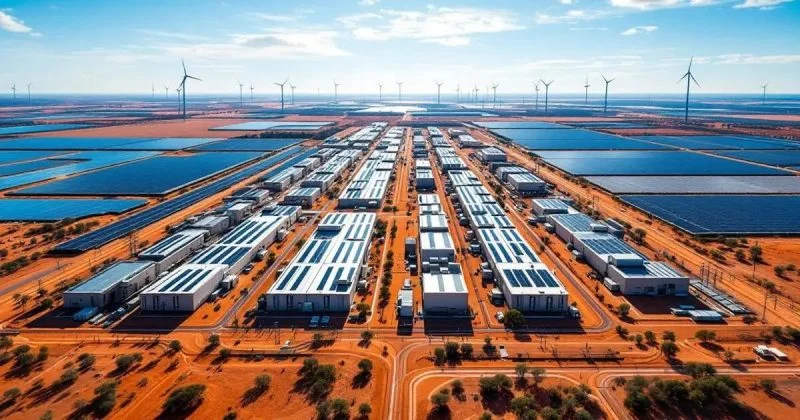
Firmus Technologies, a company that began mining Bitcoin in Tasmania five years ago using renewable hydropower, has raised $2 billion at a valuation exceeding $10.5 billion. The funding round, which closed on August 7, marks one of the most significant corporate pivots in recent memory, as the company repositions itself as a builder of modular AI data centers optimized for Nvidia's latest GPU architectures.
The latest round nearly doubled Firmus's valuation from $5.5 billion in April 2026. Backers include Coatue, Nvidia, Blackstone, and Jane Street, representing a coalition of institutional finance and AI infrastructure leaders.
From Bitcoin Mining to AI Factories
Founded in 2019, Firmus's original premise was straightforward: Tasmania offered cheap, abundant hydropower, and Bitcoin mining was energy-intensive. The company has since shifted its focus entirely, now constructing what it calls "AI Factories" — modular facilities equipped with liquid cooling to manage the thermal demands of high-density GPU clusters.
These facilities are built around Nvidia's DSX AI Factory Reference Architecture, a design framework developed by Nvidia specifically for deploying its accelerators at scale.
The pivot away from digital assets appears complete. The company's current positioning makes no mention of crypto tokens, Bitcoin mining operations, or blockchain services.
Firmus is not alone in this trajectory. A growing number of former cryptocurrency mining operators — including publicly traded firms such as Core Scientific, Hut 8, and Iris Energy — have redirected their power-secured infrastructure toward AI and high-performance computing workloads, attracted by longer-term contracts and higher margins. What distinguishes Firmus is the scale of capital and the depth of its Nvidia partnership, positioning it less as a repurposed miner and more as a purpose-built AI infrastructure provider.
Project Southgate and Asia-Pacific Expansion
The $2 billion raise will be directed primarily toward Project Southgate, an expansion initiative targeting multiple sites across Australia, with plans to extend into Indonesia and the broader Asia-Pacific region.
Total equity raised by Firmus over the past 12 months now exceeds $3 billion. The company's relationship with Nvidia extends beyond hardware procurement into cloud services and sustainability practices, with Firmus emphasizing efficient energy and water usage across its operations.
The sustainability narrative connects back to the company's origins. The same hydropower resources that originally made Tasmania attractive for Bitcoin mining now underpin Firmus's clean energy strategy for AI workloads — a differentiator as hyperscale operators worldwide face mounting scrutiny over the electricity and water consumption of AI training and inference facilities.
Access to stranded or low-cost renewable power has become a competitive moat in the AI infrastructure race, where grid connections and power purchase agreements can take years to secure. Firmus's Tasmanian base, combined with its modular construction approach, could allow it to deploy capacity faster than traditional data center builds, though execution across multiple geographies will be the key test of Project Southgate's ambition.

