Solana Tablet Test Reignites Debate Over Validator Hardware Requirements
Key Takeaways
- •Solana co-founder Anatoly Yakovenko replied 'We did it' and 'sol is money' to David Hoffman's 2023 post, which argued that low hardware requirements are essential for blockchain decentralization.
- •Firedancer creator Ritchie Patel reported a Solana mainnet full node running on less than one CPU core of a 5G-connected tablet, reaching the chain tip and voting within about 10 seconds after startup using a snapshot sync.
- •A separate live demonstration at the Block Zero event before Solana Breakpoint 2026 showed a Firedancer validator running on a single core with 20 GB of memory.
- •The tablet tests did not measure performance under heavy traffic or sustained operation, and Anza continues to recommend a minimum of 12 CPU cores, 256 GB of RAM, and fast storage for production validators.
- •An ARK Invest report published in September estimated the cost of Solana validator-class hardware at $21,478, compared with $289 for a Bitcoin full node.
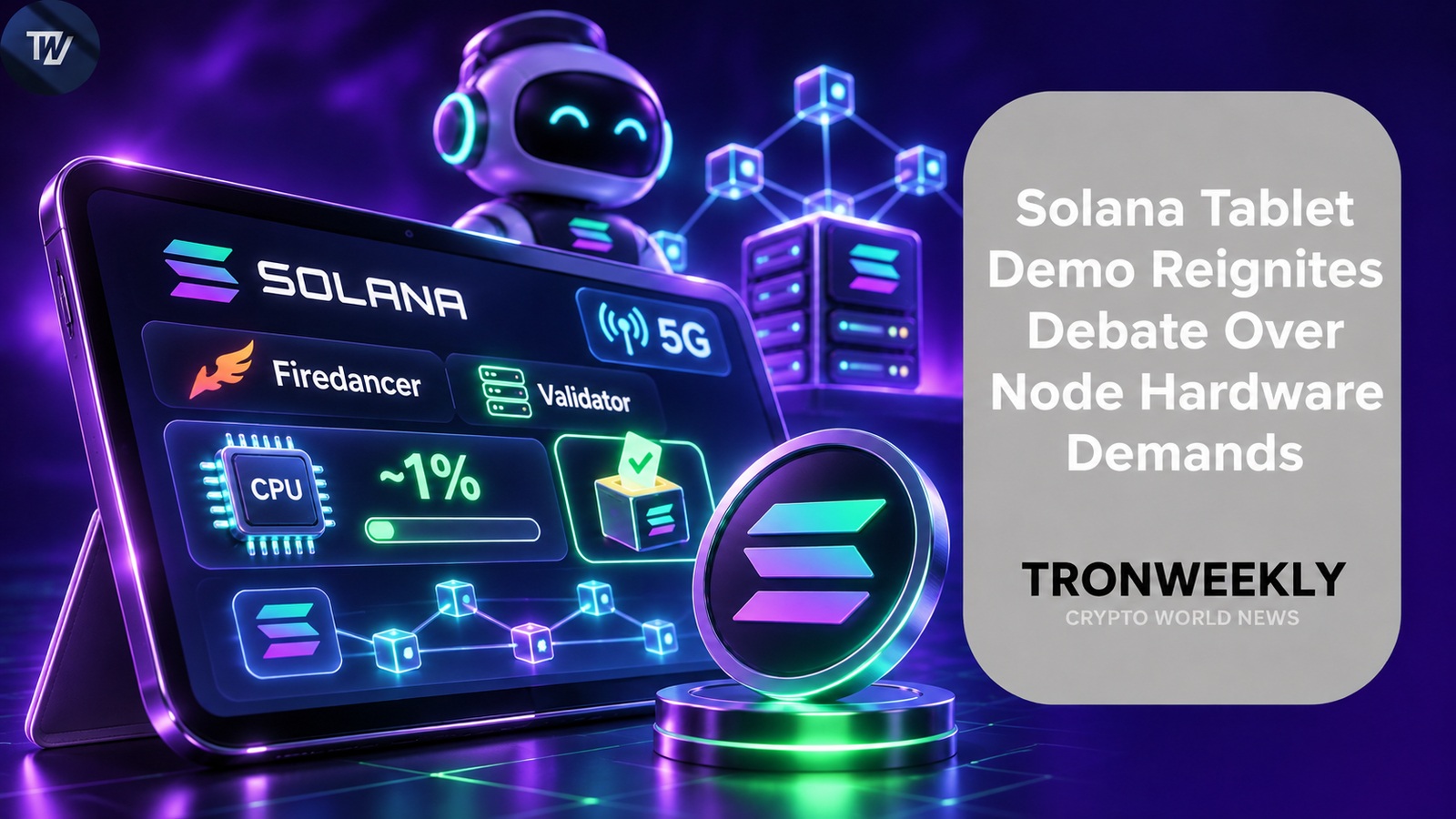
Solana co-founder Anatoly Yakovenko has reignited a debate over blockchain hardware after a Firedancer developer reported running a mainnet node on a tablet. According to the report, the setup used less than a single CPU core and caught up to the latest block within seconds.
On November 15, Yakovenko replied to a January 2023 post by Bankless co-founder David Hoffman with the words "We did it," followed by "sol is money." His response came shortly after developers shared the results of the tablet experiment.
Hoffman's original post argued that minimizing hardware requirements is an essential cultural value for blockchain networks:
It's just no one has tried to minimize the requirements on Solana This is a pretty important cultural requirement for these systems to work. Minimized blockchains are unstoppable blockchains, and without instilling this value into the code, long term prospects not great — David Hoffman (@TrustlessState), January 25, 2023
Ritchie Patel, the creator of Firedancer, confirmed that the device was connected to the network over 5G. According to his report, it took roughly 10 seconds from startup to reach the chain tip and begin voting.
Solana mainnet full node running on less than a single CPU core of a tablet, networking via 5G. 10 seconds from nothing to caught up to chain tip and voting, including make -j, and initial snap sync. — ripatel ✠ (@fd_ripatel), November 15, 2026
How the Tablet Ran a Solana Node
Patel said the Solana mainnet full node operated on fewer than one CPU core of the tablet. The "make -j" flag cited in his post refers to parallel compilation, which was counted within the 10-second figure alongside an initial snapshot sync. The performance report did not include long-term results.
A separate demonstration at the Block Zero event, held ahead of Solana Breakpoint 2026, showed a validator running live on a single core with 20 GB of memory. The test was carried out by engineer Michael McGee and still required a substantial amount of RAM.
Firedancer validator, running live, single core. 20GB RAM. From the conference venue! On a tablet!! Willy Wonka (aka Michael McGee) working his magic again. 🪄🔥 @jump_firedancer @solana #BlockZero #Breakpoint2026 — Valid Blocks IBRL/acc (@ValidBlocks), November 15, 2026
Technical context helps frame what the tests actually showed. A snapshot is an up-to-date copy of the network state that allows a node to boot without replaying every historical transaction, meaning the 10-second startup did not involve syncing from the chain's genesis. A full node verifies blockchain state, while a voting validator takes part in consensus. The developers reported that the tablet synced up and started voting, but performance under heavy load was not specified. For readers assessing the result, the key unanswered questions are whether the setup can sustain that role over time and under live network load while maintaining the connectivity, memory, storage, and software compatibility expected of validators.
Firedancer is an independent validator client developed by Jump Crypto for Solana. In May, Patel reported that the client had processed tens of millions of mainnet transactions, with its gradual rollout proceeding alongside security assessments.
Why Yakovenko Answered a 2023 Critic
The exchange traces back to January 2023, when Yakovenko compared the resource requirements of various Ethereum-based networks. He pointed to roughly 7,000 synchronized Ethereum full nodes and 400,000 validators, figures that referred to different levels of participation.
Hoffman's position was that blockchain software should be capable of running on inexpensive computers. Other developers at the time pointed to Ethereum software running on Raspberry Pi devices and asked whether Solana could offer the same.
Yakovenko acknowledged that hardware efficiency had not been a design goal, adding that he believed a computer with 16 GB of RAM and a solid-state drive could receive and validate blocks. For Hoffman, modest hardware requirements were crucial to decentralization: networks become less sustainable when individual users cannot run their own software, making minimized blockchains "unstoppable."
The tablet test demonstrated that processor requirements are smaller than previously assumed. It did not, however, prove that every network task can be handled by inexpensive consumer computers, and CPU usage alone is insufficient to establish operational cost requirements.
Production Validators Need Substantially More Hardware
Anza recommends a minimum of 12 CPU cores and 256 GB of RAM for production validators, together with fast storage. For staked validators, the team specifies a symmetric connection speed of at least 2 Gbit/s.
The environment of a 5G-connected tablet differs sharply from that of a server running continuously, and the test did not measure voting power or performance under traffic. It does not constitute production hardware guidance or evidence of sustained consensus performance.
Separately, an ARK Invest report published in September estimated the cost of Solana RPC, or validator-class, hardware at $21,478, compared with $289 for a Bitcoin full node.
Firedancer Work Continues After Network Changes
In October, Solana launched Alpenglow consensus, which replaced on-chain voting transactions with direct validator communication. Validators were initially required to maintain compatibility with the Agave software, and Firedancer and Frankendancer could not be used during the first migration.
Ahead of November requirements, Anza instructed validators to run either Agave 4.4.1 or Firedancer 26.10.6, a directive covering voting validators as well as wallet and exchange nodes. Software compatibility remains a separate matter from hardware efficiency.
An October 29 engineering note described how Firedancer manages memory and network resources, documenting fixes for issues involving network information storage and VLAN connectivity. As with the tablet test, such results do not demonstrate production-grade efficiency or network handling.

